Greek trial of Kerry man on people smuggling charges hears of refugees crushed to death on boats
One witness told the court in Lesvos about lifting children's cold, limp bodies from those boats, not knowing if they were dead or alive
Greek trial of Kerry man on people smuggling charges hears of refugees crushed to death on boats

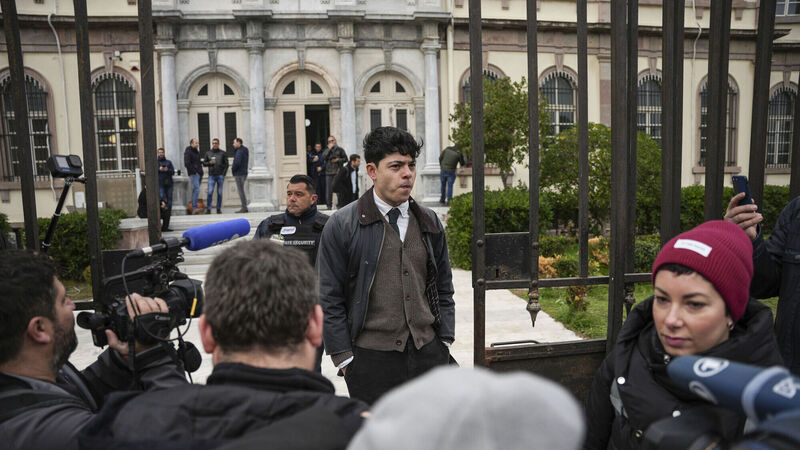
Seán Binder (centre) is one of 24 people charged with people smuggling, belonging to a criminal organisation and money laundering — three extremely serious felony charges that could result in 20-year prison sentences for the defendants. File photo: AP/Panagiotis Balaskas


Chaos had hit the beaches of Greek island Lesvos, where 3,000 people including children, many injured or hypothermic after near-lethal journeys at sea, could wash up in one day in dire need of aid, the trial of a Kerry lawyer on people smuggling charges has heard.

What was unfolding on Greek beaches in 2018 was the biggest refugee crisis since the Second World War and humanitarians, including those on trial, were trying to respond and save lives, witness Iasonas Apostolopoulos said at Seán Binder’s trial today.

Mr Binder is one of 24 people charged with people smuggling, belonging to a criminal organisation and money laundering — three extremely serious felony charges that could result in 20-year prison sentences for the defendants.

Some defendants became tearful as they recounted their experiences trying to save people from drowning off Lesvos before they were arrested in 2018. One defendant spoke of seeing people crushed to death on crowded boats, unable to help or to erase those harrowing images.

She also remembered lifting children's cold, limp bodies from those boats, not knowing if they were dead or alive.

One defendant, Sara Mardini, a former competitive swimmer and human rights activist who has been named one of Time magazine’s 100 most influential people of 2023, said she had felt compelled to help on Lesvos after having to flee her home country of Syria.

She had experienced bad treatment as a refugee, and she wanted to show others in that situation some humanity, and help translate as she spoke Arabic, she told the court.

Her colleague on Lesvos, Seán Binder, began volunteering for the search and rescue NGO Emergency Response Center International (ERCI) on Lesvos in 2017, a lethal year for crossing the Mediterranean with more than 3,000 people reported dead or missing.

In 2018, the Greek authorities arrested Mr Binder, then aged 24, and detained him for more than 100 days before releasing him on bail. The trial eventually got underway late last year and is likely to conclude this week.

Seán Binder testimony

Mr Binder gave evidence at the three-judge Court of Appeal in Mytilene, Lesvos, on Thursday.

“I just completed my Master's in 2017. In that time, the so-called migration crisis was happening. I felt that as a European citizen and someone with search and rescue training that I could assist,” he told the court today.

Mr Binder found the Greek search and rescue organisation ERCI online and applied to volunteer. He submitted his certification for scuba dive rescue, and his driving licence before his application was quickly accepted. He arrived in Greece to volunteer on October 4, 2017.

Mr Binder, who grew up in Castlegregory, Co Kerry, had significant experience at sea and in lifesaving, so he believed his skills could be of use. He joined the search and rescue team.

Part of his role involved “spotting”, when two volunteers would patrol the sea from midnight to 7am, staring into the inky blackness alert to any indication that someone was in distress.

“If we saw a boat in distress, if permitted, we would go out to sea or respond with a medical team on the shoreline,” he said. “More often than not, I did training in the daytime, or if spotting, I’d spend midnight to 7am mostly waiting, looking at the sea.” 

When not on a spotting shift, he would sometimes be called to respond at night if a colleague spotted someone in distress at sea.

When he took over as search and rescue co-ordinator in January 2018, some three months after beginning to volunteer, he began to open up their team to co-ordinate more thoroughly with other humanitarians operating on the island.

Use of WhatsApp

He believed that search and rescue should investigate information from locals, other NGOs and on social media regarding potential boats in distress. WhatsApp was used to co-ordinate the organisation’s response, to communicate within the organisation and to communicate with other humanitarian groups operating on the island, he said. 

It has been alleged that using WhatsApp was nefarious, as it is an encrypted messaging app. But the defendants have denied this strongly, saying it is a commonly used messaging app and that their messaging on it was in no way secretive.

“When I began co-ordinating, I took the view that ERCI should co-ordinate more with other organisations and help people in crisis if we can,” Mr Binder told the court. "I was open to working with other organisations on the island, I was open to locals coming up and telling us about boats they thought were in distress.

“If a boat were in distress, we may miss it on the spotting shift alone. We began training with three or four other organisations on the shoreline to make sure we shared standard operating procedures and that we would receive information from outside the spotting shift."

But he said that any distress call would be confirmed before volunteers contacted the coastguard or woke their colleagues to respond, because not all reports were genuine. False reports were often made when someone mistook a fishing buoy or other fishing activity at sea for someone in distress, he said.

“We would not share rumours,” he told the court. But sometimes, they received genuine reports of people in distress from other organisations or from locals, whom they were then able to help, he said.

Contact with authorities

But every time they knew a boat was in distress, ERCI contacted the coastguard about it, he said. Central to the charge of people smuggling is an allegation that they refused to co-operate with authorities and tried to hide their actions from them. This is strongly denied by all defendants.

In addition to alerting the coastguard to any search and rescue operation, Mr Binder said he would email the local port authority every week with names and passport numbers for anyone who would be sent out to sea on the search and rescue team for the week.

Although under Mr Binder’s leadership, the group started to investigate reports of boats in distress made on social media, by locals and other NGOs.  

He said the team never patrolled speculatively. They only responded to reports of distress. Mr Binder told the court that he is now working as a criminal barrister in London.

Iasonas Apostolopoulos testimony

Some 3,000 people were arriving on the beaches of Lesvos on a daily basis on some 50 boats, witness Iasonas Apostolopoulos told the court. He was volunteering with the Platanos Refugee Solidarity charity in 2018 when Mr Binder and his co-defendants were charged.

But they were trying to save lives in often chaotic, difficult situations, he said, and he denied that they were in any way involved in people smuggling or criminal activity. It was a totally chaotic situation, with thousands of volunteers operating across the island trying to respond to the biggest refugee crisis since the Second World War, he said.

WhatsApp was merely used to co-ordinate with other humanitarians to try to prevent people from dying, he said. There were only two ambulances on the island at the time, but there could be 50 medical emergencies to deal with at once, he said.

WhatsApp helped the humanitarians, including many doctors and interpreters, respond to the serious needs across multiple locations, often at the same times, he said. This co-ordination saved lives, he said. Without it, hundreds of thousands of people would likely have died, he told the Irish Examiner after giving evidence.

Official organisations, including the UN, were involved in the same WhatsApp groups, he said. And authorities had not yet begun "pushing back" refugee boats, he said.

The then left-wing Greek government was not hostile to those fleeing war, persecution and poverty, so there was no need for humanitarians responding to the crisis to hide their actions or for refugees not to declare to Greek authorities, he said. “So there was no motivation to hide people,” he said.

Humanitarians also co-ordinated directly with the coastguard, he said. Local services were overwhelmed, and humanitarians provided support, he said.

The trial at the Court of Appeal in Lesvos, Greece, continues.

x

More in this section

Lunchtime News

Newsletter

Keep up with stories of the day with our lunchtime news wrap and important breaking news alerts.

Cookie Policy Privacy Policy Brand Safety FAQ Help Contact Us Terms and Conditions

© Examiner Echo Group Limited