George Nkencho left supermarket staff in fear of their lives before garda shooting, inquest told
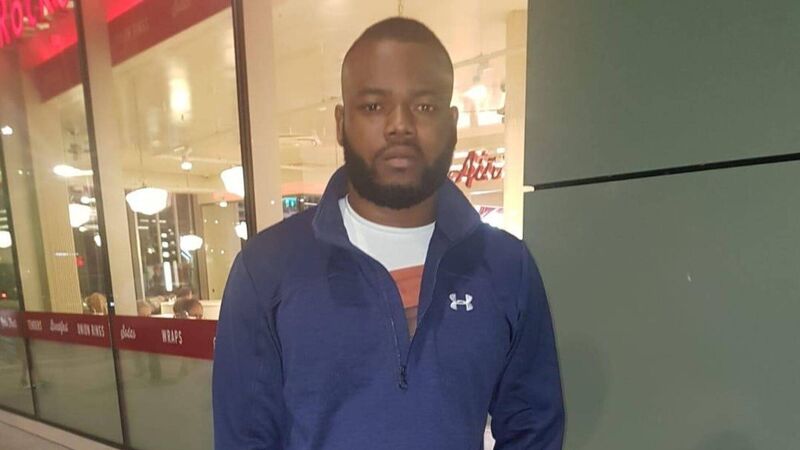
George Nkencho was shot dead by gardai at his home in Clonee, in West Dublin on December 30, 2020. File photo
A young African man put staff of a supermarket in fear of their lives after threatening them with a knife shortly before he was fatally shot by gardaĂ outside his home in west Dublin five years ago, an inquest has heard.
A sitting of Dublin District Coroner’s Court heard evidence from several eyewitnesses that George Nkencho carried out an unprovoked assault on the assistant manager of the Eurospar outlet in Hartstown Shopping Centre around midday on December 30, 2020, before producing a knife in front of other staff and customers.
The inquest also heard evidence that the deceased punched a store manager in the face without warning before producing a knife a short time before his death.
A number of eyewitnesses described how Mr Nkencho was involved in an unprovoked attack on staff at the Eurospar store in Hartstown on December 30, 2020.
The inquest, which is expected to last three weeks, is due to focus on events which occurred in a 76-minute period before the fatal shooting.
The tense situation arose shortly after Mr Nkencho had been involved in the incident at the Eurospar store which was 1.2km away from his home.
The young man, the eldest of five siblings whose family originally come from Nigeria, was pronounced dead a short time later at Connolly Hospital Blanchardstown.
The inquest is being attended by members of Mr Nkencho’s family including his sisters, Gloria and Grateful, and brothers, Emmanuel and Victor as well as Dublin West Socialist Party TD, Ruth Coppinger.

In a written deposition, the store’s assistant manager, Wayne Swords, said Mr Nkencho had come up behind him while he was talking to another staff member and struck him in the face.
Mr Swords said he felt instant pain to his nose which started to bleed as well as feeling his eyes blur. “I was caught completely by surprise,” he recalled.
He began to stumble when a second punch from the deceased grazed his face. Mr Swords then recounted how his attacker pulled a 6-7 inch knife with a serrated edge from a pocket.
“I was terrified. I could see pure and utter anger in his face,” said Mr Swords.Â
He added:
Mr Swords, who suffered a broken nose and a broken tooth, claimed he had never seen such anger in a person in 13 years working in retail.
A store supervisor who had been talking to Mr Swords, Erinda Cerepi, said she was surprised at what happened as Mr Nkencho had looked calm when he had come into the shop.
Ms Cerepi said she had pleaded with Mr Nkencho to go away before calling for help after seeing him take a knife out of his pocket.
The inquest heard Mr Nkencho left the store before coming back in and speaking to a customer who seemed to know him. He then stood at a queue for the post office located within the store for a short period before leaving again.
Another staff member who witnessed the assault, Margaret Armstrong, gave evidence that Mr Nkencho had punched Mr Swords full in the face. “He was hitting Wayne so hard, you could nearly feel it,” she recalled.
Ms Armstrong said Mr Nkencho’s eyes were wide open and he was “wild looking”. The store’s inwards goods manager, Mark Giles, said he dialled 999 because he believed someone had been stabbed.
Mr Giles said Mr Nkencho had appeared “incoherent but still in control”, although he described the deceased in the emergency call as “a crazy headcase”.Â
A checkout operator, Maria Beggs, said she had seen the assailant produce what she thought was a screwdriver after hearing screams for help. Ms Beggs, who admitted being terrified, told the inquest that Mr Nkencho’s eyes were glazed over and he looked “under the influence of something”.Â
A customer in the shop, John O’Connor, gave evidence of seeing the deceased, who was “very, very hyper”, take a knife out of his pocket. “I was sure he was going to stab someone,” he added.

Mr O’Connor admitted thinking about tripping up Mr Nkencho but decided “not to go there.”
In earlier evidence, Mr Nkencho's mother told the inquest that there was “nothing out of the ordinary” about her son’s behaviour in the weeks before his death.
Blessing Nkencho gave evidence at a sitting of Dublin District Coroner’s Court that her son had no issues with his mental health around the time of the fatal incident. Ms Nkencho described how he had loved football and had worked as a coach in both Scotland and Ireland.
However, she claimed he was affected mentally by a car accident in 2015 when he was in a vehicle driven by a friend which had made him become more isolated and solitary in his behaviour.
Ms Nkencho said they were “waiting for something to happen” after their family doctor had written to a hospital about him. “All George needed was help,” she observed.

Sitting close to a large photo of her son on a video screen, Ms Nkencho recalled how he used to tell her he was going to be married by the time he was 29 and would have five children — three boys and two girls — as well as grandchildren.
“I always thought he would be fine. I never thought a day like this would happen,” she added.
Commenting on the impact of her son’s death, Ms Nkencho said: “Since George left, my life has never been the same. I have depression and I can’t sleep.” Ms Nkencho said she thought her memory of her son would fade with time before adding: “It keeps coming because he never had a natural death.”Â
Under cross-examination by counsel for An Garda SĂochána, Ms Nkencho denied that he had mental health issues at the time of his death.Â
She remarked:
Ms Nkencho also denied that her son was violent or that she had any concerns about the safety of her family over his behaviour.
She acknowledged that he had been referred to the mental health services in Blanchardstown but that he had not attended when someone had called to the family home to assess him.
At the outset of the proceedings, Dublin City senior coroner, Myra Cullinane, acknowledged that the inquest would be “very difficult” for Mr Nkencho’s family. “We will be mindful of that at all points,” said Dr Cullinane who noted the inquest would hear “very distressing facts”.Â
The coroner told the jury of five women and five men that they had to examine the extent to which the circumstances of Mr Nkencho’s death contributed to the medical cause of his death.
However, Dr Cullinane reminded them that they could not blame or exonerate any party or make any finding that pointed towards criminal or civil liability.
She also advised the jury that they could make recommendations designed to prevent future deaths or ones in the interest of public safety.
Counsel for An Garda SĂochána, Ronan Kennedy SC, offered his condolences to Ms Nkencho and her family on their “very sad loss”.Â
Evidence is scheduled to be heard from around 50 witnesses including two members of the GASU who have been granted anonymity by the coroner who also directed that they give their testimony behind a screen where they will only be visible to the coroner, jury and legal representatives.
The DPP directed last year that no garda should face prosecution over the circumstances of Mr Nkencho’s death based on a file submitted by FiosrĂş — previously known as the Garda SĂochána Ombudsman Commission — who had conducted a lengthy investigation into the fatal incident.
An appeal by the deceased’s family against the DPP’s ruling was unsuccessful.Â