High Court dismisses challenge against 'super juniors' at Cabinet meetings
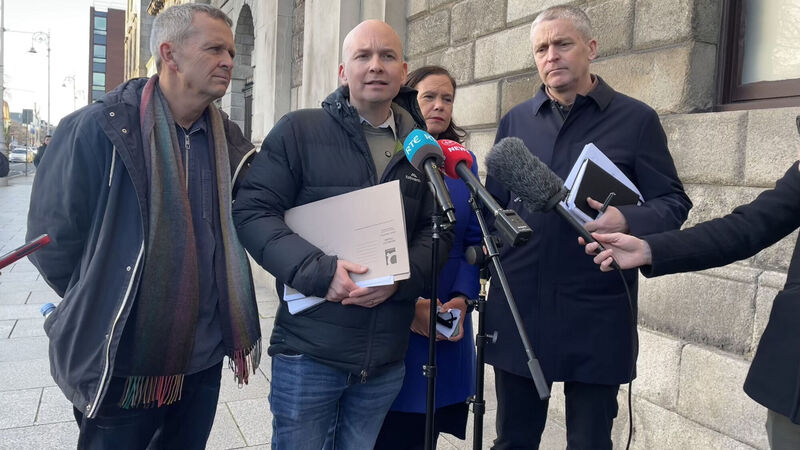
(Left to right) TDs Richard Boyd Barrett, Paul Murphy, Sinn Féin leader Mary Lou McDonald and Pa Daly outside the Four Courts after losing their case against the Government's super junior ministers. Photo: Gráinne Nà Aodha/PA
Challenges brought by two Opposition TDs claiming that attendance of “super junior” ministers at meetings of the Government is unconstitutional have been dismissed by the High Court.
Sinn's Féin Pa Daly and People Before Profit-Solidarity TD Paul Murphy brought separate but similar challenges, arguing that article 28 of Bunreacht na hÉireann limits the number of Government members to 15, and provides they meet and act as a collective authority.
A three-judge High Court, comprising the court president Mr Justice David Barniville, Ms Justice Siobhán Phelan and Mr Justice Conleth Bradley, on Friday held that no provision of the Constitution is breached by the attendance and participation of the junior ministers at meetings of the Cabinet.Â
The judges delivered separate judgments in the cases, but reached the same conclusion. The court held that the Constitution does not restrict attendances at Cabinet meetings to the 15 members of Government.
The court also found that decisions taken by Cabinet are ultimately controlled by the 15 members of Government, and the attendance of super junior ministers does not invalidate such decisions.
An appeal directly to the Supreme Court over the outcome is expected to be sought.
Attorney General Rossa Fanning, who led the State’s defence, described Mr Daly’s proceedings as a “political challenge to the integrity of the Government”. Because there is no constitutional regulation of who attends Cabinet meetings, that was an issue exclusively for the Government, he argued.
Senior Government ministers are appointed by the President of Ireland on the advice of the Taoiseach and with prior approval of Dáil Éireann.
“Ministers of State attending Cabinet”, or super junior ministers, are appointed by the Government on the nomination of the Taoiseach. Super junior ministers participate in Government meetings, but do not vote.
Four super junior ministers are attending Cabinet: Fianna Fáil’s Mary Butler (who is also Chief Whip), Hildegarde Naughton of Fine Gael, and Noel Grealish and Seán Canney of the Regional Independent Group. They are not parties to the actions.
In their judgment, the judges said a super junior minister is appointed by Government decision, on the Taoiseach's nomination and without the need for Dáil approval, in a "fundamental difference" to the appointment of ministers, or members of Government.
As only 15 TDs — that is, the 15 ministers — were appointed to the present Government by the President, it follows that the relevant super junior ministers are not members of the Government, and therefore, there has been no breach in the numerical restriction imposed by Article 28 of the Constitution, the court held.
The judges said they were satisfied that there is no provision in the Constitution that limits the attendance at meetings of Cabinet to the 15 members of Government.
“There is, in our view… no constitutional provision, express or implied, infringed, and, therefore, no disregard, still less a clear disregard, of any constitutional provision by the regular attendance and participation at meetings of the Government by the relevant Ministers of State/Super Junior Minister,” the court said.
The judges said they did not consider that the junior ministers' attendance and participation invalidate any decision taken at a Government meeting on consensus by the 15 members of the Cabinet.
They found that the obligation of Cabinet confidentiality applied generally to those attending meetings, not just the 15 members of Government.
In Mr Murphy’s case, the court made several findings on decision-making at Cabinet, which, the court found, is ultimately controlled by the 15 members of Government.
The court said Mr Murphy’s side accepted that, in the event of a vote on a Cabinet decision, only the 15 members of Government would participate in the vote.
“The attendance and participation by the super junior ministers at meetings of the Government, therefore, does not undermine the decisions taken by the members of the Government, constitutionally appointed,” the court said.
This is borne out in other findings, the court held. This includes a finding that the preparation of Cabinet memos — proposals for government decisions to be voted on by Cabinet — is controlled solely by the 15 members of Government.
The participation at Cabinet of individuals other than Government members — including the chief whip, the secretary general, and the attorney general — does not invalidate any decision taken by the 15 members of Government, the court held.
Both Mr Murphy and Mr Daly were in attendance at the Four Courts for the delivery of the judgments, as was Sinn Féin leader Mary Lou McDonald. The cases will be mentioned before the court again in January.