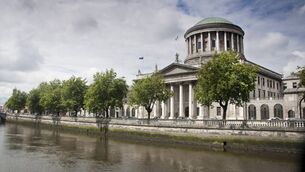
Judge orders prisoner who refuses food and fluids to be sent to hospital to 'preserve his right to life'
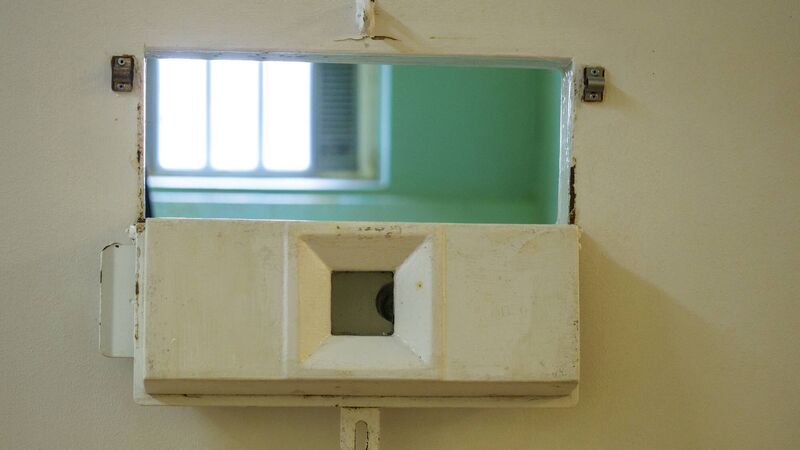
The inmate, who has not been identified, was the subject of an ex parte application by the governor of the prison where he was on remand, to the High Court. Picture: File
A judge has ruled that a prisoner who has been refusing food and fluids can be transferred to hospital for treatment to “preserve his right to life”.
The inmate, who has not been identified, was the subject of an ex parte application by the governor of the prison where he was on remand, to the High Court.
The governor sought inter alia orders “which would permit the transfer of the respondent to a certain hospital or other appropriate clinical setting so that necessary and proportionate steps could be taken to preserve his right to life by the provision of nourishment, both food and fluids, despite the expressed wish of the respondent to refuse nourishment in all forms”.
The man had been the subject of an earlier application to the High Court after he refused food and fluids between February 11 and 17. However, the second refusal began on February 25, and he also started to refuse prescribed medication on February 24.
A day later, the prisoner wrote: “I am refusing to voluntarily consume food and liquid here indefinitely until such time as this State fully restores my liberty. I have resumed this stance due to the evil and self-harm this State is seeking to promote and pursue here via me.
"I request the High Court immediately to recognise the contempt of justice and illegal use of the entire workings of the State against me.”
In the judgement, dated March 5 but only published in recent days, Mr Justice Mark Heslin said that the man’s health “on any analyses is deteriorating and has now reached a very grave and acute state”.
On March 3, the prisoner refused a “variety of medical checks”, as well as a “review by the prison psychiatric service”.
On March 4, an independent consultant forensic psychiatrist said the defendant “presented with acute mental illness in that he was exhibiting symptoms of a paranoid psychotic illness”.
As a consequence, she felt that “because his decision-making is predicated on delusional beliefs, I am of the view that he lacks the ability to weigh information in a reasoned manner and this negates his capacity” regarding his capability to make decisions relating to the refusal of food and fluids.
She also said his “distrust was all pervasive and his delusional beliefs all consuming. He repeatedly expressed a desire for The State or other government parastatals and their employees to stop persecuting him and was clearly distressed by his delusional belief system.”
This, according to Judge Heslin, was consistent with the views of a consultant psychiatrist who assessed him in a hospital on February 16 and 17, who noted: “He believes his life was and is central to the occurrence of the covid virus. He believes the government and other agencies, nationally and internationally, have pursued a campaign against him to supress and control him and that they have engaged in higher level communications and surveillance.”
On the morning of March 5, the prison doctor said his physical and mental health had deteriorated overnight, and said: “In my opinion he (is) at risk of sudden death and requires refeeding and rehydration immediately.”
Mr Justice Heslin said that on the evidence presented to him, the inmate “is someone who lacks capacity to make the relevant decision to refuse nutrition, including liquids, and medical care”.
He ruled in favour of the governor’s application and said: “In crude terms, the right to life is taking precedence over the right to autonomy, given the evidence of lack of capacity.”
- If you are affected by any of the issues raised in this article, please click here for a list of support services.
CONNECT WITH US TODAY



Be the first to know the latest news and updates