'Leo is to get it this week', man who phoned in bomb threat to Helen McEntee's home told gardaí
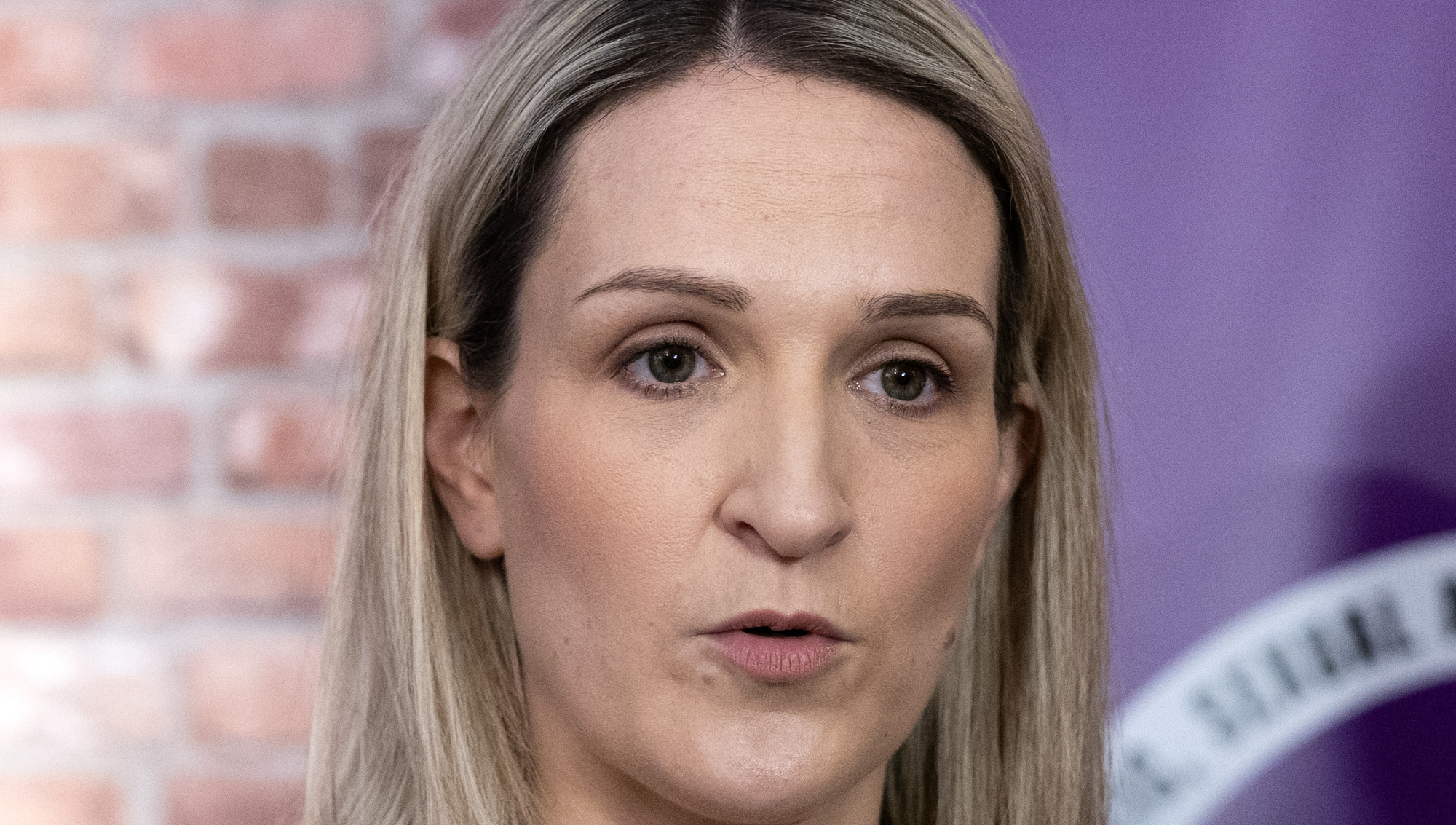
'Helen McEntee is not a target of mine. Policies implemented underneath her are,' accused told trial. Picture: Sam Boal/Collins
During the trial of hoax bomb caller Michael Murray, a Samaritans volunteer told the court she was left “really shook” after receiving a call saying explosives had been planted at the Justice Minister's family home.
The volunteer said she had been on duty on March 7, 2021, when the phone rang.
She answered the phone and, after a few moments of silence, heard a male voice say: “Can you take a message?” She told the court the caller then said: “This is the Irish National Liberation Organisation. Explosives have been planted at the home of the minister for justice and her family. The password is Red October. This is to do with a court case happening in Dublin tomorrow.”
The woman told the court the voice spoke “slowly, carefully and calmly”. She said it did not sound like the voice of a teenager or someone in their 20s and she thought it could be a Dublin accent.
When Sergeant Paul McGarry — a supervisor at the Eastern Regional Communications unit at the time — was informed, he contacted gardaí in Navan, where Ms McEntee lived at the time.
He said he was “acutely aware” Ms McEntee was pregnant at the time and he did not want to cause her undue stress.
Gardaí from Navan were sent to the minister's house to look for suspicious devices or anything that stood out.
Sgt McGarry said he received a phone call at 10pm saying everything appeared to be in order and no suspect devices had been found. Gardaí also examined the Department of Justice for any suspect devices in the vicinity and nothing untoward was recovered.
Tracing the call, a senior garda told the jury the call was considered a criminal offence at a serious level “that might threaten the security of the State”.
Superintendent Dermot Dray said his objective was to try and establish the phone number and identity of the person who had contacted the Samaritans hotline and made the threat.
He made an application to his superior officer to find out the caller's number and where they had called from. He received information two days later that the call had come from the Midlands Prison.
Noel Reilly, who worked in the IT department of the Irish Prison Service at the time, said the call was traced back to a number associated with Murray.

He explained before a call can be made from within an Irish prison, prisoners must enter a number given to them to access the phone system. He said calls to the Samaritans and solicitors are not recorded.
The court heard the call to the Samaritans was traced to the extension within Murray's cell, that his unique identification number was used and he was alone inside his cell overnight.
Mr Reilly said it was his observation Murray made the phone call to the Samaritans at the exact time.
In cross examination, he agreed with Garret Baker SC, defending, that it was possible for someone to use another prisoner's phone number and he was relying on numbers rather than actual identities or CCTV footage.
When interviewed by gardaí, Murray agreed to having “well-known” links to the paramilitary group named in the threat.
Video footage of his arrest and Garda interview on March 26, 2021, was played to the jury.
When asked if he had been aligned with the INLA in the past, Murray responded: “That's well known.”
Murray said he had been imprisoned with political prisoners due to this association and he had made an unsuccessful application to the High Court to be released as part of the Good Friday Agreement.
He said he had a problem with the DPP office and it was a “constant fight” to get evidence as a defendant.
“It's harder to run a criminal trial than it is to commit a fucking bank robbery these day,” he said.
“Our State is run on lies and deceit and it's the same as the criminal justice system.”

He said his issue with Ms McEntee was that “she represents a department that does not release material in a defence trial”. He also said he had no personal problem with her, but with the department she represented.
When gardaí asked him if he rang the Samaritans and phoned in the bomb threat, the interview footage showed him laughing and responding: “Oh man, are you serious?” He denied the allegations.
Murray said he regularly called the Samaritans and had “no problem” that he called them on the day of the bomb threat.
He said they discussed how he was feeling “a bit down” and that he was in court the following day.
Murray also told gardaí there was a group called the Criminal Revenge Group (CRG) which was making “credible” and “immediate” threats. He said members of the group included convicts and former paramilitary members of the INLA who were not imprisoned.
Murray said there was a “legitimate threat” to Taoiseach Leo Varadkar and the Justice Minister. He said: “Leo is to get it this week.”
The court also heard the CRG had a “list”, including named civil servants within the Department of Justice and barristers.
Murray said the threats came “from both North and South” and had to do with the setting up of the Special Criminal Courts. He said the threats were coming to the targets “because of their own actions”.
Detective Garda Patrick Muldowney told the court Murray later contacted gardaí through his solicitor on August 9, 2021, and made admissions.
The court heard the conversation was done on a voluntary basis and had not been recorded. However, Murray signed a memorandum of the questions and answers.
“I wish to say I was the person who made the call,” Murray told gardaí, the court heard. “I did so in frustration.
“That stops the bullshit,” he told them, and added he regretted the phone call.
In cross examination, Mr Baker put to Det Garda Muldowney that he had misinterpreted Murray.
He said his client was making admissions to ringing the Samaritans at a different time to the bomb threat. Mr Baker said “what he meant by this was that his mental health was not what it should have been” and that he had frustrations in regard to disclosure issues.
“It was my understanding for the purpose of that meetings that he was accepting the phone call — that he made the threat,” Det Garda Muldowney said.
“It was fully my understanding going down to the prison that Mr Murray was looking to make admissions.”
Murray gave evidence during the trial and said the allegation was “ludicrous” and did not make sense.
He said he had made a phone call to the Samaritans on the night of March 7, 2021, but it had absolutely nothing to do with the Justice Minster.
“Even from a logical perspective, this does not make sense,” he said. “[To say] that I would isolate myself in my cell on my own at 8.30 at night and threaten the highest ranking member of the Department of Justice is ludicrous.”
Murray said if he wanted to make the threat, he could have entered someone else's cell during the day. He said it did not make sense for him to do it on his own line that “was already being monitored on my request”.
When Mr Baker asked him what his “gripe” with the Department of Justice was, Murray responded it was with the policies of the DPP's office.
“Helen McEntee is not a target of mine,” he said. “Policies implemented underneath her are.”
Murray said he had an issue with how the DPP's office was run and that “it needs to be fixed from the inside".
“At the end of the day it comes down to evidence, and in this case it is miles short of what the State is trying to allege,” he said. “It is ridiculous.
“The evidence was not clear because I did not make that call. End of story.”
In his closing speech to the jury, Sean Gillane SC, prosecuting, said only one person could possibly have made that call. “That person is the accused Mr Murray.
“There is a lot of smoke and a lot of sound, a lot of material that has nothing to do with the essence of the case,” he said.
Mr Gillane said it was “crystal clear” a call had been made to the Samaritans making the bomb threat.
He also said it was “for certain” the call came from the Midlands and the “absolutely sound evidence” was that the call was made on the extension in Murray's cell, using his identification number, while he was alone inside.
Mr Gillane asked the jury whether it was a “coincidence” that the caller picked a paramilitary organisation that Murray “openly acknowledges being aligned with in the past”.
He also asked whether “maybe its just another layer of coincidence” that Murray admitted to having a gripe with Ms McEntee and was aware of “credible” threats to have explosives planted at her home.
“That's lottery winning odds if it's all it was,” he said, “Your tolerance of coincidence would be sorely tested. Riddle me this,” said Mr Gillane,
“On top of all of that, the person making the call is saying this has got to do with a court case tomorrow and Mr Murray just happens to have a court case the following day.”
Mr Gillane said “the only logical conclusion” was that “they're simply not coincidences”.
In his closing speech, Mr Baker told the jury the evidence in the case was “a million miles from where you need it to be”.
“Mr Murray is not Mother Theresa and he's not claiming to be that,” said Mr Baker, adding his client wanted “a fair roll of the dice” and for the jury to make an honest appraisal.
“When you look at the evidence as a whole in this case, there are aspects that are concerning,” he said.
He said gardaí reported the caller had a “strong Dublin accent” and had spoken slowly in the call. Mr Baker told the jury they had heard Murray's voice and he didn't have that accent, nor did he speak slowly.
Mr Baker also asked the jury to consider there was a variation between the time the call to the Samaritans was recorded in the logs of the service provider and the prison service.
The variation was 18 seconds long, which “in the context of this case is a lifetime”, he said.
Mr Baker said there were “important holes, gaps, deficiencies in the prosecution case”.
He asked the jury whether it made sense for Murray to make threats from his cell when he'd asked for it to be monitored in the past.