Stardust inquest: Eamon Butterly denies throwing head doorman 'under a bus'

Former manager of the Stardust nightclub Eamon Butterly at the Stardust inquest on Friday. Picture: Gareth Chaney/ Collins
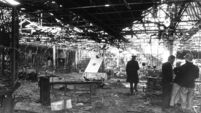
Harrowing accounts of people trying to escape the Stardust in north Dublin in the early hours of 14 February 1981 as fire was spreading were described as “devastating” by the club’s manager Eamon Butterly on Friday, but he maintained his stance that all the exit doors were open on the evening.
Dozens of witnesses described men having to kick doors to get them open, people trying the bars on the exits which would not work, a crush at the exits, and panic, with one person recalling hearing someone shout “we’re all going to die”.
When this “graphic picture” from multiple witness accounts were put to him about how difficult they found it to escape the Stardust during the fire, Mr Butterly conceded this may have been the case.
“On the basis of those accounts, the exit wouldn’t open without force,” Michael O’Higgins SC said.
“That’s what it looks like,” Mr Butterly replied.
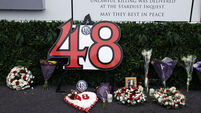
Friday marked the second day of Mr Butterly’s evidence at the fresh inquests for the 48 young people who died following the blaze at the Valentine’s disco.
Families had long-awaited hearing from the man who ran the Stardust as a crucial part of these inquests into the deaths of their loved ones. The Butterly family had converted the Stardust into a venue to host discos and showbands in the late 1970s.
The court had previously heard evidence at length about the apparent policy of keeping emergency exit doors locked at times when patrons were on the premises on disco nights.
It had heard of the practice of draping chains over emergency exits to give the impression they were locked in an apparent bid to deter people inside from opening them and allowing their friends enter for free.
It had also heard a statement from Eamon Butterly saying it was a policy that was “forced” on him.
On Thursday, Mr Butterly claimed he never saw any doors locked in the Stardust and instances where witnesses reported seeing doors locked were not reported to him.
He said when he learned there was a practice of keeping some of the doors locked when patrons were on the premises, he told the head doorman Thomas Kennan to put a stop to it.
Some of the questioning of Mr Butterly by counsel for the families was attempting to reconcile those accounts.
Under questioning by Michael O’Higgins SC, for some of the families, Mr Butterly denied he was throwing the head doorman Tom Kennan “under a bus” in his testimony, by saying it was Mr Kennan’s idea to keep the doors locked for periods during an evening and he had told Mr Kennan to stop it.
It was also pointed out to him that, in a statement given to gardaí in October 1981, he said the policy of locking doors for a portion of the night was “forced upon” him and this was the policy decided upon that he was involved in creating.
Mr O’Higgins asked Mr Butterly which version "he was backing”, and Mr Butterly replied that he was backing the one where Mr Kennan had chosen for doors to be locked “on his own initiative”.
It was also put to him that Mr Kennan had “skin in the game” in saying that the doors were all opened. Mr Butterly maintained he believed the doors had all been opened.
Mr O’Higgins had begun his questioning by setting Mr Butterly out with a roadmap of all the things he would be asking him. He put this roadmap on the screen for the court to see.
These included headings such as “staff issues”, “hiring and firing at will”, status of doors”, and “any justification for locking the doors”.
Although we have yet to hear from fire experts commissioned to examine the case of the Stardust specifically for these inquests, excerpt of draft reports from these experts were put to Mr Butterly.
This included reports from both experts commissioned by the coroner and the families’ legal teams.
Both suggested that the carpet tiles used on the walls of the Stardust had an important role to play in the spread of the fire.
In one case, an expert said the carpet tiles “significantly reduced the time available” for occupants to escape the Stardust and the tiles on the wall “significantly contributed to the rapid spread of fire”.
Gemma McLoughlin-Burke BL, for the coroner, closed her questioning of Mr Butterly to begin the morning and returned to the themes of his evidence the day before.
She put it to Mr Butterly that, according to the evidence of his now-deceased father, it was he who was the “man in charge” at the Stardust. This however, appeared at odds with Mr Butterly’s own evidence.
Ms McLoughlin-Burke said: “You told me you didn’t hire and fire staff. You told me you didn’t manage staff issues. If there was a problem in the nighclub, like people seeing smoke, like an electrical issue, no one seemed to tell you about those problems.
“You didn't recall seeing any of the doors locked. Isn't that right? You didn't recall seeing any of the doors at all actually I think was your evidence. Isn't that right? So it wasn't your job to keep an eye on the exits, wasn't your job to keep an eye on the patrons. So Mr Butterly, what was your job in the Stardust?”
Mr Butterly replied it was job to look after the management of the place, through the managers they had. Previously, he said general manager Brian Peel would look after many issues, as would Mr Kennan.
“That was my job,” he said. “But I still went around.”
“Went around?” Ms McLoughlin-Burke asked.
“Went around the areas and looked at it and...” Mr Butterly said.
“Looked at things?” he was asked, to which he said “yes”.
“And had cups of tea?” the barrister said, to which Mr Butterly said he did.
The inquests continue on Tuesday.
CONNECT WITH US TODAY



Be the first to know the latest news and updates