Electrician noticed 'flickering' neon sign that 'could cause a fire' on night of Stardust blaze
Electrician said he had spent a number of years working for a firm dealing exclusively with high-voltage neon signs  
Electrician noticed 'flickering' neon sign that 'could cause a fire' on night of Stardust blaze

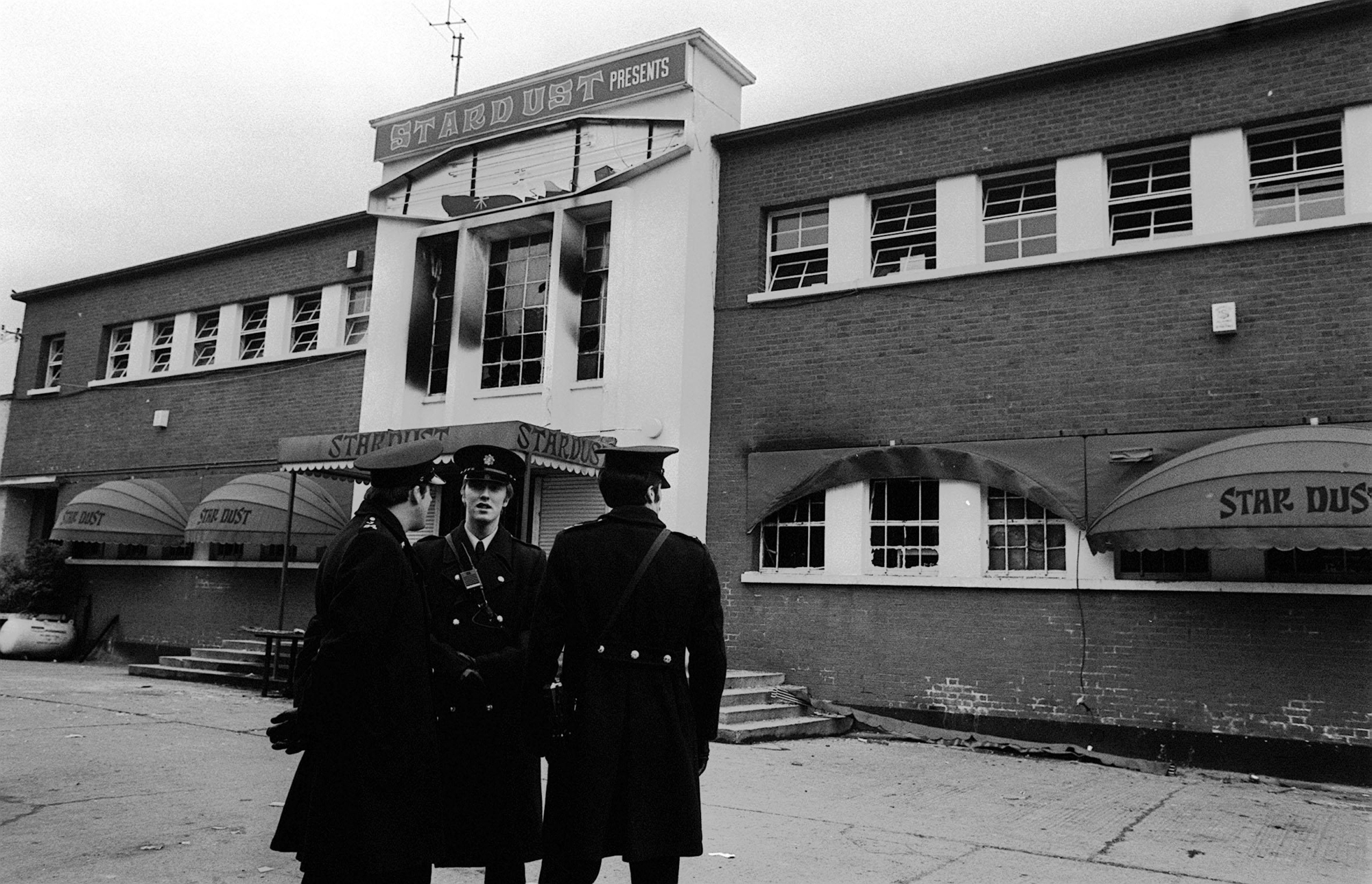
Gardaí outside the fire-blackened Stardust night club in Artane, Dublin, the morning after the fire in 1981 that claimed 48 lives. File picture: Tony Harris/PA

An electrician who attended the Stardust complex on the night of the fatal fire noticed a neon roof sign “dimming” and “flickering” and believed it was due to an electrical fault which “could cause a fire”, an inquest has heard.

Stephen Byrne, who worked as an electrician at Cadbury's in Coolock at the time, said he attended the Silver Swan public house on the night of February 13, 1981 and noticed a neon strip at roof level which was “dimming” and appeared to have a short in it.

“As soon as I heard about the fire I immediately thought of the short I noticed in the neon sign. From my experience as an electrician I know that it could cause a fire,” Mr Bryne said in a deposition taken on February 16, 1981 and read to the inquest on Friday.

The inquest has heard that the Stardust had been open for three years as a venue for various music concerts and dances when the fire broke out in the early hours of Valentine’s Day 1981. There were three venues on the site, including another function area known as the Lantern Rooms and a bar known as the Silver Swan.

Electrician's second statement

In a second statement provided three days later, Mr Bryne said he had worked as an electrician for 20 years, including a number of years spent working for a company dealing exclusively with high-voltage neon signs.

He said when he saw the neon tube flickering on the night of February 13, he believed it could have been caused by a number of faults, including degassing, a faulty transformer or a faulty connection. He said a faulty connection would be “the most likely” fault which would cause the high voltage connection to “arc” which in turn could cause a fire.

The jury also heard on Friday how staff at the stardust noticed the smell of smoke months before the fire and how there were power outages at the facility just days before the blaze.

Statements from other unavailable witnesses were also heard, including Caitriona Ross, who worked as a waitress at the Stardust. She said part of her job was to check that the emergency exits were locked.

The inquest was told Ms Ross’s statement was not a garda statement but was made specifically for the purpose of these proceedings.

Waitress came forward due to RTÉ programme

Ms Ross also said she believed the materials kept in a storeroom had been understated at the original inquest and said in a deposition that to the best of her recollection, the materials kept in the room would have included 40-50 five gallon drums of cooking oil, between 20 and 30 five gallon drums of cleaning fluids, several drums of liquid floor polish, several drums of detergents and dozens of boxes of plastic glasses, plastic knives and forks, as well as napkins and toilet rolls.

She said she had been prompted to come forward to make a statement and give the information she has following the broadcast of a documentary into the Stardust on RTÉ in February this year, which was first broadcast in 2006.

Ms Ross said she started work at the Stardust on a part time basis and worked there for about eight or nine months before leaving about three weeks before the fire to concentrate on training as a hair stylist.

She said it was a condition of the licence that meals were served at the Stardust and said upwards of 800 to 1,000 meals were served each night. The meals were cooked in two very large frying machines which would have been six to seven foot long, she said.

Checking that emergency exits were locked 

She said part of her job was to check that the emergency exits were locked. Ms Ross said they were locked with chains and security would have the keys for them.

It was also her duty to go to the storeroom, which was located at the top of the steps at the end of the north alcove above and adjacent to the main bar, to collect plastic pint glasses and napkins.

In the statement, Ms Ross said she had been shown the list of the contents of the storeroom as set out in a letter from the solicitors of the owners of the Stardust ballroom sent to the Tribunal of inquiry dated September 1, 1981.

“I completely disagree with that list,” she said. 

It entirely understates the quantity of material which was stored and does not mention some things which were stored there routinely, at least while I was working there.

The list furnished to the tribunal is “completely unrealistic” given the number of meals served, she said, adding the kitchen employed five cooks at any one time.

'Power failed twice' on February 11

In her witness statement, Doreen Delahunty, who worked as a cleaner at the Stardust complex at the time of the fire, said the power failed on two occasions while she was at work on February 11, 1981.

She said this was a complete breakdown of power, the lights went out and the power to the hoovers failed. The first time it happened the handyman went to “see about it” and after about ten minutes the power came on again but “the lights kept flickering” and power to the hoovers came and went down before going again completely 15 minutes later.

'Strong smell of burning' in 1980

James Murphy, who worked as a glass washer at the Stardust from October to December 1980 while studying for his Leaving Cert, said in his deposition that about a week before he stopped working at the Stardust, he noticed a “strong smell” of burning.

He said he was in the main bar getting things ready for the night with one of the barmen who asked him if he got a smell of smoke.

Mr Murphy said at this point he noticed a smell like “rubber burning”. He said he stood on a chair at the middle of the back balcony and could still get the smell. He then went up to the lighting room which was directly over the room where kegs were stored for the complex and when he opened the door he got a stronger smell. There were a number of large cables in the room, Mr Murphy said.

He said he went back to work and the smell faded away after a while.

Carpet tiles 'were not sold off' 

On Friday morning, Declan Conway, a sales representative for the company that provided the carpet tiles for the Stardust, denied the carpet tiles used on the walls of the Stardust were a “job lot” that was being “sold off on the cheap”.

Mr Conway told Brenda Campbell, representing nine of the families of the deceased, that the tiles were made “specifically” for the Stardust and said there were production difficulties getting them into Dublin on time.

He denied assertions made by a representative of the English company who supplied the tiles, made during a 1981 inquiry into the fire under Mr Justice Ronan Keane, that this particular tile “had reached the end of its life” and the company was “selling it off”.

Ms Campbell put it to him that the company representative, Mr Graham Whitehead, had told Mr Justice Keane during the 1981 tribunal that what had been supplied for the Stardust was the “remnants” of the Stateroom tile and when asked if it was a clearing out of stock he replied: “I assume so”. The tiles went out at £1.28 originally and this was reduced to 77p.

He said the tile had been in production in 1977-78 and had reached the end of its life and as a result was being “sold off”.

“What he told Mr Justice Keane was that it was being sold off as a job lot and it was being sold off on the cheap,” said Ms Campbell.

Mr Conway denied this was the case. “You would not be able to job lot that quantity of tiles,” he said. “The quantity was significant and they would never have had the stock.” 

'Sparks from ceiling' in January 1981

The jury in the inquest into the fire, which claimed the lives of 48 young people, also heard evidence on Friday morning from Fiona Doherty who told how she saw “big sparks” coming from the ceiling of the Stardust a month before the fire. She said this alarmed her so much she wanted to leave.

She told the jury the sparks made loud cracking noises and were so big she wanted to leave the venue because she was afraid a fire was going to break out.

She told Simon Mills, a member of the coroner’s legal team, that she could remember seeing the sparks “as if it was yesterday” and said she told her parents about what she had seen when she came home from the concert.

The sparks lasted for between 10 and 20 minutes, she said, and she told her friends she wanted to leave the concert but they were reluctant to leave so they stayed.

Ms Doherty said the sparks were like sparks you would see at bumper cars but “much bigger” and more substantial. She said: 

When you’re on a bumper car you can see the sparks but these particular sparks in the Stardust were much bigger.

She said there were “so many” and they were so big that she spent a lot of time watching the ceiling rather than watching her favourite bands on the stage.

Ms Doherty, who gave her evidence remotely from France, said she made her statement to gardaí following the fire because she felt what she had seen that night was important and added she “couldn’t understand” why no one had contacted her since 1981.

She agreed with counsel Sean Guerin, also acting on behalf of a number of families of the bereaved, that the club was crowded to the point of being uncomfortable and there was pushing and shoving.

She said she spent a large amount of time looking at the sparks coming from the ceiling and was afraid a fire was going to break out.

The witness added: “They weren’t just tiny little lighting a match sparks, they were big sparks so big that I wanted to leave and they were my two favourite groups.”


More in this section

Lunchtime News

Newsletter

Keep up with stories of the day with our lunchtime news wrap and important breaking news alerts.

Cookie Policy Privacy Policy Brand Safety FAQ Help Contact Us Terms and Conditions

© Examiner Echo Group Limited