Blow for Gerry Hutch as 'unlawfully' taped conversations admitted in 'interests of justice'
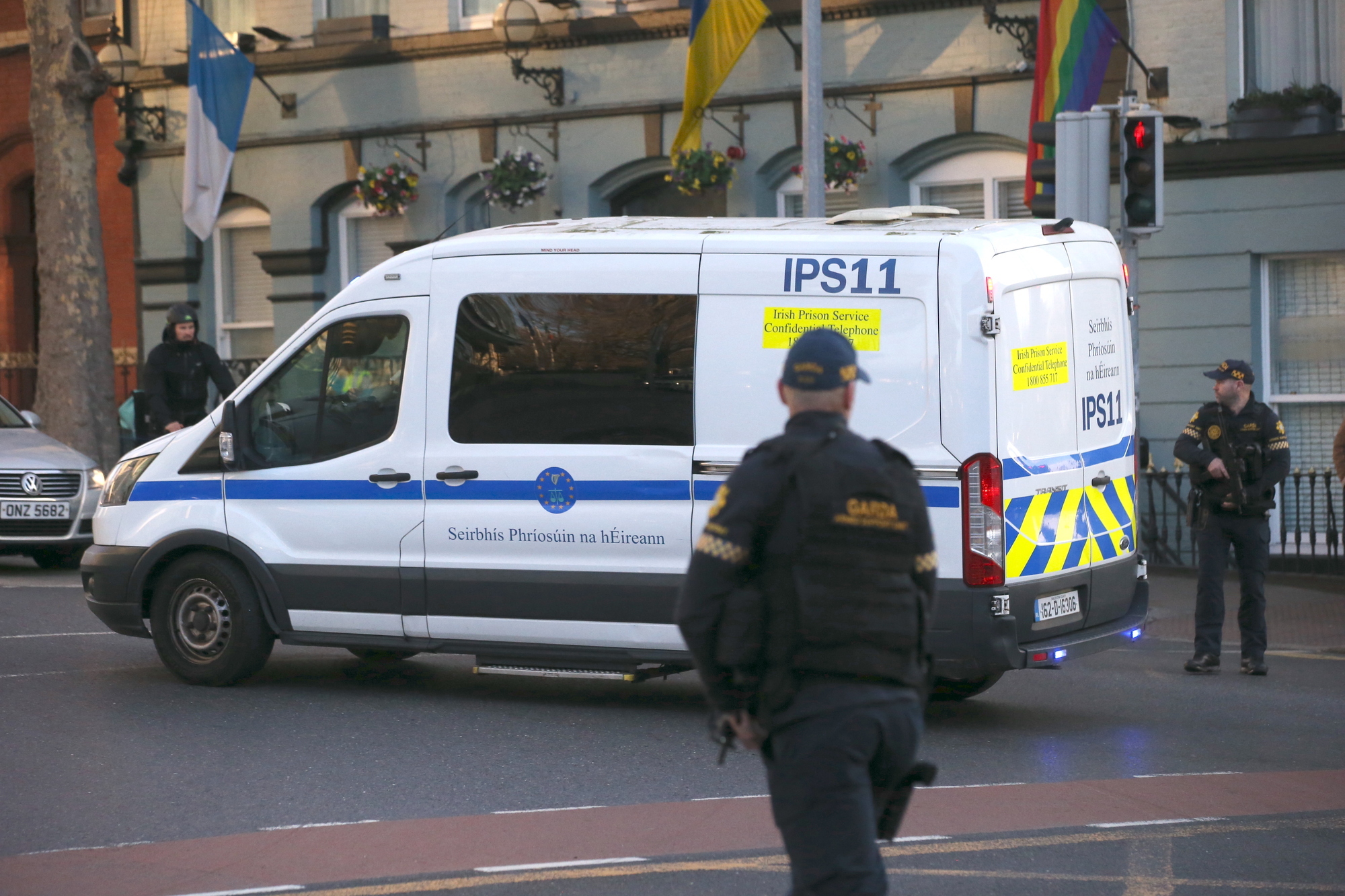
A prison van under Garda escort arriving at the Special Criminal Court where the trial of Gerry Hutch, for the murder of David Byrne, continues. Picture: Collins Courts
Judges at the Special Criminal Court have ruled that 10 hours of conversations between murder-accused Gerard 'The Monk' Hutch and ex-Sinn Féin Councillor Jonathan Dowdall that were captured by a garda bugging device are admissible in the trial, despite the majority of the evidence having been "gathered unlawfully" while Dowdall's jeep was outside of the State.
The three judges were on Friday delivering their ruling on a defence application to exclude either all or most of the conversations between Mr Hutch and Dowdall that were captured by a garda bugging device outside the State, weeks after the shooting of Kinahan Cartel member David Byrne at the Regency Hotel.
The prosecution is seeking to use in evidence the 10-hour recording of conversations from that journey on March 7, 2016, from 2.23pm until 00.15 on March 8. The audio was played for three days to the non-jury court in "a voir dire" or trial within a trial before the court was to rule on the admissibility of the evidence.
Following lengthy legal arguments by counsel for both sides in the trial, presiding judge Ms Justice Tara Burns on Friday delivered the judgment of the three-judge court. The judge said that the court found that the National Surveillance Unit (NSU) officers "had no power" to gather evidence in Northern Ireland, that the evidence was "gathered unlawfully" and that the breach that had occurred was "of significance".
Nonetheless, she said the court was satisfied that the relevant NSU officers had acted in good faith, that there was no "mala fides" on their part and that the illegality was unknown at the time.
Ms Justice Burns went on to say that the court was satisfied that the conversations between the two men ought to be admitted into evidence in the "interests of justice". "The court will admit that portion of the conversations from Northern Ireland into evidence in the trial proper," she added.
Under Section 14 of the Criminal Justice (Surveillance) Act 2009, surveillance information may be admitted as evidence despite any failure by the garda to comply with a requirement of the authorisation if the trial court, having regard to particular matters, decides that the garda acted in good faith, the failure was inadvertent, and the information ought to be admitted in the interests of justice.
The judge rejected the defence's challenge to the authorisation of the audio bugging device by the District Court judge but accepted their second argument that the operation of the surveillance device was illegal. The court ruled today that gardaí have no power to investigate or gather evidence in another State and that the gardaí cannot operate independently in another jurisdiction.
The conversations between Mr Hutch and Dowdall took place when they were allegedly travelling north to a meeting in Strabane in Co. Tyrone on March 7, 2016, in Dowdall's Toyota Land Cruiser jeep, that had been bugged by garda detectives.
The prosecution's case is that Mr Hutch had asked Dowdall to arrange a meeting with his provisional republican contacts to mediate or resolve the Hutch-Kinahan feud due to the threats against the accused's family and friends.
Mr Hutch (59), last of The Paddocks, Clontarf, Dublin 3, denies the murder of Mr Byrne (33) during a boxing weigh-in at the Regency Hotel on February 5, 2016.
Ruling on the challenge to the authorisation of the audio bugging device by the District Court judge, Ms Justice Burns said it was being challenged by the defence on several grounds, but she rejected all of them.
The main part of the defence's challenge was the authorisation for the bugging device granted by the District Court judge, which they argued was "unlawfully issued" and submitted that no evidence gathered on foot of it should be admitted.
Mr Hutch’s defence lawyer Brendan Grehan SC said permission to deploy a bugging device that recorded conversations between his client and Dowdall was sought under "a culture of secrecy" and with "an unintentional lack of candour" on the part of a detective superintendent, who counsel said did not give the judge all the information that would have been required for him to make an informed decision.
Mr Grehan said the detective superintendent was obliged to tell the judge that he had already approved the deployment of a tracker and logging device on Dowdall's vehicle 36 hours earlier, before asking the judge to deploy a third device on it. Counsel said the judge also should have been told that the jeep may travel outside the jurisdiction.
In reply, Sean Gillane SC for the Director of Public Prosecutions said the detective superintendent had "more than discharged" his duty of candour by putting the intelligence he had "on the table" and "setting it out in black and white".
Ruling today, Ms Justice Burns said the application before the District Court was for authorisation of a surveillance device of the recording of a group of people and that a tracking device was only used for providing locations of a person, place or thing. "These are completely different devices which record very different things, accordingly failure to disclose this fact does not breach a duty of candour," she said.
Referring to the submission that the jeep may have been travelling outside the jurisdiction, the judge said that the detective superintendent did not have the intelligence that there would be "future visits" to Northern Ireland and any assumptions of this could only be based on speculation.
She found that there was no obligation on members of An Garda Siochana to discuss possibilities and that applications to the District Court are based on fact and anything further would be complete speculation on the detective superintendent's part. "There was no obligation on him to discuss the various possibilities that might arise," she added.
In summary, Ms Justice Burns said the court was satisfied that the authorisation for the bugging device issued by the District Court was a lawful and "valid" one.
Dealing with the defence's second argument concerning the extraterritoriality issue raised about the audio recordings, the judge said the question which arises is whether information gathered when the bugging device was out of the jurisdiction and in a foreign jurisdiction was lawful.
She said An Garda Siochana has no authority to investigate or gather intelligence in another jurisdiction and that "officer after officer" had given evidence that they were not permitted to operate in Northern Ireland. She said the unlawfulness relating to the gathering of the material is significant but that there was no "mala fides" on the part of An Garda Siochana.
The defence's challenge had centred on what they submitted was the "illegal use" of the audio device outside the jurisdiction.
It was the defence's contention that any material gathered by gardaí from the bugging device in Dowdall's jeep from when it crossed the border at 3.10pm at the Carrickdale Hotel in Dundalk, Co. Louth, until 10.50pm that night when it re-entered the jurisdiction at Aughnacloy in Co. Monaghan was outside the remit of the Criminal Justice (Surveillance) Act 2009.
Mr Grehan said the 2009 Act is "as clear as can be" that an authorisation for a surveillance device can only apply within the State and there had been an illegal operation of the Act in this case. He said there was nothing in the Act to suggest it had scope beyond the borders of the State and that the Oireachtas would have legislated for this with "irresistible clearness" if this had been the case.
Section 5(9) of the Criminal Justice (Surveillance) Act 2009 states "subject to any conditions imposed by the judge under subsection (5), an authorisation shall have effect both within the district court district to which the judge is assigned and in any other part of the State".
Mr Gillane rejected the defence argument that the authorisation for the surveillance device was not valid. The prosecution said it was not making any extraterritorial claim for garda surveillance but argued that the bug was an “inanimate object” and that the recordings made “by happenstance” when it crossed the border were admissible in evidence as long as the device was lawfully deployed, retrieved and downloaded in the Republic.
Any issue about where the device travelled to is "a cloud" which the defence has placed over the case, said Mr Gillane.

However, the judge went on to find that the prosecution's argument that support was to be found for its interpretation concerning "sea going vessels" and aircraft referred to in the Act did "not hold water". Mr Gillane previously referred to the words "aircraft" and "a vessel, whether sea-going or not" saying: "Can I ask, what is a purely rhetorical question, where do airplanes go, where do sea-going craft go, where the Oireachtas submits that these are places where audio surveillance devices can be put".
Ms Justice Burns said the intention of the legislature for the lawful operation of a surveillance device in another jurisdiction cannot be read into the Act. She said the court was of the opinion that had the legislature meant for a surveillance device to be deployed anywhere other than inside the State then they would have expressed that to clearly be the case.
Furthermore, she said gardaí had no power to gather evidence in the North and described this as a significant matter. Therefore, she said only the portions of the audio recording captured in this jurisdiction was lawfully gathered.
Thirdly, it was also submitted by the defence that the use of the audio device was a breach of Mr Hutch's "well established constitutional right to privacy". Mr Grehan said it is a fundamental requirement of the Irish Constitution and European law that incursions into privacy rights must be "clearly expressed and sufficiently clear" so that individuals can understand the conditions in which the State might use covert surveillance on them.
Mr Gillane said Mr Hutch's expectation of privacy was "considerably attenuated" in the circumstances. “One might ask is there a privacy right to discussing murder in a jeep belonging to someone else?” he asked.
The court found today that a conditional right to privacy "cannot stand" when criminal matters are being planned and that a breach to the right of privacy does not arise in this case.
The court wishes to make it quite clear it has not determined any of that conversation relates to the charge and rather the court has determined in a general way that criminality is being discussed," added Ms Justice Burns. She said the probative value of these conversations had yet to be established and that the court would determine that in due course.
Following the decision, Mr Grehan said he must accept the court's ruling and that it had ruled that the surveillance in Northern Ireland was unlawfully obtained under the Act and had nonetheless decided to admit it into evidence under the Act.
"I want to say, Mr Gillane as I heard and understood him, never canvassed for a position that in the event the surveillance was obtained outside the remit of the Act he was nonetheless seeking to have it admitted under section 14 of the Act," he said.
Later, Lewis Mooney BL, for Mediahuis Ireland, applied to the court for the release of transcripts of the conversations between the two men. Mr Gillane, for the State, said he had clear instructions to oppose the application.
Mr Grehan said he "largely agreed" with Mr Gillane and that "that ship had sailed" in terms of reporting on the transcripts. He said: "Let's get on with the trial. This trial is about more than the transcripts and that it might bring an imbalance to things".
Counsel said there was still significant evidence to come and that he was not trying to make anybody's life difficult but that he did not think what was being sought was necessary.
In reply, Mr Mooney said that journalists who had been in court on his client's behalf had reported to have had "very significant difficulty" in keeping "a full record of the words" displayed on the screens. He said his client was "very keen" to ensure an issue would not arise in respect of reporting going forward and that was the basis of the application before the court.
Ms Justice Burns said she would rule on the application on Monday.
Mr Grehan said he wished to raise an issue on the admissibility of evidence to be given by Dowdall on foot of the Supreme Court decision in DPP v Gilligan. He said that he wanted to call three witnesses in relation to this and the matter would take two days. He also said in response to an enquiry from the court that he expected Jonathan Dowdall's evidence would conclude this side of Christmas, "barring something falling out of the sky".
In the Gilligan case, the Supreme Court found that while the evidence of a witness in a protection programme is admissible, it should be excluded if the circumstances in which it came about fall below the fundamental standard of fairness.
The trial continues on Monday before Ms Justice Burns sitting with Judge Sarah Berkeley and Judge Grainne Malone.

CONNECT WITH US TODAY



Be the first to know the latest news and updates