Last week, Hutch trial told records had been destroyed — today they were found
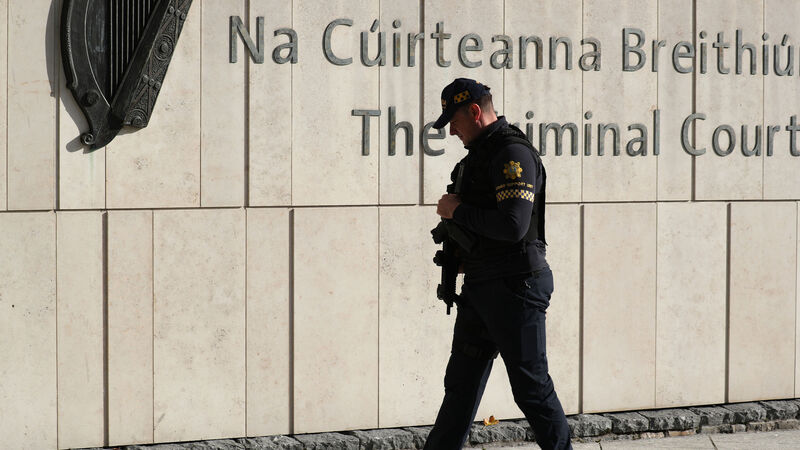
A member of the Garda Armed Support Unit provides added security at the Special Criminal Court where the trial of Gerry Hutch continues. Picture: Collins Courts
Brendan Grehan SC was incredulous.
Defending Gerry ‘the Monk’ Hutch, he cross-examined the former head of the gardaí’s covert National Surveillance Unit at great length last week over the destruction of records related to a tracking device put on Jonathan Dowdall’s Toyota Land Cruiser in early 2016.
In the prosecution’s case against Mr Hutch, it alleges the Monk was with the former Sinn Féin councillor on trips to and through Northern Ireland in the aftermath of David Byrne’s murder in the Regency Hotel on 5 February, 2016.
Mr Grehan last week said that he couldn’t understand how the records could’ve been destroyed “in good faith” and in accordance with the appropriate legislation. He called it a “real problem”.
By Monday morning, those records the court heard had been destroyed had shown up.
“If it appears what has been lost was now found, I will need just a little bit of time to consider matters,” Mr Grehan said.
He later asked the current head of the National Surveillance Unit, Detective Superintendent Eugene Lynch: “You previously made a statement and gave evidence to this court that this data was all gone. How could that happen?”
Mr Grehan also made reference to the defence team “banging on the desk” for weeks over records pertaining to the case.
For his part, Detective Superintendent Lynch told the court that members of the Garda National Cyber Crime Bureau were enlisted last week in an attempt to retrieve this data which the court heard had been destroyed.
These members first looked at the possibility of imaging the server that the data had been on, but they warned it could take weeks if not months to get the data. They then asked to examine the NSU’s equipment and began with seven computers that were securely stored and earmarked for destruction.
On the third, they found the data related to the tracker records of Mr Dowdall’s Land Cruiser. The senior garda said it was found on a machine that was scheduled to be destroyed.
Mr Grehan remained incredulous. “You got lucky on the third computer you looked at,” he said.
It was then he changed tactic and turned to what has been a key part of the defence’s case so far, and that is whether the gardaí used a tracker to detect the movements of Mr Dowdall and Mr Hutch while outside this jurisdiction in Northern Ireland.
Mr Grehan has already said that, if that was the case, then the defence’s case would be that was illegal.
Detective Superintendent Lynch, on numerous occasions, was clear that his members would not have tracked them in Northern Ireland.
Mr Grehan put it to him that once they crossed over the border, the tracker would still be working and that gardaí could have continued to track them. He also asked if it was the case that gardaí simply looked away from the screen when a person they were tracking entered the north.
“Nothing is stopping us [from tracking them],” Detective Superintendent Lynch said. “But we didn’t.” He said the PSNI was conducting surveillance separately of the pair in the North.
Mr Hutch’s defence counsel later asked Detective Superintendent Lynch directly if he would have destroyed the documents relating to the tracker, and the senior garda said he wouldn’t.
This was echoed by his superior officer, Assistant Commissioner of Crime and Security Orla McPartlin.
She ultimately signed off on the records’ destruction, but it was part of a long list given to her of 87 items due to be destroyed by then-NSU head former detective superintendent Ciaran Hoey as part of a routine “cleaning house”, as Mr Grehan referred to it.
Mr Grehan asked: “I take it, assistant commissioner, if you had the slightest inkling it had anything to do with this trial, you wouldn’t have ordered its destruction?”
Assistant commissioner McPartlin replied: “No, I would have requested it be retained.”
With hindsight, she was asked if perhaps the policy in this regard needed to be “tightened up a bit”. She said that a process to do just that was already under way.
And now, the tapes.
The court was expecting to begin hearing the recordings made of Jonathan Dowdall and Gerard Hutch on one of these trips up North.
There is 10 hours’ worth of these conversations and the court is set to hear all of it, and rule on the admissibility of this evidence afterwards.
Prosecuting counsel Sean Gillance SC has said these recordings are a “core” part of its case against Mr Hutch.
The discovery of the tracker data put paid to that happening on Monday.
Interjecting on his client’s behalf, Mr Grehan said Mr Hutch is “anxious his trial be in public as far as possible”, and went so far as to propose that the media would be at a “very significant disadvantage” if transcripts weren’t offered to them to indicate who was saying what on the tapes.
“I’d very scared to report that it is Jonathan Dowdall saying x and Gerard Hutch saying x,” he said. “We do have an interest in it being accurately reported.”
Ms Justice Tara Burns, meanwhile, indicated her keenness to get going with these tapes as soon as possible, given how long it will take to hear the 10 hours of evidence.
“It did strike me it will be a tiring process,” she said.
The case continues before the three-judge Special Criminal Court on Tuesday, with the tapes of the recordings made of Jonathan Dowdall and Gerard Hutch played in court for the first time.
CONNECT WITH US TODAY



Be the first to know the latest news and updates