Family of UDR man murdered by IRA in 1972 granted access to court file of trial allegedly linked to killing
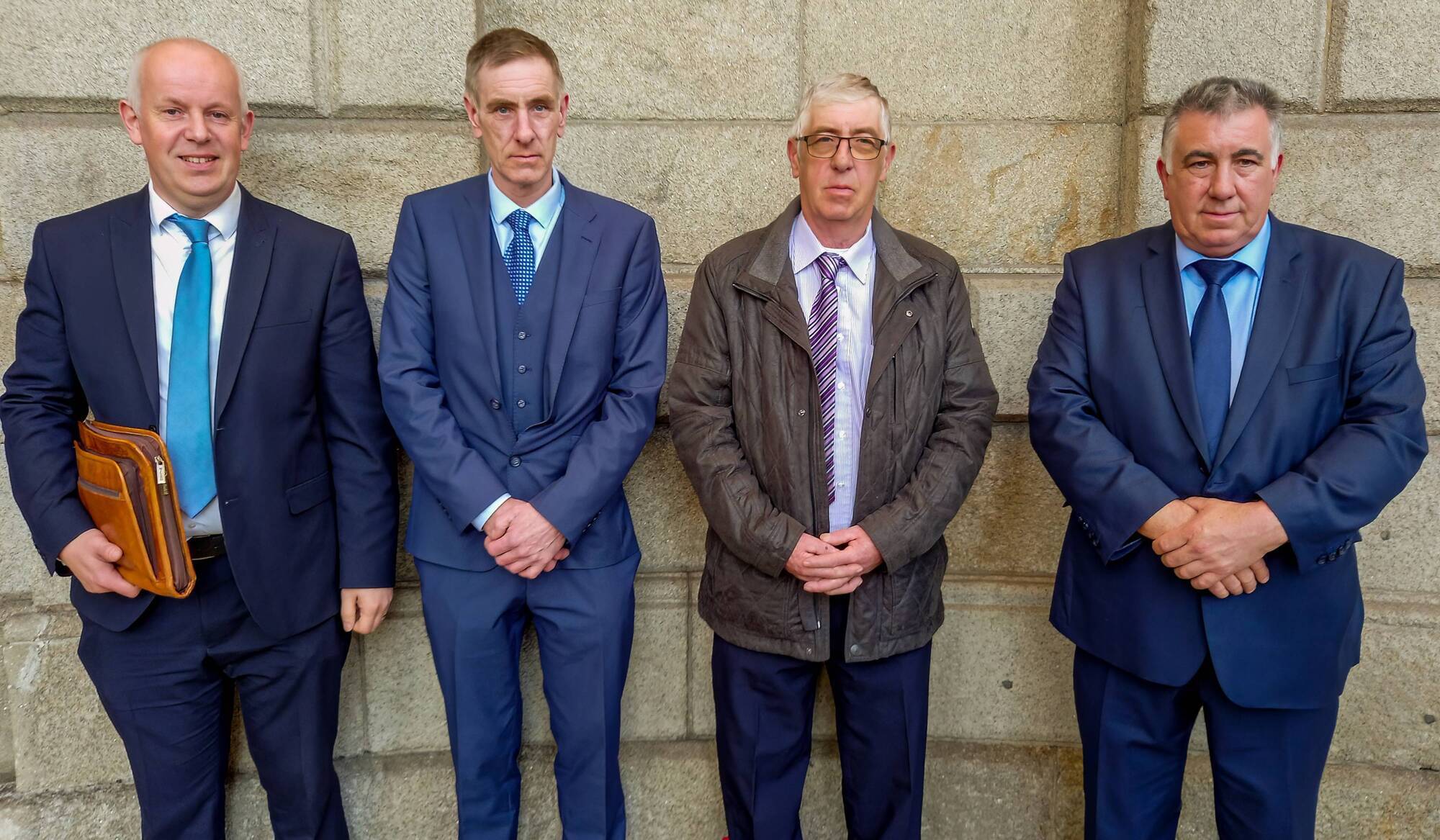
Jonathan Larner, liaison officer with Ulster Human Rights Watch, with Lester Elliott, Jim Elliott and Cyrill Elliott, whose father was murdered by the IRA in 1972, at the Four Courts on Tuesday. Picture: Aodhan O'Faolain
The President of the High Court has ordered that the family of a part-time member of the British security forces who was kidnapped, murdered, and his body booby trapped by the Provisional IRA over 50 years ago be provided with a court file of the trial of two men before the Special Criminal Court.
The order, in relation to a trial of two alleged IRA members that took place before the non-jury court in July 1972, was granted by Mr Justice David Barniville following an application on behalf of the family of Corporal James Elliott, who for decades have been seeking answers in respect of his murder.
The family claims the court file from the 1972 trial, which they say is connected with their father's death, may help them in their search for answers.
On April 17, 1972, James Elliott, a part-time corporal with the Ulster Defence Regiment, was working as truck driver doing delivery between Kingscourt, Co Cavan, and Warrenpoint, Co Down, when he was kidnapped at gunpoint by masked men near a border crossing at Newry.
He was held for 30 hours before being murdered, after being shot multiple times with a machine gun.
His body was left a few yards from the border at Mullaghduff, Altnamackin, Newtownhamilton, in Co Armagh. It was used as a lure by the IRA for a planned larger attack on British security forces.
Corporal Elliott's body was booby trapped and had been connected to a 500-600lbs of gelignite in steel containers in a culvert under the road.
Several 'Claymore' landmines were also placed near the site.
Following an operation that involved security forces on both sides of the border, his body was recovered after the explosives were removed and detonated at a nearby field.
The IRA later admitted it had killed Corp Elliott, who was from Rathfriland, Co Down. It claimed the married father of three sons had been killed while forcefully resisting abduction.
The family strongly dispute that, and say medical evidence is entirely inconsistent with the IRA's claim. Investigations into the kidnapping and killing were conducted on both sides of the border.
The family say nobody has ever been charged with Corp Elliott's murder.
Arising out of the Garda investigation of the incident in July 1972, two Co Monaghan men, described in court documents as being IRA members, Brendan Finnegan and Patrick Lynch, were convicted by the Special Criminal Court of conspiring to commit an explosion and for possessing explosives.
Finnegan was jailed for nine months while Lynch was jailed for 15 months.
It is claimed other charges, including conspiring to commit murder and attempted murder, were brought against the two men but were subsequently dropped.
The court heard the while the trial had occurred months after the killing, Corp Elliott's family were never informed about it and only discovered in 2005 that persons had been tried and convicted of offences they claim are linked to the murder and abduction.
Represented by Michael Lynn SC, one of the deceased's sons, Jim Elliott, applied to be provided with the Special Criminal Court's file on the case.
The family is unclear about issues surrounding the investigations into their father's death, and do not know why certain charges were dropped.
Obtaining these files will help their understanding to what happened to their father, and at the subsequent trial before the Special Criminal Court.
Access to the file was extremely important to the legacy process and commitments made by the Irish State in the 1998 Good Friday Agreement, the family say.
The proceedings were against the Special Criminal Court, the DPP, the Garda Commissioner, the Minister for Justice, Ireland, and the Attorney General were notice parties to the application.
Counsel said Finnegan. of Drummond, Inniskeen, Co Monaghan, was served with copies of Mr Elliott's proceedings.
Patrick, or Pat, Lynch who was also from Inniskeen, died over a decade ago.
He was described in an obituary published in the Irish republican newspaper in 2009, which was put before the court in support of the application, as being an active member of the IRA's South Armagh unit during the late 1960s and 70s, before taking a prominent role in Sinn Féin in his later years.
Counsel said it was an "unusual case" and the application was in respect of one of the first cases to come before the Special Criminal Court after that particular court was established.
His client's family, with the assistant of the NGO Ulster Human Rights Watch, have been looking for answers for a long time and had written letters to parties including political figures and senior gardaí seeking access to documents without any success.
Mr Lynn said his side, after much research by the Elliotts' legal team assisted by the voluntary organisation Ulster Human Rights Watch, believed the only way to obtain the material was to make an application to the High Court.
Mr Lynn said a statutory instrument was in place in Northern Ireland to help families seeks information form court held files on legacy issues arising out of the Troubles.
No such instrument was in place in this jurisdiction, but it was in the interest of transparency, and the justice that the family be given access to the Special Criminal Court file, counsel said.
Padraig Lyons SC, for the Courts Service, which has official charge of the file, said his side was not objecting to the application and said his client would comply with any directions made by the court in relation to the file.
James Geoghan, Bl for the commissioner, minister and the State respondents, said his clients were also not opposing the application.
Granting the application, Mr Justice Barniville expressed his sympathies to the Elliott family and described their father's murder as being "horrendous".
He directed the Elliotts' lawyers be given access to the original file, and that they also be provided with a copy of the file within the next seven days.
It was in the interests of justice that file be made available, the judge said.
The president agreed that it was an unusual and complex matter and praised the Elliotts' legal advisers, who he said had taken on the case under a voluntary scheme.
Outside court, Jim Elliott, accompanied by his brothers Cyrill and Lester, and Jonhathan Larner, a liaison officer Ulster Human Rights Watch, welcomed the court's decision to grant them access to the Special Criminal Court file.
He said he hoped the contents of the file would be the first step on the road to answering questions about their father's murder.
CONNECT WITH US TODAY



Be the first to know the latest news and updates