Charges dismissed against four defendants in golf society dinner trial
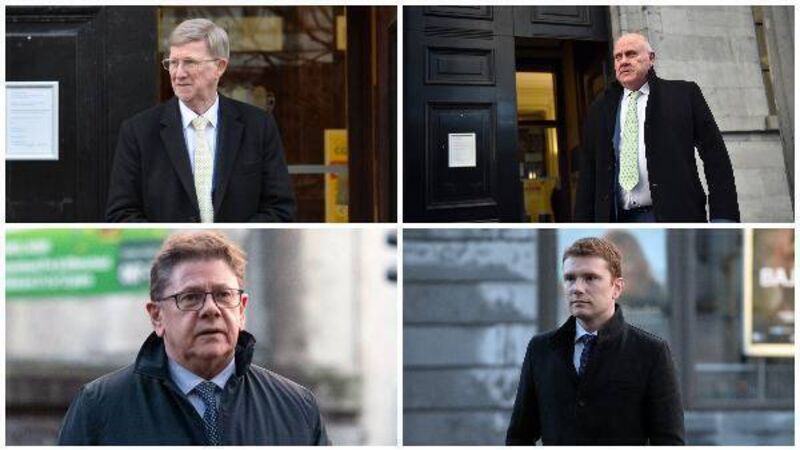
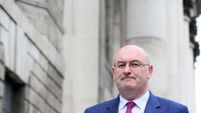
Pictured on the first day of the Golfgate trial were former Fianna Fáil senator Donie Cassidy, Independent TD Noel Grealish and hoteliers John Sweeney and James Sweeney.
Charges have been dismissed against four men accused in relation to an Oireachtas golf society event dinner in August 2020.
Galway East Independent TD Noel Grealish, 55, former Fianna Fail senator Donie Cassidy, 75, John Sweeney, 60, and his son James Sweeney, 32, who own the Station House Hotel, had been accused of illegally holding the event in August 2020.
All four had faced a single charge that they organised an event that contravened the Health Act 1947, as amended, to prevent, limit, minimise or slow the spread of Covid-19.
The alleged offence related to a dinner at the Station House Hotel in Clifden, Co Galway, which was attended by 81 people.
The event had sparked significant controversy in Ireland and the widespread public anger at the time was referenced on several occasions throughout the trial.
During three days of proceedings at Galway District Court, the court had heard from a range of witnesses including Supreme Court judge Seamus Woulfe, a former attorney general who was appointed to the Supreme Court in July 2020, a month before the controversy.
It also heard from a former barman, as well as Fine Gael Senator Jerry Buttimer, who resigned from his position as leas-cathaoirleach of the Seanad following the event.
On Thursday, Fianna Fail TD Dara Calleary was called to give evidence.
Speaking at the end of a three-day trial at Galway District Court, Judge Mary Fahy there had been a huge body of evidence presented to the court which showed that while there had been one golf outing, there had been two distinct areas in the hotel which catered for two groups.
“The regulations provided for 50, but in two distinct areas. We have to admit the evidence was most impressive, from Judge Woulfe and Mr Buttimer in particular - he was most impressive.
“They were all responsible people who would not have gone to a dinner unless they felt comfortable and unless the organisers had not put in place all that was required to make it safe.
“I’m satisfied the organisers did everything to comply - not in a court of public opinion - but in the court of law in my opinion.
“Unfortunately, very good people lost very good jobs and very good contracts and just to clarify, I didn’t make my decision based on that.
“I’m dismissing the charges against all four defendants,” Judge Fahy said.
Mr McDowell, who represented Mr Grealish during the course of the trial, told the court in his closing remarks that his client had no case to answer.
He said that Mr Grealish had no role in organising the dinner and that such a role would not fall to him as captain of the society.
He told the court that it was a “very serious matter” and that “nothing could be graver as an accusation”.
Mr Calleary had appeared briefly as a witness in the trial on Thursday.
The Fianna Fail TD resigned as Agriculture Minister in the wake of the controversy, after attending the event.
“It was very clear that every precaution was being taken in terms of Covid-19 guidelines,” he told the court.
He said that Mr John Sweeney had been greeting guests as they arrived, “which was reassuring”.
He said that he checked into the hotel and at the function, he was at a table of six in the corner of the room.
He said that staff went through the Covid-19 protocols at the table.
“It wasn’t a normal function”, he said, describing the space between tables.
He said he was “very conscious, in the room we were in, everything was very much compliant”.
Mr Calleary said that he estimated 45-46 people were in the room.
He recalled seeing “another space, on the far side of the partition” while he gave a speech at the event.
Asked by the prosecution how wide the partition was, he said it was “my width”.
He also said that the divide, or partition, “succeeded” in preventing mingling.
Later, Garda John O’Donovan, appearing as a someone who had attended the event, said that the gap was “slightly larger than a door”.
He told defence counsel that he felt “safe” at the event.
In the course of questioning, he also said: “I thought everybody was trying to do their best.” Thursday morning had been dominated by questions to Inspector Peter Conlon, who led the investigation.
Taking questions from the defence counsel, he rejected the suggestion that he leaked information to the media that two politicians were to be charged with breaching coronavirus regulations.
Mr Conlon was accused by Mr Colm Smyth, representing Mr Cassidy, of leaking details to Irish Independent journalists regarding a story on February 17 2021 that the defendants were set to be prosecuted in relation to the event.
Mr Smyth said that his had happened before the defendants had been formally notified themselves.
Mr Conlon had rejected the allegation in the strongest terms.
He told the court that he was not aware of the Irish Independent article.
Mr Conlon said that all four men had been contacted by phone at the exactly the same time regarding the fact they were to be prosecuted He said that call was made on either February 16 or February 17 2021.
Taking questions later from Mr McDowell, he put to Mr Conlon that the present court case would not have happened had the event been organised in “two different rooms and with a partition”.
“The air was circulating from one room to another, so it would be my assertion that yes it was one room,” Mr Conlon had said during questions from Mr McDowell.
At the outset of proceedings on Thursday, the Director of Public Prosecutions was accused by defence counsel Eddie Walsh, representing John Sweeney, of acting like a “separate state”, in a back-and-forth between the prosecution and defence over the acceptance of Government Covid-19 guidelines as formal evidence by the court.
Eoghan Cole, the prosecution counsel, had said that he would accept the use of the Failte Ireland Covid-19 guidelines as a defence exhibit.
Mr Walsh said that the attitude of the prosecution towards the guidelines is “devoid of reality”.
“For the DPP to seek to ignore the Government of Ireland is outrageous.
“Is the DPP a separate state? Is the DPP ignoring the Government of Ireland?” The prosecution robustly rejected that accusations in court on Thursday and said that the DPP was independent of the Government.
It also transpired during the course of proceedings that no CCTV was provided to gardaí investigating the incident.
There was, the court heard, no legal basis for Irish police to be provided with the CCTV footage in this case.
The court also heard that there was no CCTV of the function room in question.


CONNECT WITH US TODAY



Be the first to know the latest news and updates