'Sad and tragic case': Jury in Deirdre Morley trial to consider verdict on Thursday
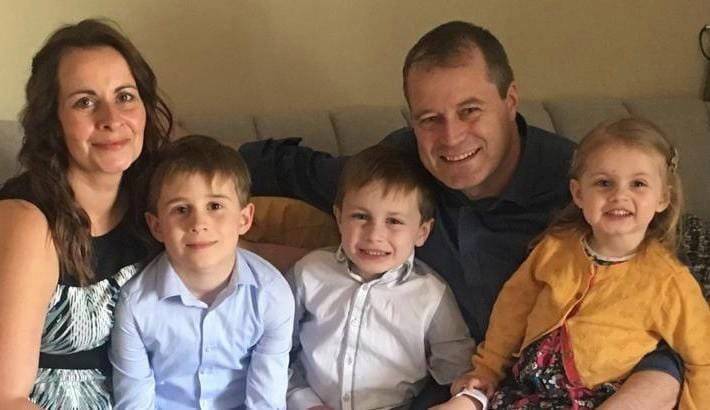
Deirdre Morley, 43, and Andrew McGinley with their three children, nine-year-old Conor (second left), seven-year-old Darragh (centre) and three-year-old Carla (far right).Â
The jury in the trial of Deirdre Morley, accused of murdering her three young children in their family home, will return to the Central Criminal Court tomorrow morning to consider its verdict.
The jury of 10 men and two women deliberated for one and a half hours this evening before telling the judge that they wanted more clarity on what constituted an insanity verdict. They chose to resume their deliberations on Thursday
The jury also asked the judge if they must bring in the same verdict for all three children. Justice Paul Coffey said that no, they did not because each case was separate.Â
Deirdre Morley, 44, is charged with murdering her three children, Conor McGinley, 9, Darragh McGinley, 7, and Carla McGinley, 3, at their home in Parsonâs Court, Newcastle, Co Dublin, on January 24, 2020.Â
She has pleaded not guilty by reason of insanity.
The children's father, Andrew McGinley, found their bodies when he returned from a work trip to Cork hours after the killings.Â
Mr Justice Paul Coffey said that in this "sad and tragic" case there was "no contest" about what the verdict should be.Â
Forensic psychiatrists for both the prosecution and the defence agreed that Ms Morley was "insane" at the time of the killings.Â
"The intention to kill is where the battleground lies in this case," he said.Â
He said that a murder conviction was impossible unless the jury did not accept the professional psychiatric reports which found that Ms Morley was suffering a mental disorder at the time of the killings.
Deterioration in mental health
The Central Criminal Court heard how Ms Morley's mental health had deteriorated over a number of years, with symptoms becoming "severe" in the months before the deaths.Â
She was diagnosed at various points with depressive illnesses and later with bi-polar affective disorder.
The court heard Ms Morley satisfied the criteria necessary to prove that she was insane at the time of the killings under the Criminal Law (Insanity) Act 2006.
Although the court heard that she did know what she was doing when killing her children, she believed that she was saving her children from a life of pain caused by her mental illness, which she believed she had passed on to them.
Dr Brenda Wright, consultant psychiatrist, said the mental health difficulties suffered by Ms Morley had developed into a major depressive disorder by the time she smothered her children to death.
Dr Wright said it is her view that Ms Morley "has a mental disorder" as defined in the Criminal Law Act.
Ms Morley did not know what she was doing was wrong, the court heard. And she had no capacity to stop herself from carrying out the killings, the court heard.
âI just wish I could go back in time. I just felt they had no other options," Ms Morley said.
âI wish I had a time machine."
Ms Morley first reported mental health difficulties after moving to Cork to study nursing in 1996.
She said she was âvery homesickâ but her mental health improved when she settled in Cork and made friends.
The court heard testimonies from forensic psychiatrists Dr Wright and Dr Mary Davoren that her mental health deteriorated over the years.
Ms Morley, who the court heard was diagnosed with bipolar affective disorder, was first prescribed anti-depressant medications in October 2018.

The court heard she was plagued with concerns about her children, that she wasnât a good enough mother, and that her imagined sub-standard parenting had irreparably damaged them. She worried about work and that she wasnât a good enough wife.
In 2018, she said that she âwasnât able to enjoy anythingâ. She was sleeping in the day and she dropped 10 pounds in six weeks. The court heard she reported feeling unwell and that she had suffered greatly from the death of a young patient in her work as a paediatric nurse.
On July 6, 2019, she was admitted to St Patrickâs psychiatric hospital with the symptoms of a depressive illness including low mood, excessive guilt, low self-worth, disturbed sleep and low appetite.
On January 10, 2020, she visited her GP for a sick cert for work. She said that she felt somewhat over-sedated and denied suicidal ideation. Her anti-depressant medication was reduced.
Remembering her mental state, Ms Morley said in interviews read to the court: âI wanted to evaporate for a long time. Iâm not sure when it became more definitive.âÂ
But she thought that she couldnât leave her children, she said.
âI had to go. I couldnât not take them with me.
âIâd ruined them with my mental illness.
âI thought they were doomed.âÂ
She said that she believed her children would never be secure in life.
She decided to âtake them out of their future misery.â She said that she now wished she considered an alternative.
The court heard that Ms Morley had displayed symptoms of a severe depressive illness with psychotic episodes.
Dr Wright said: "At the time of the alleged offences, Ms Morley was suffering from a mental disorder.
"She knew her acts would result in the death of her three children."
But as a result of her mental disorder, she did not know that her actions were wrong, Dr Wright said.
As part of her psychotic state, she believed that her actions were morally right. She believed that she had irreparably damaged her children and she believed that she had to end their lives.
Dr Davoren said that Ms Morley was "not guilty by reason of insanity".
She said that she was suffering a mental disorder, a "clear depressive episode" at the time of the killings.
Ms Lawlor said that for someone to be deemed not guilty by reason of insanity it must be established that they were suffering a mental disorder at the time. This had been established by both psychiatrists.
It must also be established that they fulfilled at least one of three criteria under the Criminal Law (Insanity) Act 2006 - that they did not know the nature or quality of the act; that they did not know what they were doing was wrong; and that they were unable to refrain from committing the acts.
Dr Davoren said that Ms Morely satisfied two of these three criteria.
Ms Morley did appear to know that she was killing her children because she checked their pulses to see if they were dead, she said.
"It is clear that she did know that she was killing her children," Dr Davoren said.
But Dr Davoren said that she "lacked the ability to appreciate the true nature of the situation" which impaired her ability to appreciate what she was doing was wrong.
She also lacked the ability to refrain from committing the act due to her depressive illness, Dr Davoren said.
Senior Counsel for Ms Morley, Micheal Bowman, said both psychiatrists were in agreement that Ms Morley was not guilty by reason of insanity.
"I submit to you..that that is the only verdict," he said to the jury.
Justice Paul Coffey, also addressing the jury, said that it was a "tragic case".
"The intention to kill is where the battle ground lies in this case," he said.
He said that a murder conviction was impossible unless they also rejected the defence of insanity.
The jury has retired to consider its verdict.