Ambulance services ‘at breaking point’, Dáil told amid strike action
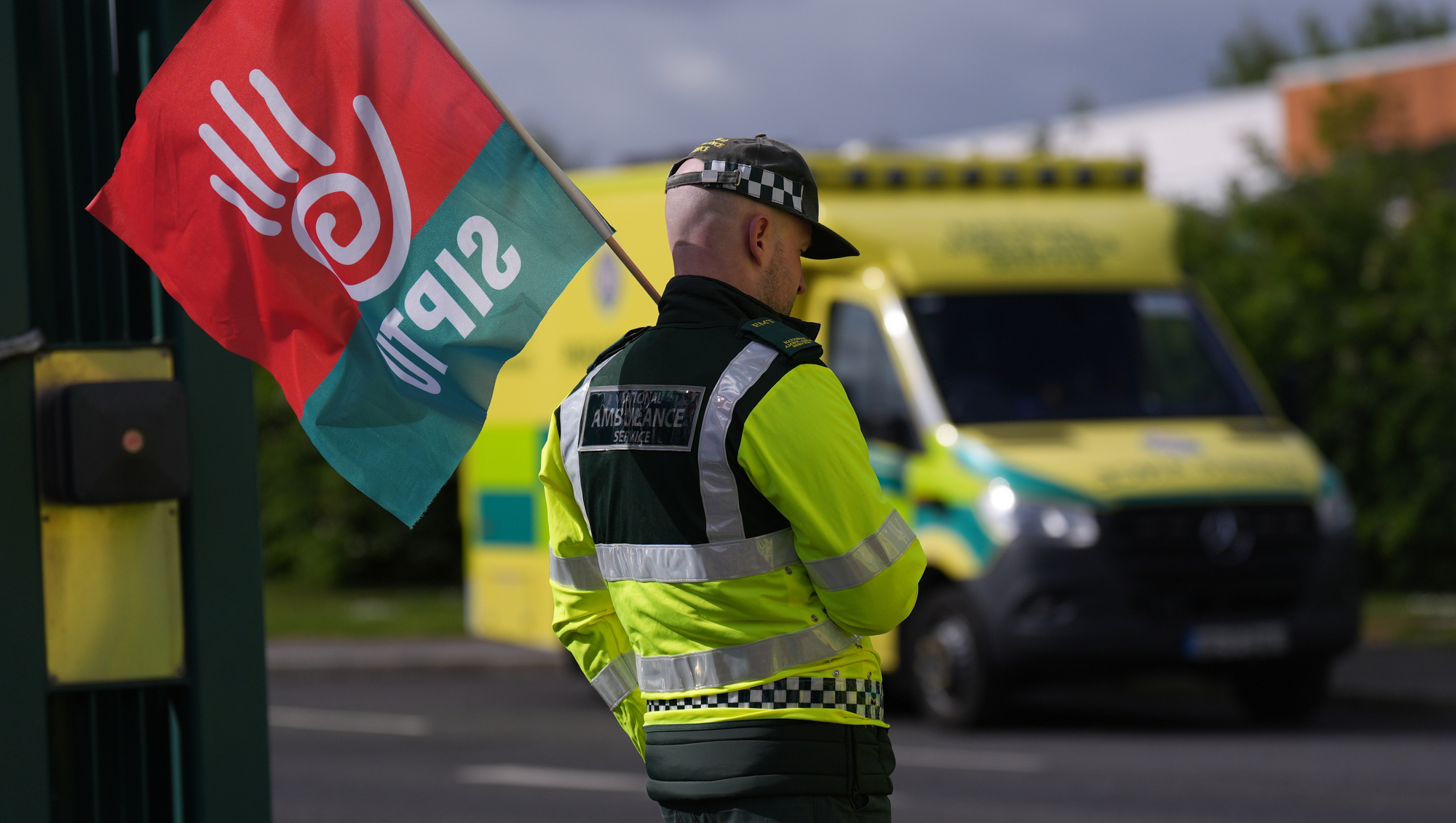
Members of Siptu and Unite unions on the picket line outside National Ambulance Service depot in Dublin South Central (Niall Carson/PA)
The Government has refused to resolve long-standing pay, conditions and staffing issues in the National Ambulance Service, the leader of Sinn Féin has said.
The coalition came under similar charges from other opposition parties during Tuesday’s Leaders’ Questions session which largely focused on the strike by Siptu and Unite paramedics and emergency medical technicians within the NAS.
They initiated a 24-hour work stoppage at 8am, although workers continued to leave picket lines to respond to life-threatening incidents.
Sinn Féin leader Mary Lou McDonald said the Government has “left the ambulance system stretched to breaking point” with “overworked paramedics under extreme pressure”.
Read More
Speaking during Leaders’ Questions in the Dáil, Ms McDonald told the Taoiseach the work stoppage could have been avoided but accused him of letting the situation “fester” since a 2020 independent report recommendation of modernisation of ambulance services.
She said: “People who save lives are on the picket line.”
Ms McDonald also criticised health minister Jennifer Carroll MacNeill for a “failure to intervene”.

She said: “Indeed, yesterday, at a meeting in Clare, the minister shocked people when she referred to paramedics and EMTs as ‘ambulance drivers’.
“And there’s the problem. In a nutshell, your Government is blind to the expertise and skill of those who save lives every day.
“You ask ambulance workers to upskill and then refuse to pay for it properly.”
The Taoiseach characterised the contribution as “distortion” and “very dishonest” presentation of the paramedic strike.
He told the Sinn Féin leader: “Surely you realise that the HSE has been engaged with the trade unions for quite some time on this issue.”

Mr Martin said the State has invested “very significantly” in the NAS.
He said negotiations had arrived at an agreed outcome that was recommended to the membership by unions, but added he accepted that members had been entitled to vote against it.
The Taoiseach said the only way to resolve the dispute was through dialogue and “exhausting the well-established industrial relations machinery of the State”, namely the Workplace Relations Commission or the Labour Court.
Micheál Martin said a package for ambulance staff was agreed and recommended by representative bodies and told the Dáil that the HSE remains willing to engage with unions.
Responding to Social Democrats leader Holly Cairns Mr Martin ruled out any direct involvement from the Minister for Health.
"We've long gone from the day when there's a ministerial intervention in every single dispute," he said, adding that disputes must be resolved through the industrial resolutions process of the WRC.
However, describing Ms McDonald's description of the dispute a "very dishonest portrayal and presentation of the situation", Mr Martin said the HSE has been engaged with the trade unions for quite some time on the issue and the State has invested "very significantly" in the ambulance service over the past two decades.
He said there had been a 41% increase in investment in the service in recent years.
Labour leader Ivana Bacik said ambulance drivers and paramedics are struggling “to make ends meet on their current pay rates”.
Ms Bacik told the Dáil that the NAS “cannot recruit or retain the staff they need” and said: “Crews are being asked to provide increasingly complex care under relentless pressure – unfair, and above all, unsafe.

“They have my solidarity and that of my Labour party colleagues today.”
Social Democrats leader Holly Cairns said successive Governments had not acknowledged the upskilling within the NAS from “essentially being a patient-transfer service to providing what is nearly A&E-style services”.
She said she had spoken to paramedics who went on a picket line after finishing a 12-hour shift.
Also speaking during Leaders’ Questions, she said: “These are workers who go above and beyond to do the most important work, who even volunteer after they finish work to provide that crucial emergency care.
“They spoke about how much they had to upskill over the years so they can provide better and faster treatment to patients and how the evolving nature of their role has not been recognised by this or any previous Government.”
Ms Cairns said years of underfunding and understaffing had led to hours-long delays in the ambulance service.
She said personnel numbers need to be doubled and said “stretched” services are having “very serious consequences for patients”.
Ms Cairns called on the Government to drop pre-conditions around its pay proposal.
She said workers had been asked to accept there would be a reduction in the number of trained paramedics in a crew – and because of the conditions around overtime, that some of their pay might be decreased.
Earlier, People Before Profit leader Richard Boyd Barrett accused the Government and the HSE of a “disgraceful failure” to acknowledge the “completely justified” demands of striking paramedics.

He told reporters at Leinster House: “The responsibility for the industrial action they were forced to take lies absolutely squarely at the door of the Government and the HSE.”
However, the Taoiseach as said “no one can charge Government with acting in bad faith” over the ambulance strike.
Responding to Ms Bacik in the Dáil, Mr Martin said the Government had entered into “good faith negotiations” but a “comprehensive outcome” recommended to union members had been defeated.
Calling for a return to dialogue, he said: “We acted in good faith, and will continue to act in good faith.”
Domhnaill Joyce, emergency medicine technician and Siptu rep with the National Ambulance Service, was protesting on Tuesday at the biggest base in the country in south Dublin.
“We’ve a lot of people here, we maintained basic cover at 46% of people on so there’s cover throughout the service,” he said.
He disagreed with comments by the National Ambulance Service that people might have to drive themselves to hospital or miss out on care.
“We probably have half the number of vehicles on the road that we should have anyway, half the number of vehicles and half the number of staff,” he said.
“So by the HSE’s own argument, there are shortfalls in relation to the service itself.”
The new €2.2bn children’s hospital will open just up the road from this ambulance base but he said: “the people who are going to be bringing patients into that hospital have just been disregarded by the HSE.”
Paramedics feel, he said: “we’ve just been left behind.”
Siptu has called for the HSE to drop its ask for pre-agreement on changes in work practices before talks in order for discussions to resume on these issues.
A key issue is plans to consolidate allowances and change how extra payments are made as part of the pay deal.
“So the money they would have given us they would have taken back by taking the allowances away,” he said.
This has all left paramedics “utterly frustrated” he said.
Saying people are “dedicated to their work”, he also knows paramedics leaving to work in the prison service and An Garda Siochana.
“I know one person who was an advanced paramedic and he actually left and went to drive a train because the conditions were better. So you lose that skill and experience, that can’t be replaced,” he told the
CONNECT WITH US TODAY



Be the first to know the latest news and updates