Extreme heat and drought threatening world's food systems
Extreme heat and drought threatening world's food systems

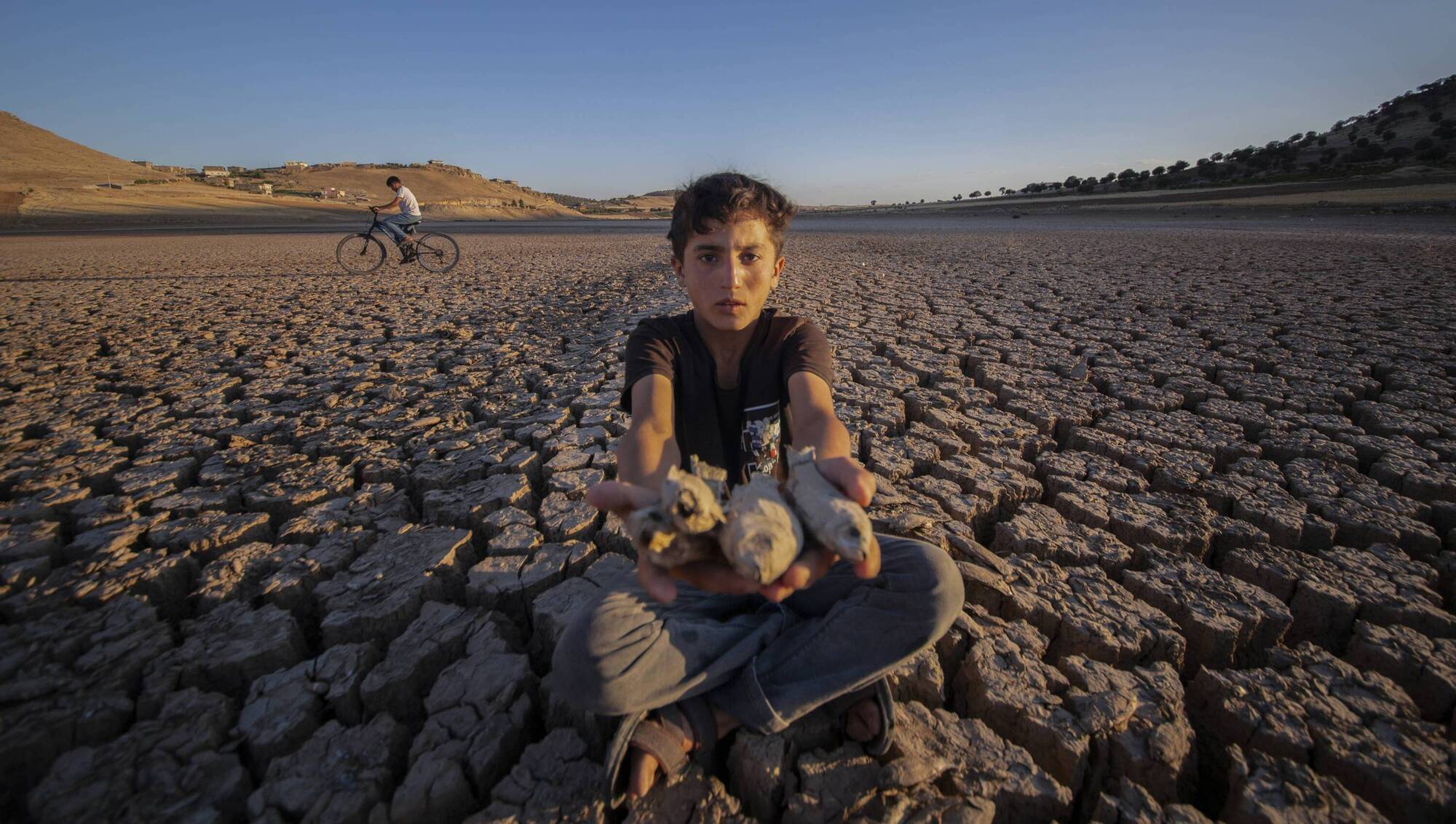
Dead fish on a dried up pond in Mardin, Turkey in July 2025. As temperatures exceeded 40C, leaks at the bottom of the pond caused the water level to drop rapidly. Picture: Mustafa Kilic/Getty

Extreme heat is threatening the world’s food systems, with farmers unable to work outside, livestock experiencing stress, and crop yields falling, putting livelihoods for more than a billion people in peril, the UN has warned. 

The impact globally will be felt here in Ireland.

Experts said food supply in some areas is being “pushed to the brink” by increasingly common and severe heatwaves, on land and at sea, in a major report written jointly by the Food and Agriculture Organization and the World Meteorological Organization.

Farmers could find it impossible to work safely for as many as 250 days of the year — more than two thirds of the time — in already hot regions including much of India and South Asia, tropical sub-Saharan Africa, and swathes of Central and South America.

Livestock are already experiencing an increase in mortality rates, as heat stress begins for common species at about 25C.

Extreme heat reduces yields from dairy cows and cuts the fat and protein content of milk. Pigs and chickens are unable to sweat and, as temperatures rise, face digestive tract breakdowns, organ failure,  and cardiovascular shock.

The Grugni farm in Cervignano d'Adda, about 20km south of Milan, where modern stalls   improve ventilation and mitigate the heat for cattle. The 2025 heatwave in Italy caused a significant drop in milk production, decreasing outputs by 10% on average, with some farms reporting up to 15% reduction. Picture: Michele Luigi Edoardo Novaga/Getty

Yields begin to decline at temperatures above 30C for most agricultural crops, with damage including weakened cell walls and the production of toxins. The yields of maize in some areas have declined by about 10%. Wheat has fallen by nearly as much, and is projected to decline further as temperatures rise to more than 1.5C above pre-industrial levels.

Ocean heatwaves are also killing fish, as heat reduces the level of dissolved oxygen in the water, leading to mass decline in populations.

Much more could be done to warn farmers, as heatwaves are often predictable, according to the report published on Wednesday.

Weather forecasts and mobile communications could be used to alert farmers when extreme weather is expected.

Severe drought  devastated sunflower fields in Bougé-Chambalud, France in 2025. Despite their resilience to heat, the crops withered under relentless conditions. Picture: Romain Doucelin/Getty

Richard Waite, director of agriculture initiatives at the World Resources Institute think tank, who was not involved in the report, said it was crucial to start adapting to rising temperatures now, by giving farmers the tools, knowhow, and early warnings to help them anticipate and protect against extreme weather.

“Without adaptation, extreme heat will cut crop and livestock yields, forcing more land into agriculture to maintain food production. That would drive even higher emissions from land use change, which in turn would make climate impacts on agriculture even worse,” he said.

“What’s needed is the opposite: Scaling solutions that help farmers maintain and sustainably increase productivity, even in a changing climate, so we can break that vicious cycle rather than reinforce it.” 

Tim Lang, emeritus professor of food policy at the University of London, said that though the worst effects would be felt in already hot countries, temperate regions and developed countries could not ignore the impacts. 

“The acceleration of climate uncertainties poses dire challenges for food growers worldwide,” he said, adding Ireland and Britain are not immune to the effects.

“Places we’ve got food from will dry up. Land use here will be changed. Water dependencies are exposed. Crops that started off well will fail to thrive. Productivity will be disrupted. Regular patterns of growing and consuming will be forced to change. Anyone who thinks climate change won’t affect us should think again.” 

  • Guardian

CLIMATE & SUSTAINABILITY HUB

More in this section

Lunchtime News

Newsletter

Get a lunch briefing straight to your inbox at noon daily. Also be the first to know with our occasional Breaking News emails.

Cookie Policy Privacy Policy Brand Safety FAQ Help Contact Us Terms and Conditions

© Examiner Echo Group Limited