Forecourts could run out of fuel 'as early as Thursday' due to blockades at Whitegate, Foynes and Galway terminals
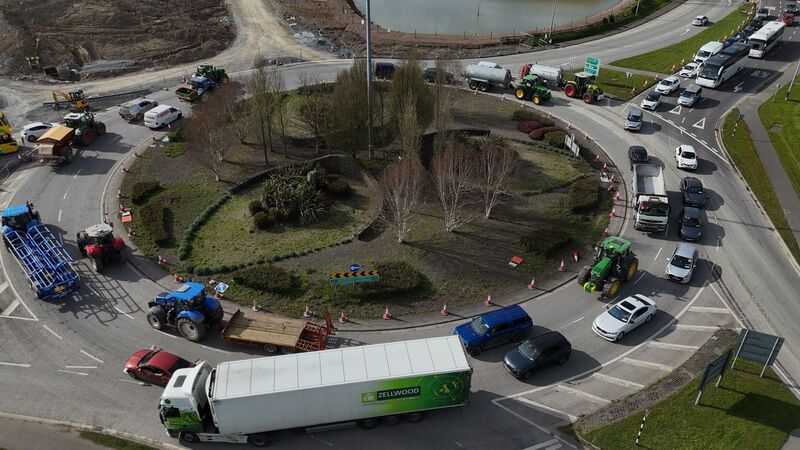
National Fuel Protest at Shannonpark Roundabout Cork on the N28. Picture: Larry Cummins
Forecourts around the country could run out of petrol and diesel as early as Thursday because terminals in Cork, Galway and Limerick are being blocked by protestors, Fuels for Ireland has warned.
Its chief executive Kevin McPartlan told the Irish Examiner the blocking of the Whitegate oil refinery in Cork, as well as two depots in Galway and Foynes has “locked up” 50% of the country’s fuel.
“The consequences of this are very grave. We will have forecourts running out of fuel,” Mr McPartlan warned.
Blockages at the Whitegate refinery in Cork could lead to the city’s busier forecourts struggling to meet demand, he said.
He raised concerns about the blockading of the Whitegate refinery, saying there is currently no access for emergency service vehicles onto the site in case of an emergency.
Mr McPartlan questioned why Gardaí have not acted to prevent the closure of key fuel depots.
Mr McPartlan said he is aware of some forecourts who have already run out of fuel, warning this could become exacerbated if fuel supplies are not unblocked.
While he said he sympathised with the protesters over the impact on their businesses, Mr McPartlan said they were not taking the correct “tactical approach” and urged them to reconsider.
Protesters have caused gridlock for commuters in Cork, Dublin and other counties amid rising fuel costs linked to the war in Iran.
Gardaí say slow-moving convoys and blockades are affecting traffic on major routes, while fuel depots in Cork, Limerick and Galway remain obstructed.
Protesters blocked the entry to Irving Oil Whitegate in east Cork, which has the capacity to produce 75,000 barrels of oil per day.
This is equivalent to 40% of Ireland’s fuel needs.
Four tractors and three trucks have blockaded the main entrance to the refinery, with a tractor separately blocking a second entrance.
Anthony Kelleher, a protest organiser, said that no petrol tankers will be allowed through and they will stay "for as long as it takes."
Further protests are expected on Thursday morning.
Read More
In Cork, several trucks have blocked the Shannonpark Roundabout in Ringaskiddy.
Gardaí advised the Port of Cork that protests would resume today at 4pm, starting from the roundabout outside Carrigaline and are "expected to cause significant traffic delays in the Ringaskiddy area".
Pharmaceutical companies in Ringaskiddy, which employ some 7,250 people, say they are being seriously impacted and are pleading with politicians and Gardaí to intervene, local councillor Jack White said.
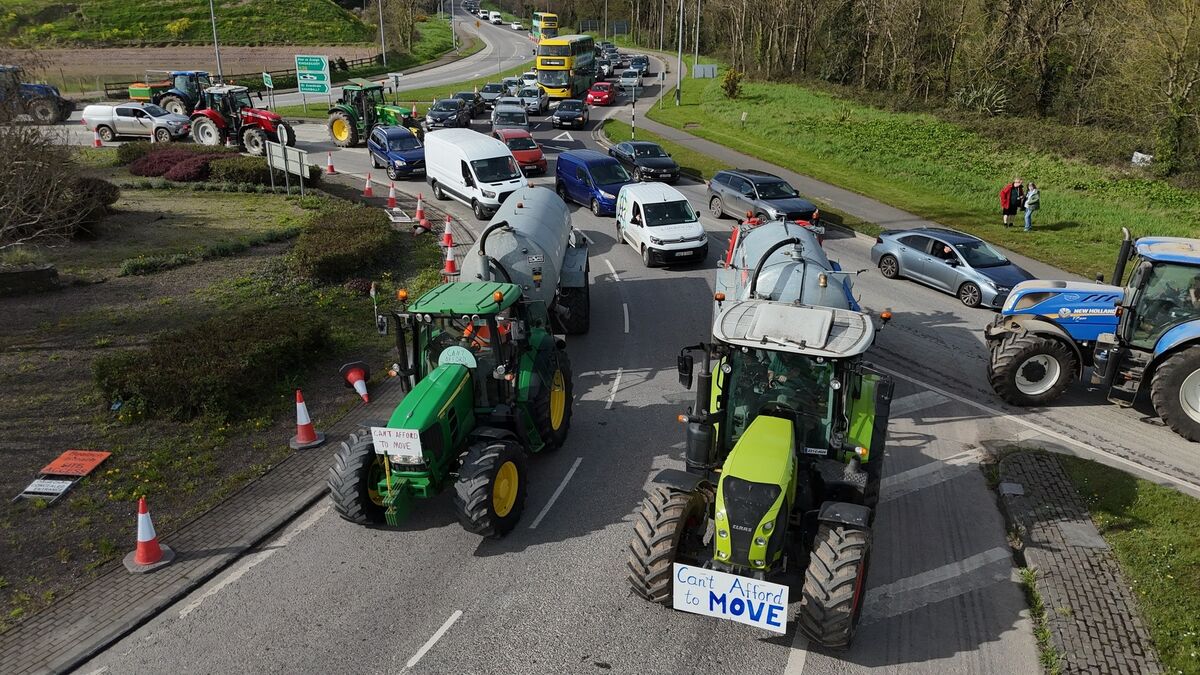
The blockade at the Shannonpark Roundabout limits access to major industry in Ringaskiddy, Port of Cork facilities, the National Maritime College of Ireland, the Island Crematorium, and Haulbowline naval base.
However, local residents will be allowed access along the shared road and people will be permitted to leave the site, Mr Kelleher told .
A Cork participant in the ongoing fuel protest has said motorists are expected to face continued delays tomorrow[/url[ if talks are not had with members of government.
Agricultural equipment supplier, Dave Mulcahy, who was among protestors on the M8 this morning, told the that while there is “a lot of support for us out there, people are getting frustrated”.
“There are people who don’t understand the whole thing - we had a few hand gestures out the window - but it went well,” said Mr Mulcahy.
“Traffic was never stopped on the motorway; wheels kept rolling, emergency routes were kept open, and cars were able to pass us.
“We’ll see what happens now, if there’ll be talks – but if not, we’ll be back out again.”
In Dublin, several tractors were parked along O’Connell Street, and buses were seen abandoned on O’Connell Bridge as farmers and other fuel-dependent workers blocked the main road for the second day in a row.
Lines of buses were parked along city streets, while some of the busiest thoroughfares were left empty.
There were some tense exchanges between Dubliners walking through the city’s main thoroughfare and the protesters, with one woman telling the protesters that they had the fuel to drive up to Dublin so they should drive home.
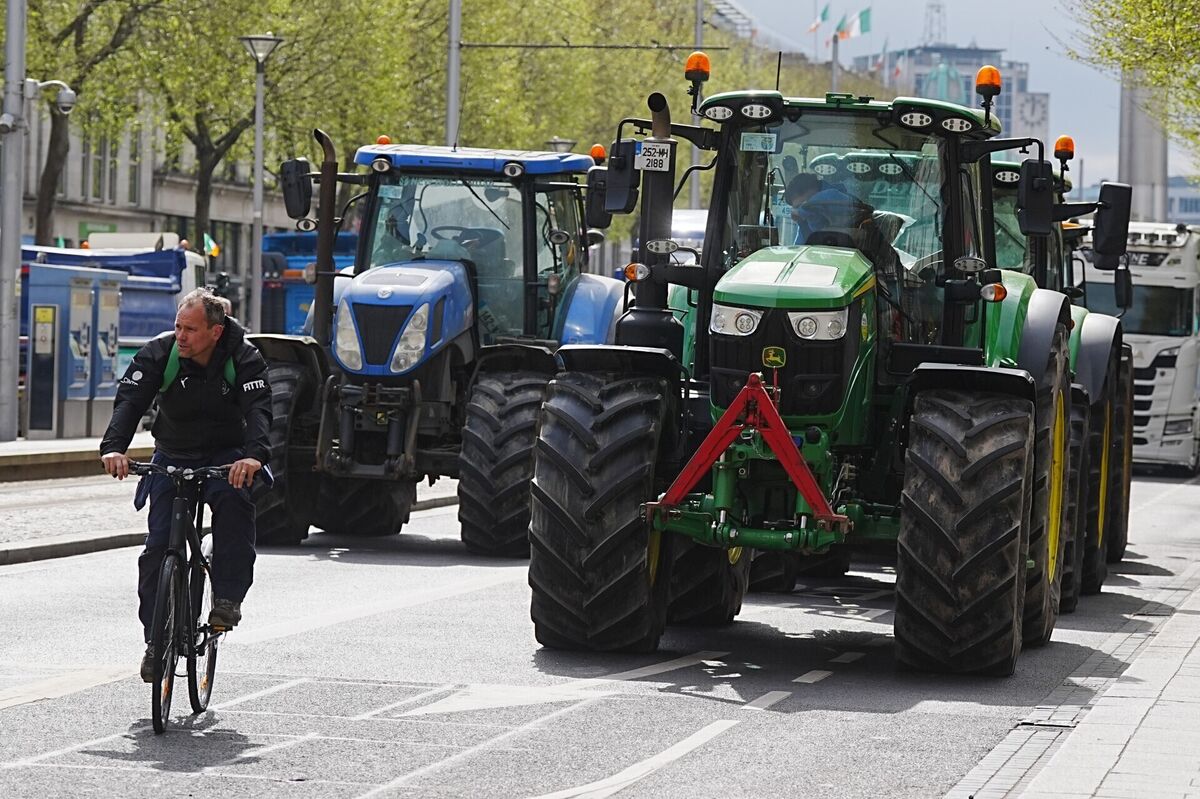
Gardaí say the protests are also impacting traffic on a number of major roads such as the M7 and N18 in Limerick, the M50 North in Dublin, the N6 at Athlone, the M8 at Cashel, the M18 at Ennis, the N52 at Tullamore and the M7 at Portlaoise.
A spokesperson for the protest group in Dublin said that if protesters went home later or on Thursday, they would be back next Tuesday, when the Dail returned.
“We will hopefully go home, but the word from other groups around the country is that if they go home today or tomorrow, they’re back next Tuesday. Government is sitting next Tuesday,” James Geoghegan said.
“We came up broke and there’s no point going home broke.” Asked about Dubliners who may be unhappy with the disruption, he said “the price of fuel is costing lives”.
He said: “They might be struggling, but do they realise what a struggle actually really is?
“We’re not blocking emergency services, we’re not blocking people going to hospital appointments or anything.
“We don’t want to be in anybody’s way or cause any trouble to anybody medically or cause an issue.” He said the measures taken by the Government in March did not make a difference “worth talking about”.
“We need (the Government) to listen and act. There’s no point making a promise. Where do we cash in a promise?” he said.
Taoiseach Micheál Martin, Tánaiste Simon Harris and junior minister Seán Canney held a “wide-ranging discussion with the IRHA, including the pressures being faced by hauliers due to high costs”.
“The leaders confirmed the Government will continue to engage with the IRHA on the impact of the ongoing war on the cost of fuel,” the statement reads.
“The discussions were constructive and form part of a series of meetings between the industry and Government.”
It adds that there will be continued engagement with national representative organisations to “keep the situation under review”.
However, a spokesperson for the Tánaiste reiterated there are no plans to meet with protest organisers.
“Taoiseach and Tánaiste made it very clear they meet with national representative bodies,” the spokesperson said.
Justice minister Jim O’Callaghan met senior Gardaí responsible for policing the protests and warned about “consequences for unlawful activity”.
In a statement, he said the Government was aware of the pressures caused by rising costs, but emphasised that it was essential for ports and fuel depots to remain accessible.
He said: “Democracy cannot be dictated to by an unelected group whose actions are now damaging the Irish public.
“No-one is above the law and those breaking the law should know that there are consequences for unlawful activity.”
Dublin Fire Brigade, which is responsible for fire and ambulance services in the capital, has appealed to protesters to allow passage for emergency vehicles.
“Earlier this morning Dublin Fire Brigade experienced significant delays in their response to emergencies, particularly mobilising from Townsend Street HQ. Alternative mobilisation routes are being employed, with the use of empty Luas lines,” the Dublin Fire Brigade said in a post on Facebook.
“The situation has eased somewhat, due to the excellent cooperation with An Garda Siochana, liaising with protesters and clearing routes for our vehicles.
“We continue to work with the other emergency services to ensure operational readiness and emergency access, and we ask all involved to be extra vigilant and compliant when they hear emergency sirens approaching.”
An Garda Síochána released a statement saying it is engaging with protesters. While demonstrations have been peaceful, it has received reports of emergency workers being delayed or unable to travel to work, and of people missing hospital appointments.
“Key public transport routes are also delayed or not operating, which means that employees and businesses are heavily impacted,” the statement said.
“A small number of fuel depots are also being blocked.
“While An Garda Siochana respects and facilitates the right to peaceful protest, An Garda Siochana must also balance and protect the rights of individuals to travel freely and commercial organisations to conduct business. An Garda Siochana has asked and asks again for protesters to engage with Gardai locally to facilitate public transport and other traffic.
“An Garda Siochana has also received reports of the blocking of diversion routes put in place to facilitate travel around protests. Again, An Garda Siochana is requesting that protesters engage with Gardai locally to facilitate important diversion and emergency routes.”


CONNECT WITH US TODAY



Be the first to know the latest news and updates