ASTI calls for pause to Leaving Cert laboratory projects on health and safety grounds
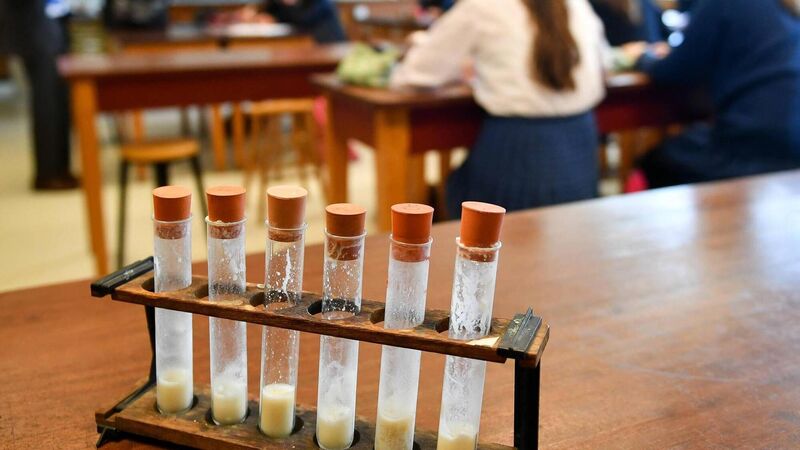
Laboratory investigations form a crucial part of the additional assessment component aspect of the Leaving Certificate. File picture: Ben Birchall
The main secondary school teaching union has called on the Department of Education to “urgently take steps” to pause laboratory projects for Leaving Certificate subjects on health and safety grounds.
Delegates at the Association of Secondary Teachers in Ireland (ASTI) annual convention in Wexford voted on an emergency motion calling for the department to “fully implement” a recommendation that lab-based investigations be “paused immediately” due to requisite conditions not being present in all schools.
Those conditions include adequate levels of equipment and storage space, training for teachers in how to administer those investigations, and the presence of expert laboratory technicians to make sure the working space is safe.
The emergency motion, which was not included in motions distributed in advance by the ASTI, was carried unanimously.
Laboratory investigations form a crucial part of the additional assessment component (AAC) aspect of the Leaving Certificate, introduced by the department as part of its overhaul of the senior cycle curriculum.
AACs count for 40% of each Leaving Certificate student's final grade in the subjects that have been revamped to date — chemistry, physics, biology, and business.
However, AACs have come in for criticism from teachers for myriad reasons, from the lack of available supplies to the impact of artificial intelligence (AI), which educators fear could be used by students without teachers being able to flag it.
Teachers have called for the AAC to be trialled before being fully implemented, which was initially envisaged by the Department of Education, before a decision to instead accelerate the process.
The motion introduced by the ASTI was inspired by the first recommendation of a report prepared by professor of education at Brunel University in London, Mike Watts, last February, commissioned by the Irish Science Teachers’ Association.
That report found that 70% of the teachers surveyed by the author said they do not feel qualified to perform risk assessments for laboratory conditions.
It further found that 97% of those asked said they had received no training on the health and safety implications of supervising an AAC at Leaving Certificate level.
“Risk assessment is not optional in that work; it’s fundamental,” Adrienne Healy, incoming ASTI vice president, proposing the motion, told members.
Considering the motion, delegates said it was necessary for it to pass in order to “protect” teachers from unsafe conditions.
Multiple teachers addressed the crowd on the subject of laboratory technicians, saying that other countries that have adopted a similar approach to student assessment all employ such technicians as a matter of best practice.
Seconding the motion, Cork teacher John Byrne noted that Prof Watts’s report had found that the “majority of labs are not in keeping with the safe implementation of lab-based AACs”.
He added a “word of caution” for parents, saying that they should be aware that their children “could be embarking on a project for 40% of their marks in that Leaving Cert subject in an unsafe environment”.
Separately, the union voted to reject a motion calling for the ASTI to direct its members not to conduct AAC research if they felt there was a “risk of injury” to students or staff after general secretary Kieran Christie noted that to adopt such a motion would automatically trigger industrial action.
Mr Christie said that there was a fundamental difference between that motion and the emergency variant just passed, given the latter would not be dependent on action from the ASTI, but would rather be calling for the Government to act.
He said that should the motion pass, the “political reality” would be that the Government would immediately pull out of any labour relations disputes or pay talks with the union.
The general secretary added that should it pass, any ballot on the prospect of industrial action would be taken by science teachers alone, as they would be the only cohort affected.
The motion was rejected without a formal vote.
CONNECT WITH US TODAY



Be the first to know the latest news and updates