'It needs to be significantly increased': Calls to raise 'invisible' sugar tax on sweet drinks
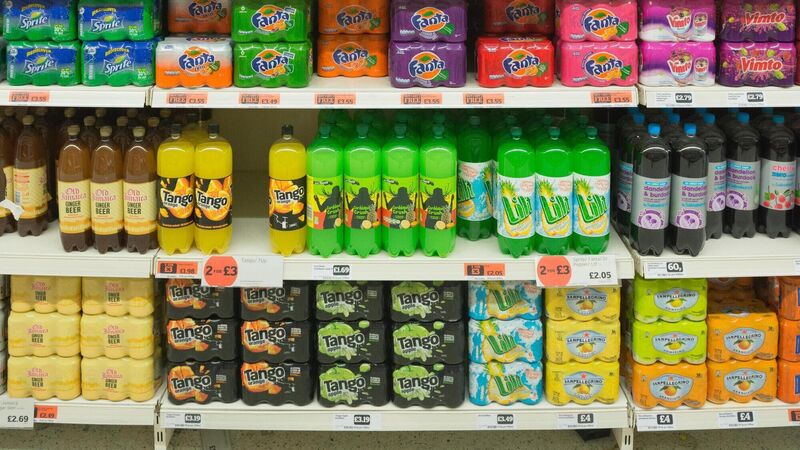
Sugary soft drinks are now being sold at the same price — or even cheaper — than sugar‑free options, according to researchers. File picture
The sugar tax on sweet drinks, introduced almost eight years ago, has become “invisible” because of inflation and shifts in how products are sold, prompting academics to call for a significant increase.
Sugary soft drinks are now being sold at the same price — or even cheaper — than sugar‑free options, according to researchers at Technological University of the Shannon (TUS), University of Limerick (UL), and University College Dublin (UCD).
The tax ranges from 5c to 24c depending on the sugar content in a drink per 100ml. It is applied to cans, bottles, and litre-bottles of soft drinks, plant protein drinks, and drinks with milk fats.
The research team noted the tax had a positive impact when introduced in May 2018 but has been "undermined".
Read More
Frank Houghton, principal investigator at the HEALR research group in TUS, said: “The sugar tax was modest when it was introduced, and with inflation it is now insignificant.
“The sugar tax needs to be significantly increased, index-linked, and amended to kick-in earlier.
The tax band thresholds are currently set at 5g of sugar per 100ml and 8g per 100ml. The researchers recommend lowering these thresholds over the next decade to 2.5g per 100ml.
Their findings show many soft drinks — including Pepsi, 7Up, Fanta, and Club Orange — have reformulated their recipes to contain less than 5g of sugar per 100ml. Coca‑Cola, by contrast, still contains 10.6g of sugar per 100ml.
Mr Houghton also raised concerns about super-sizing of drink containers. Their data shows small 330ml cans are “increasingly being replaced by larger, often 500ml cans and similarly sized bottles, in many garages and convenience stores".
The research notes a range of issues that have limited the impact of the tax, including “inflation erosion, supersizing, inconsistent pass‑through, invisibility, and limited scope”.
They called for a mandatory sugar tax logo on drinks containers and noted it was rare to see the tax listed on menus. They suggested many people no longer think about the extra cost on their drink.
Jeremy Auerbach, an assistant professor in the School of Geography at UCD, raised concerns over how the sugar tax was used by the Government.
It raises about €30m every year, according to Revenue. Mr Auerbach wants this money ring-fenced for health programmes, including obesity treatment and community food projects.
“These will help improve health, community resilience, and community integration,” he said, pointing out the World Health Organization sees sugar taxes as a positive for health.
A Department of Health spokesman said an evaluation of the tax in 2024 found “sugar consumption via carbonated drinks has dropped since the tax was introduced”.
This included fewer drinks consumed, less sugar volume, and a reduction in annual tax receipts.
Responding to the calls for change, he said: “Any future changes to the structure/content of the [sugar-sweetened drinks tax] will be considered as part of the development of a new obesity strategy, which is currently ongoing and expected to be published this year.”
The spokesman agreed that reformulation is happening and linked this to the tax, saying: “Four out of five of the leading soft drinks brands now fall outside of the tax altogether.”


CONNECT WITH US TODAY



Be the first to know the latest news and updates