ieExplains: Would a new assessment process cut waiting lists for dermatology treatment?
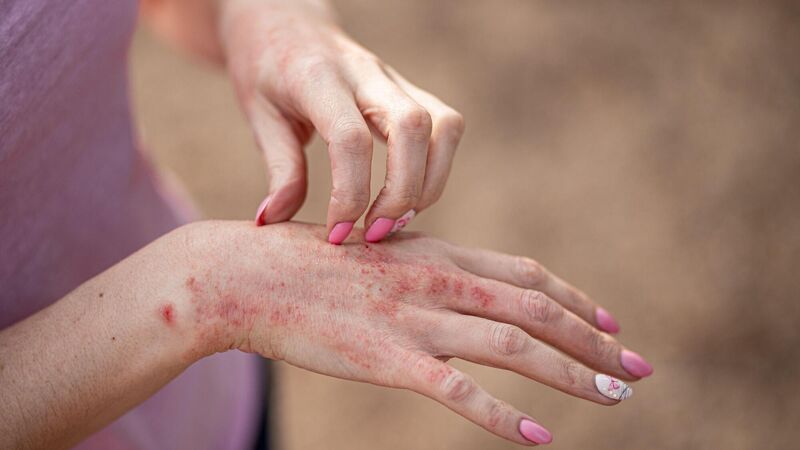
There were 60,821 people waiting by January this year for treatment of their skin conditions, with 3% waiting over three years. File picture
Amid growing waiting lists, thousands of patients with skin conditions could see a new assessment process with GPs taking images to share with dermatologists and potentially speeding up access to care.
How might this work?
In this case, it means a GP sending images or videos of a patient’s skin condition to a dermatologist, as well as a referral letter. It could include a live interactive video.
This includes various conditions such as skin cancer, eczema or rashes.
Images can be digital photographs or dermoscopic images taken with a hand-held device which makes things look 10 times bigger.
Health watchdog Hiqa last week published advice for its potential use in a national system connecting GP patients with hospitals.
There were 60,821 people waiting by January this year, with 3% waiting over three years.
Hiqa identified a rapid growth in referrals — up by 55% between 2019 and 2024 — compared with a slower increase in doctor numbers.
Dermatologist Professor Brian Kirby works at St Vincent’s University Hospital. He was on the expert advisory group for the assessment.
“This may increase capacity. It certainly should help in triaging patients, prioritising people,” he said.
“It needs to be done carefully within a public dermatology setting in a dermatology department. For its impact on waiting lists, we will have to wait and see.”
He is also the Irish representative on the British Association of Dermatologists working group for tele-dermatology.
This approach is used by some NHS trusts, but he said: “They still have huge waiting lists in the UK, so it’s not the answer to all.”
Mr Kirby cautioned: “The big fear with this system is that it will miss skin cancers.
“All of the studies done down the years show that it’s kind of almost as good as seeing somebody in person, but it’s not as good as.”
The system would “run into problems” if it tries to replace doctors with tele-dermatology, he added. He pointed out in Australia that "they only use this for people who live thousands of miles away".
“The reason they don’t is they have enough consultants.” He noted that other countries saw this system increase referrals because it gives easier access to dermatologists.
University Hospital Limerick (UHL) recently set up the first HSE teledermoscopy clinic.
Dermatology specialist registrar Berbie Byrne works there and has a special interest in dermoscopy.
She explained that advanced nurse practitioners (ANP) assess the clinical photographs and dermoscopic images.
“They are both highly trained and will flag urgent findings to the consultant,” she said. The doctors then diagnose and decide patients’ next steps.
“GP photos and ANP input will streamline and improve efficiency with a teledermoscopy service,” she said.
“But it requires additional and specialist training, which the majority of doctors and nurses do not have.”
Tele-dermatology is also used in some private sector health facilities, and Boots Ireland also offers it as a paid service.
Hiqa advised that over 10 years, it could see an extra 270,000 patients treated. However, this is assuming an extra five dermatologist posts in the HSE every year.
Hiqa chief scientist, Dr Conor Teljeur, said: “There remains an urgent need to recruit more consultant dermatologists.” It advised that a pilot programme would be needed.
Mr Kirby suggested the Cork University Hospital (CUH) dermatology unit as a good option due to its large size.
“I think it’s really important that a pilot study be done,” he said. “And I stress it would be within the public health system, so we can keep quality and governance and all of those things involved.”
GPs would need standardised devices to take the images. A secure digital system would be needed, among other changes.
Dermatologists in Sligo University Hospital published a paper in the Irish Medical Journal in 2023.
They looked at 51 referrals; each was triaged using a referral letter alone, followed by both the letter and a photograph together. They said “an image supplied with the referral letter greatly enhances the quality of a referral”.
Hiqa’s assessment refers to a pilot project in Cork involving e-photograph triage for a specific type of tumour. This was also between GPs and hospital dermatologists.
- Niamh Griffin is the Irish Examiner health correspondent
CONNECT WITH US TODAY



Be the first to know the latest news and updates