Gardaí have yet to discharge tasers three months into pilot project, justice minister confirms
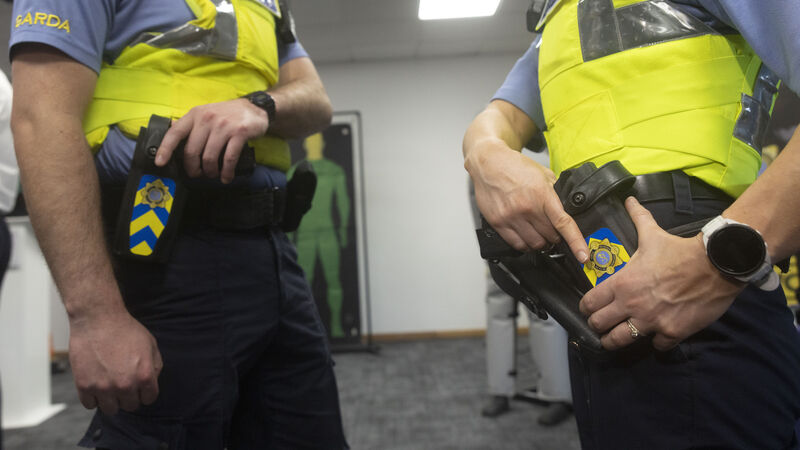
Some 128 frontline gardaí were provided with tasers as part of a pilot project that was rolled out in Dublin’s Store Street and Pearse Street Garda stations and Waterford Garda Station from December 18. Picture: Sam Boal/Collins
New taser guns provided to gardaí have yet to be discharged nearly three months into a new pilot project.
While tasers have been drawn as a de-escalation tool four times since mid-December, gardaí and justice minister Jim O’Callaghan confirmed they have yet to be used.
Some 128 frontline gardaí were provided with tasers as part of a pilot project that was rolled out in Dublin’s Store Street and Pearse Street Garda stations and Waterford Garda Station from December 18.
Gardaí must wear body-worn cameras to carry a taser.
In response to queries from Social Democrats TD Gary Gannon, Mr O’Callaghan confirmed tasers, officially referred to as Conductive Energy Devices (CED), had yet to be discharged.
“In carrying out their duties, gardaí, as far as practicable, consider non-physical means before resorting to the use of force in the resolution of incidents that they respond to,” he said.
“The use of a CED is one of the tactical options available to gardaí when faced with violence or the threat of violence when it is reasonable to believe [this] may result in injury to themselves or others, including self-harm by an individual.
“I am advised by the Garda authorities that there have been no discharges of a CED during the course of this pilot.
“A CED has been drawn and successfully used as a de-escalation tool on three occasions, in Dublin Metropolitan Region South Central and Waterford during January 2026, and Waterford during February 2026.”
A Garda spokesperson later confirmed that by March 1, a taser had been drawn but not discharged on a fourth occasion.
Mr Gannon also asked Mr O’Callaghan to confirm the number of gardaí who had been seriously injured since the start of the taser pilot.
The minister said the Garda system “does not categorise injuries as serious and non-serious”.
Mr Gannon said his question followed concerns raised by UN human rights experts over the purchase of double-strength pepper spray and the taser pilot.
“When the UN is raising red flags about policing powers here, Government needs to answer that properly,” Mr Gannon said.
“We are told there have been no discharges, which is good. But Garda systems cannot even categorise injuries by seriousness. If you cannot measure harm properly, you cannot tell the public the risks are under control.
“What makes the lack of clear safeguards even more concerning is that the UN has also specifically warned that information provided to them by gardaí states these weapons could be used against pregnant women and the elderly.
“No one is trying to make the gardaí’s job harder, but if these powers are going to expand, the safeguards have to be real, transparent, and independently scrutinised. Otherwise, we are being asked to accept reassurance without the evidence to back it up.”
A Garda spokesperson said any use of tasers “forms part of a graduated policing response” and "it is too soon to fully assess" the "effectiveness" of the taser pilot.
CONNECT WITH US TODAY



Be the first to know the latest news and updates