'More heartache' to come as a result of extreme weather conditions, researchers warn
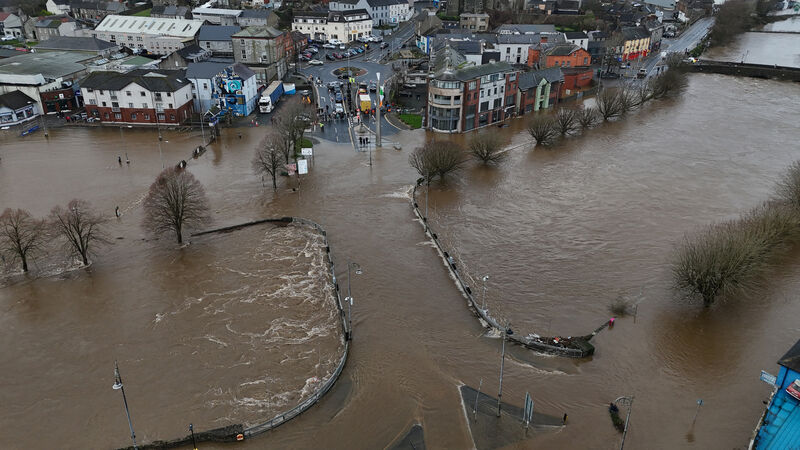
The River Slaney bursts its banks in Enniscorthy, Co Wexford on January 27, leaving thousands without power. File picture: PA
Irish communities face “more heartache” with weather events such as the recent flooding the "permanent future", experts have warned, as new European data gave a “stark reminder” of how extreme conditions are becoming due to climate change.
After widespread flooding during Storm Chandra in many parts of the country, Professor Peter Thorne, director of the Irish Climate Analysis and Research Units group at Maynooth University, sounded the alarm if global warming continues unabated.
“It’s just another sad milestone in a litany of sad milestones of a climate going awry and going wrong to the detriment of all of us,” he said.
Read More
Europe's Copernicus Climate Change Service said that January was the fifth warmest on record, and brought temperature extremes to both the northern and southern hemispheres.
In the latter half of the month, the northern hemisphere experienced severe cold waves, bringing Europe its coldest January since 2010.
“January 2026 delivered a stark reminder that the climate system can sometimes simultaneously deliver very cold weather in one region, and extreme heat in another,” said Samantha Burgess, strategic lead for climate at the European Centre for Medium-Range Weather Forecasts.
"While human activities continue to drive long-term warming, these recent events highlight that resilience and adaptation to increasing extremes are key to prepare society for heightened climate risk in the future."
The country faced into severe weather conditions from Storm Chandra, with the heavy rain lasting well into February, bringing widespread flooding.
Met Éireann said that it was the wettest January since 2018, and the second wettest January ever recorded in Dublin, as it saw double the average amount of rain.
While this January was not as warm as recent years, Mr Thorne said that it came as a result of temporary cooling in the global climate, which happens constantly.
“That’s our permanent future, as we blast beyond 1.5C to 2C, this continues to get worse, and more extreme," he said.
Assistant professor of climate change at Maynooth Nick Scroxton said the recent weather is exactly what we can expect from climate change at home, as winter storms will be about 20% more intense in future.
“In addition to needing better flood early warning systems, we also need to slow down water from reaching our rivers, and to slow down our rivers to reduce flood height,” he said.
Elsewhere, Fianna Fáil MEP for Ireland South Billy Kelleher has asked junior finance minister Robert Troy for a State-backed insurance scheme to include homes for which flood insurance cannot be obtained, as well as businesses.
“Flood waters do not discriminate if a property has a business license or a family living in them — they simply destroy whatever is in their path,” he said.
Meanwhile, the Government has been accused of ignoring the scale of the climate consequences in its decision to lift the passenger cap at Dublin Airport.
Transport minister Darragh O’Brien secured Cabinet agreement for new legislation to lift the passenger cap above 32m people at the nation’s largest aviation hub to 40m.
Mr O’Brien said he hoped to introduce it for passage through the Oireachtas as soon as possible.
However, climate organisation Opportunity Green said it was part of a political pattern where climate obligations can be sidelined if they conflict with lobbying and international pressure.
“It sends a clear signal that environmental limits are conditional and can be set aside when they become inconvenient,” senior manager for Ireland Sorcha Tunney said.
CLIMATE & SUSTAINABILITY HUB
CONNECT WITH US TODAY



Be the first to know the latest news and updates