Call for emergency co-ordinators to have adequate records of people with disabilities ahead of storms
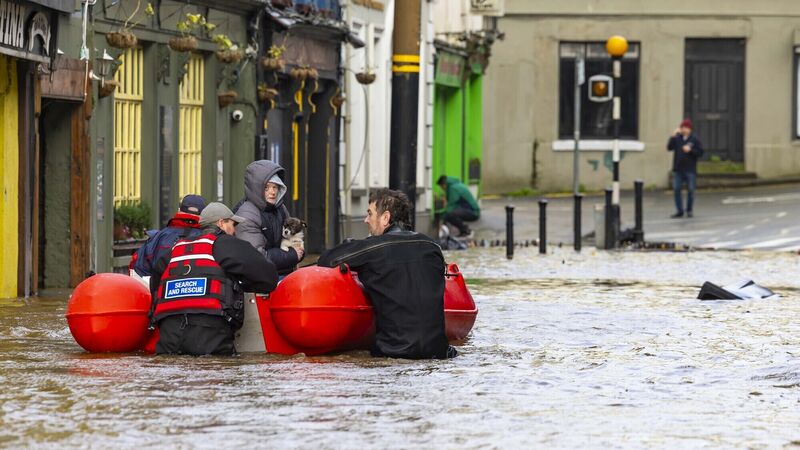
A search and rescue team transporting locals yesterday in Enniscorthy, Co Wexford, after the River Slaney burst its banks. Picture: Patrick Browne
Emergency co-ordinators must ensure they have adequate records of people living with disabilities ahead of major storms, according to recommendations from the Oireachtas climate committee.
The committee's series of proposals, stemming from the aftermath of Storm Éowyn last January, were issued as the country was once again battered, this time by Storm Chandra, almost exactly a year later.
Within hours of the latest storm making landfall, tens of thousands of homes and businesses were without power, with high winds and widespread flooding causing havoc to transport networks and school settings, particularly in the South East.
Members of the Oireachtas climate committee have said the National Emergency Co-Ordination Group (NECG) should “engage directly with disabilities and disability organisations” and review the vulnerable customer register and how it is managed across relevant State agencies like the ESB, the HSE, and Úisce Éireann.
Storm Éowyn, one of the most extreme weather events to hit the country in recent years, battered Ireland in January 2025, inflicting devastating winds, widespread power outages and disruption to water supplies across the country, leaving more than 715,000 homes and businesses without electricity at its height.
The committee’s recommendations stem from hearings held within the Oireachtas last November when the committee heard the Department of Housing had failed to consult with disabilities groups while conducting a review into its response to Éowyn.

In delivering its findings on storm preparedness, the climate committee also recommended that a national list of community support hubs be completed in advance of the winter season.
The members said the Government should commit to the full funding of those community hubs, “including the provision and distribution of generators to municipal districts and local authorities to support their rapid establishment during power disruptions”.
Those hubs were outlined by the head of the NECG Keith Leonard last November.Â
He said that plans were in train to create more than 400 such installations across the country to aid in future storm resistance.
The hubs would be provisioned with supplies needed for basic needs such as water, hot food, broadband, and phone charging.Â
Some 93 power generators were to be acquired as part of those plans.
The committee further recommended that a “national emergency communications system” be established capable of “sending coordinated and targeted information to regions via mobile phones during a national emergency”.
Such emergency messaging systems are already in place in many developed nations worldwide, including across the UK and Northern Ireland.
Members of the committee also called for ESB Networks to expand its apprenticeship intake in order to “perform preventative maintenance work, such as the cutting of diseased, damaged, and overhanging timber from lines” during and in the aftermath of high-impact storm conditions.
Meanwhile, the housing minister has claimed yellow weather warnings lead to a "false sense of security". James Browne said that the warning system employed by Met Éireann was being reviewed. "An orange warning on itself is manageable, but an orange warning coming from a step back from a red actually is far more dangerous because you have so much loose trees, for example, and one man unfortunately lost his life last year...during the orange warning. "I think they do need to be looked at, because there are very particular measurements that are triggered, and rather than looking at the system as a whole in terms of what is the potential impact here. "The UK.... rather than you triggering it based on hitting a certain amount of measurements, the UK look at it 'Well, okay, but what is going to be the overall impact here?' And I think that perhaps at times, the yellow warning is giving people a false sense of security. "So I do think we have to look at how those warnings are working in our communities, and take what we can learn from each of these very serious events."
Check out the Irish Examiner's WEATHER CENTRE for regularly updated short and long range forecasts wherever you are.