Jennifer Carroll MacNeill faces defining year on hospitals, overcrowding and agency spend
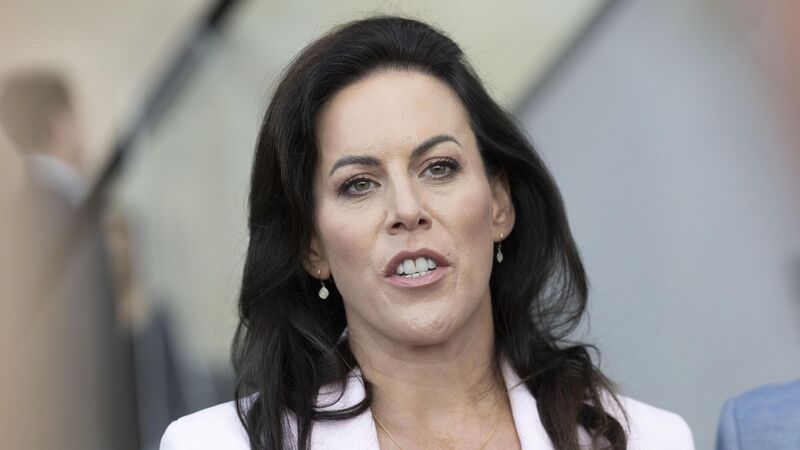
Minister for health Jennifer Carroll MacNeill has focused on the options given by Hiqa to address overcrowding in Limerick, particularly options ‘B’ and 'C' — the former is a new elective-only centre, and the latter a longer-term plan for an additional hospital with an emergency department. File photo: Sam Boal/Collins Photos
If 2026 delivers a new elective hospital for Limerick and the handover of the National Children’s Hospital to the HSE, health minister Jennifer Carroll MacNeill will be happy.
Progress on tackling hospital overcrowding, especially in Cork and Galway, as well as reducing the enormous drain on the HSE budget from over-use of agency staff are also on the minister's to-do list.
Limerick is to get an elective-only hospital as part of the Government's response to concerns raised by the health watchdog, Hiqa, about the safety risks to patients from overcrowding.
Ms Carroll MacNeill has focused on the options given by Hiqa to address overcrowding in Limerick, particularly options ‘B’ and 'C' — the former is a new elective-only centre, and the latter a longer-term plan for an additional hospital with an emergency department.
She described the projects as “a real test” for the new reforms of planning laws whereby the construction of buildings for the public good can navigate the planning hurdles more easily.
Cork is also awaiting an elective hospital, promised in 2022, but it is not now expected to be shovel-ready until 2030.
“The elective hospital in Cork has an issue with the council, which is a straightforward planning issue about the (access) road," she said. "The council has to sort that out and we need to put the planning permission in, but that (the road) has been the barrier."
A spokesperson for Cork City Council said it is fully supportive of the HSE’s proposal to build an elective hospital at its Sarsfield Court site in Glanmire.
"The city council has engaged in extensive pre-planning discussions with the HSE on this proposal and substantial progress has been made on key planning issues identified," the spokesperson said.
"That engagement is continuing and the city council stands ready to help, as always, to progress matters as quickly as possible. The city council looks forward to considering a detailed planning application for this site, if and when it is submitted by the HSE."
Ms Carroll MacNeill conducted this interview in her office, on the top floor of the Department of Health.
It is where the top brass of Bank of Ireland once worked, with its glass corner walls looking over the city.
Her desk, however, looks inward where a large painting of Dun Laoghaire Harbour greets her eyes.
Her predecessor Stephen Donnelly had this office too, but his desk faced out towards the city views.
In one corner of the room, there is a framed newspaper page from 1985, containing a photograph of a young Jennifer Carroll MacNeill and her mother at a Fine Gael conference.

Just inside the door, a statuette of the Big Fella, Michael Collins, sits proudly on the top shelf.
It was presented at Beal na mBláth, where she made a speech last year.
This led to much commentary about her remarks on neutrality and care for children with scoliosis.
Setting up an inquiry into the substandard care received by children with spina bifida and scoliosis is likely to dominate much of 2026, along with an inquiry into the historic prescribing of Epilim to pregnant women.
A scoping exercise, which could lead to a further inquiry into convicted sex offender and former hospital consultant Michael Shine, is also happening.
The spinal care inquiry will directly affect Children’s Health Ireland, just as it should be ramping up to move to the new National Children’s Hospital.
One floor of the hospital was given to the HSE before Christmas and specialist cleaning is ongoing. IT teams will begin work this month, with the first batch of equipment delivered yesterday.
Ms Carroll MacNeill said the main contractor BAM has "certainly improved engagement" after years of delays and cost overruns that saw the builders at loggerheads with the project overlords, the National Paediatric Hospital Development Board.
Full commissioning of the National Children's Hospital, after handover, is now seven to eight months away, Ms Carroll MacNeill said.
Pressed on an exact date, the minister said: “I wish BAM would just give me the hospital."
A spokesperson for BAM said it is "working closely with all stakeholders to actively manage the challenges involved and to secure the earliest possible opening date for the children of Ireland".
An inquiry into spinal care was promised in the aftermath of the death of Harvey Morrison Sherratt, aged 9, last July. Ms Carroll MacNeill said the tragedies that have sparked the inquiries are often difficult to process.
“There are some quiet, very difficult days, when you get patient notifications about things that have happened around the country and you can get those at any time.
"Many of those are just natural things but they are always very sad. That’s not something you anticipate before becoming minister for health.”
She added: “I appreciate there has been significant difficulties in spinal care for some time, but I do see improvements."
Many hospitals have faced unprecedented patient numbers in recent days, due to freezing conditions and the high number of flu cases.
Some 75 people were on trolleys for longer than 24 hours, including 14 people aged over 75, on Thursday. The Irish Nurses and Midwives Organisation counted 708 people unable to get a bed.
Tackling overcrowding is Ms Carroll MacNeill's "no 1 priority" and she was especially critical of health chiefs in Cork and Galway for not doing more.
“I think if I was living in Cork I would reasonably ask why can't I have the predictability or the relative predictability that we achieve in the Mater or Beaumont or St James,” she said.
Over the last year, all hospitals moved to a seven-day week roster, among other reforms, in a bid to ease overcrowding.
Ms Carroll MacNeill said: “Cork and Galway are further behind on this journey of process change, but to be very fair they have certainly come a distance.”
She highlighted improvements elsewhere, saying: “Limerick is performing really well, they’re discharging around 100 people per day despite very increased attendances.”
In response, HSE South West said CUH and other hospitals locally are challenged because of “increased demand and capacity constraints”.
It said it is “determined to ensure that CUH and all sites progress to meeting national targets, including those relating to emergency department wait times on a consistent basis”. The CUH emergency department sees 14% more patients now than in 2023, but the number of patients on trolleys has dropped in a 17% year-on-year improvement.
“Average adult discharges increased by 7% in 2025, with CUH regularly achieving the highest discharge volumes nationally,” it said.
It had 585 beds by April, up from 493 in 2020 and 30 critical care beds, up from 18. More acute beds are planned this year.
Recruitment has continued with the workforce now at 4,840, including additional nurses and midwives.
The HSE expects recent investments, including in Mallow and Blarney, as well as building a new surgical hub “will help to alleviate the pressures on acute settings such as CUH", it said.
It said “greater integration of health and social care services“ this year will also help.
A spokesperson for HSE West and Northwest said Galway hospital is “challenged with bed capacity, delayed discharges and high numbers of patients being treated for flu and RSV, however, we are doing everything we can.”
The statement added: “This is not the standard of care that we want for patients of our services and we regret that any patient would have to wait for a hospital bed in this way. This is a patient safety issue.
"Existing facilities are outdated and lack the space and design needed to support modern, state-of-the-art healthcare delivery. A new emergency department and 300 new inpatient beds are key elements of the long-term development plans.”
One broader area where reforms seem to be having little impact is slashing the ballooning bills for agency workers.
“We clearly have an imperative to reduce the spend which is close to €1bn a year on agency,” Ms Carroll MacNeill said.
“And while I think there is always a measure of some appropriate agency work, we have become too used to it. It has become too expensive.”
She cautioned: “It’s too much a normalised part of the system.”
Solutions include plans to revamp hiring processes in hospitals, community and therapy roles.
Ms Carroll MacNeill also touched on wider plans to help people avoid vaping by making it easier to clamp down on new products.
“Vaping is far too available,” she said.
“We’re trying to do this future-proofing in the legislation which will give me or my successor the opportunity to catch different products more quickly than would have been the case by having to do primary legislation all the time.”
Tobacco companies try to make vapes “more and more attractive”, she said, while also developing new products like nicotine pouches.
“They’re just different ways of manipulating children and getting them addicted to nicotine,” she warned.
It is too early to say how many of her plans will have come to fruition by December especially for construction but patients and healthcare workers will surely hope for as many as possible to land.