McEntee vows to press for answers in Sean Brown murder case
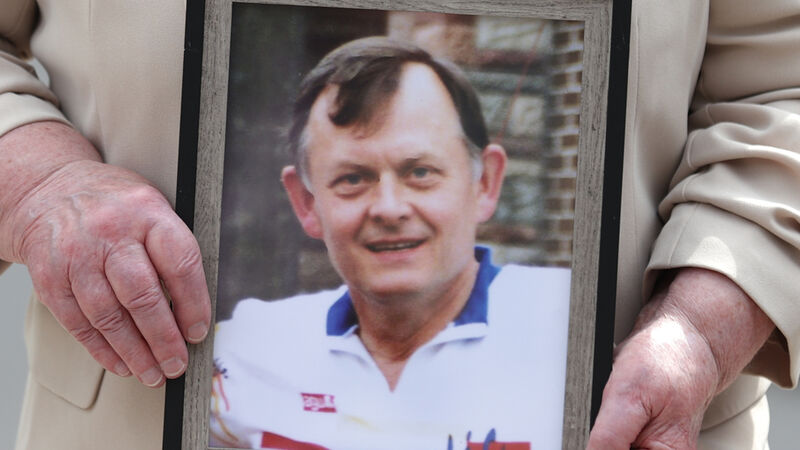
Bridie Brown, the widow of murdered GAA official Sean Brown, holds a picture of him, outside the Royal Courts of Justice in Belfast. Picture: PA
The Government remains committed to doing everything in its power to secure answers for the family of murdered GAA official Sean Brown, the Minister for Foreign Affairs has said.
Helen McEntee said it was “absolutely essential” that the circumstances of the 1997 killing were fully investigated.
Despite agreeing a new joint framework on structures for dealing with Troubles-related cases with the UK government last September, the Dublin government has not dropped its call for a public inquiry into the murder of Mr Brown.
The Government argues that a public inquiry remains the best avenue for his widow Bridie to receive a timely remedy in her case, given she is aged in her late 80s and the legislative steps to create new legacy structures for investigating unsolved Troubles crimes will take time to complete.
Last year, Northern Ireland Secretary Hilary Benn applied for a Supreme Court appeal on judicial rulings in Belfast that compel him to establish a public inquiry into the loyalist paramilitary murder.
Mr Brown, 61, the then chairman of Wolfe Tones GAA Club in the Co Derry town of Bellaghy, was ambushed, kidnapped and murdered as he locked the gates of the club in May 1997.
No-one has been convicted of his killing.
Preliminary inquest proceedings in 2024 heard that in excess of 25 people had been linked by intelligence to the murder, including several state agents.
It had also been alleged in court that surveillance of a suspect in the murder was temporarily stopped on the evening of the killing, only to resume again the following morning.
Last year, Appeal Court judges in Belfast affirmed an earlier High Court ruling compelling the government to hold a public inquiry.
However, Mr Benn took the case onward for further appeal at the Supreme Court, insisting it involves a key constitutional principle of who should order public inquiries – the government or the judiciary.
Mr Benn has argued that a reformed legacy investigative commission set up under the joint UK/Irish framework is a more appropriate way to examine the Brown case.
Ms McEntee, who replaced Simon Harris as Foreign Affairs Minister late last year, was asked about the prospect of changing the UK government’s mind on a public inquiry as she spoke to reporters on her first visit to Belfast since taking on the role.
“This is something that has been raised previously by my predecessors, something that I have raised, and that I’m very happy to continue to raise as well,” she said.
“I think it’s absolutely essential for his family that answers are got, and I think it’s absolutely essential that we do everything that we can to get to that point.”
She added: “I mean in terms of the new structures and the commission, I think they have been broadly welcomed, but as I think most people agree, it’s where we start to see delivery and where we start to see answers for people that we really start to see it work.
“But I think we need to work with families, and we need to make sure that we do everything in our power to get answers for those families that they deserve.”
On her visit to Stormont, Ms McEntee met Speaker of the Northern Ireland Assembly Edwin Poots and senior figures from the Alliance Party, Ulster Unionist Party and the SDLP.
She also met representatives from Troubles victims’ and survivors’ groups.
Earlier, the minister visited students from different community backgrounds in Belfast to hear about their involvement in reconciliation projects.