Robots and AI could transform future of farming, says expert
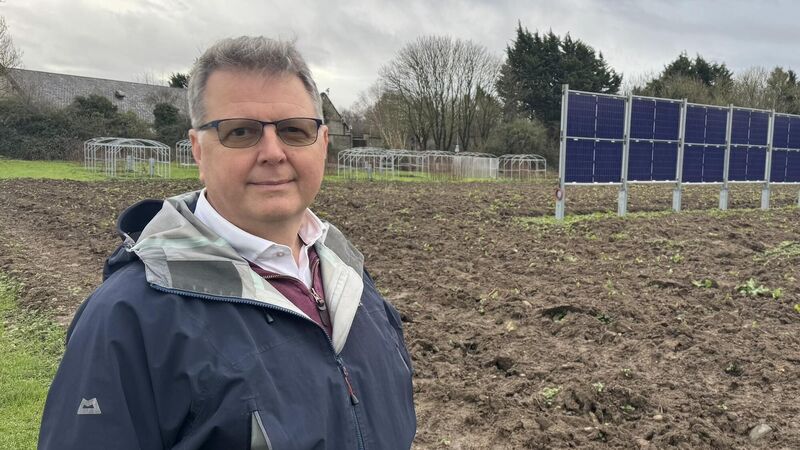
Professor Gerry Lacey of Maynooth University. Picture: Bairbre Holmes/PA
In the near future, the sight of robots trundling through rural fields could be as familiar as that of combine harvesters and tractors, according to Professor Gerry Lacey.
The robotics expert, along with his team of âenthusiastic young peopleâ, are working on a range of experiments to push the boundaries of modern farming at the Automating Regenerative Agriculture (Aura) project at Maynooth University.
Using a hectare of land in Co Kildare they are exploring how robotics and artificial intelligence (AI)Â can pick crops more efficiently, tackle weeds more effectively and integrate solar panels into the everyday work of a farm.
He believes technological advances are key to solving the looming problem of how to feed the worldâs growing population.
âBy 2050, weâre going to have to feed 10 billion people, which means that we have to increase the amount of food on planet earth by 56% but we need to do that without using any more land,â he said.
âWe also need to do that while we reduce the emissions from agriculture.â
Despite the growing population, there are fewer people interested in working in agriculture, and Prof Lacey said this is contributing to âfield wasteâ where viable produce gets destroyed or left behind during harvesting.
âFrequently youâll hear farmers saying, âOh, well, we couldnât find the people to harvest this crop, so it got ploughed back in.ââ
One way of combating this problem involves using AI and robots to âgo back to the way our forefathers and mothers used to harvest foodâ by selectively picking fruits and vegetables when they are ripe.
Currently the use of mechanical harvesting, where one large machine harvests an entire field in one go means: âSome of the crop is ripe, some of it is overripe, and some of it isnât ripe yetâ.
But, one piece of kit being developed by the Aura project is a machine that can use minimal amounts of energy to pick individual fruit and vegetables at their optimum ripeness.
Another old method being reimagined for the 21st century involves a robot using boiling water to weed crops.
All of these, he said need to be designed in âsuch a way that it is maintainable by a farmer themselvesâ because if a machine breaks during harvest they could lose their âentire incomeâ.
They are also looking at how to optimise solar technology in Ireland, experimenting with vertical panels so that they can be installed in fields which are also being used for crops.
The project has teamed up with commercial organisations like Irish Distillers and Comex McKinnon to use the latest technology to create more sustainable grains.
The issues facing farmers in Ireland are a âa great engineering challengeâ said Una Parsons, an upcoming president of Engineers Ireland.
Alongside a distinguished career in manufacturing and academia, she lives and works alongside her husband on an organic farm in Co Sligo.
She said the agritech industry is a âhuge opportunityâ for the country, pointing out that Ireland is ârenownedâ for producing agricultural machinery and for its tech industry.
Technological developments, too, can engage a younger generation in farming, helping to tackle labour shortages in the sector.
Young people who grow up on farms are âmini engineersâ, she said, and âevery young kid is into their phoneâ so âcombining the two could be a winâ.
Ms Parsons said there are a number of start-ups and âfantasticâ innovations in the country.
She points to Herdwatch as an example of an agritech success story, the software management tool uses AI to help farmers manage their herds.
It is now being used on 20,000 farms across Ireland, the US and UK.
But Ms Parsons feels the sector needs more support and would âlove to seeâ an intergovernmental task force to develop the agritech sector.
She also thinks advancing agricultural technology should be a focus of Irelandâs presidency of the Council of the European Union next year.
In response, the Department of the Environment pointed to a range of projects and initiatives they said have supported the agritech space.
Including the VistaMilk Research Centre, which, they said, will âtransform an already world-class dairy sector into a global leaderâ.
They also said the department has been involved in a number of agritech events where researchers and industry executives from the US and Ireland have met.