State of the art research into ‘mini brains’ at University of Galway
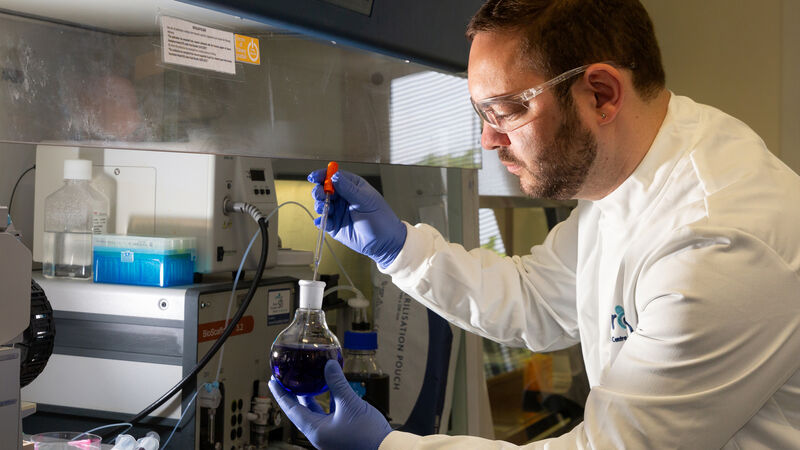
Dr Mihai Lomora’s team grows mini brains Picture: Martina Regan/University of Galway
Scientists in Ireland have discovered improvements in growing “mini brains” in laboratories, which could benefit studies into strokes, Alzheimer’s and Parkinson’s.
The research examined the potential development of blood vessels in small clumps of brain cells – referred to as cerebral organoids or “mini brains”.
One of the problems with these structures, which are barely visible to the naked eye at just a few millimetres wide, is that cells towards the middle tend to die due to a lack of oxygen.
Lead researcher, Dr Mihai Lomora, acknowledged that the work “might sound like science fiction” but said the reality is “not so far-fetched” and scientists all around the world are working on such organoids.
His team at CURAM – the Research Ireland Centre for Medical Devices based at the University of Galway – grew mini brains in a soft, biologically compatible material called a hydrogel and introduced cells that can form blood vessels.
The result was that organoids grew bigger and had fewer cells dying in the middle.
They also observed behaviour similar to the protective blood-brain barrier, which could mean the research is relevant for studies on diseases that involve the brain.
Dr Lomora said: “When we started the project, we could see in the scientific literature that cerebral organoids growing in the lab tended to have a vasculature or blood vessels that were superficial only.
“That meant that the blood vessels didn’t penetrate into reach the deeper cells in the organoid, then these cells became starved of oxygen and nutrients over time and they died off.”
Dr Lomora, who is a biomaterial chemistry lecturer and lead of the CerebroMachines Lab at the University of Galway, explained that the clump of cells is not the same as growing a brain in the lab – but it can act as a mini-model for how one functions.
“We want it to be as physiologically relevant as possible. We believe that by increasing the vasculature, we have taken steps to making the organoids more physiologically relevant.”
In an effort to increase oxygen and nutrient supply to deeper cells, the researchers adapted an existing technique for growing the mini brains by experimenting with different environments and timings for the blood vessels.
The improved approach resulted in three times less cell death in the organoids.
Dr Lomora added: “We were fascinated to see that the vasculature really was able to protrude towards the interior of the organoids, which actually was quite a big advancement.
“And we also saw that cells involved in forming some of those blood vessels came from the organoid itself. It’s at the edge of the state of the art for now.”
The research, led by CURAM, has been published in the Advanced Science journal and also involved a multi-disciplinary team based in RCSI University of Medicine and Health Sciences, Trinity College Dublin and the University of Edinburgh.