Ukrainian ambassador: We are fighting for the security of all of Europe, not only for our country
Ukrainian Ambassador to Ireland Larysa Gerasko: ‘[Putin’s] goal too is to undermine the security in the whole world, not only in Europe. This is a struggle of democracy against autocracy, against tyranny.’ Picture: Gareth Chaney
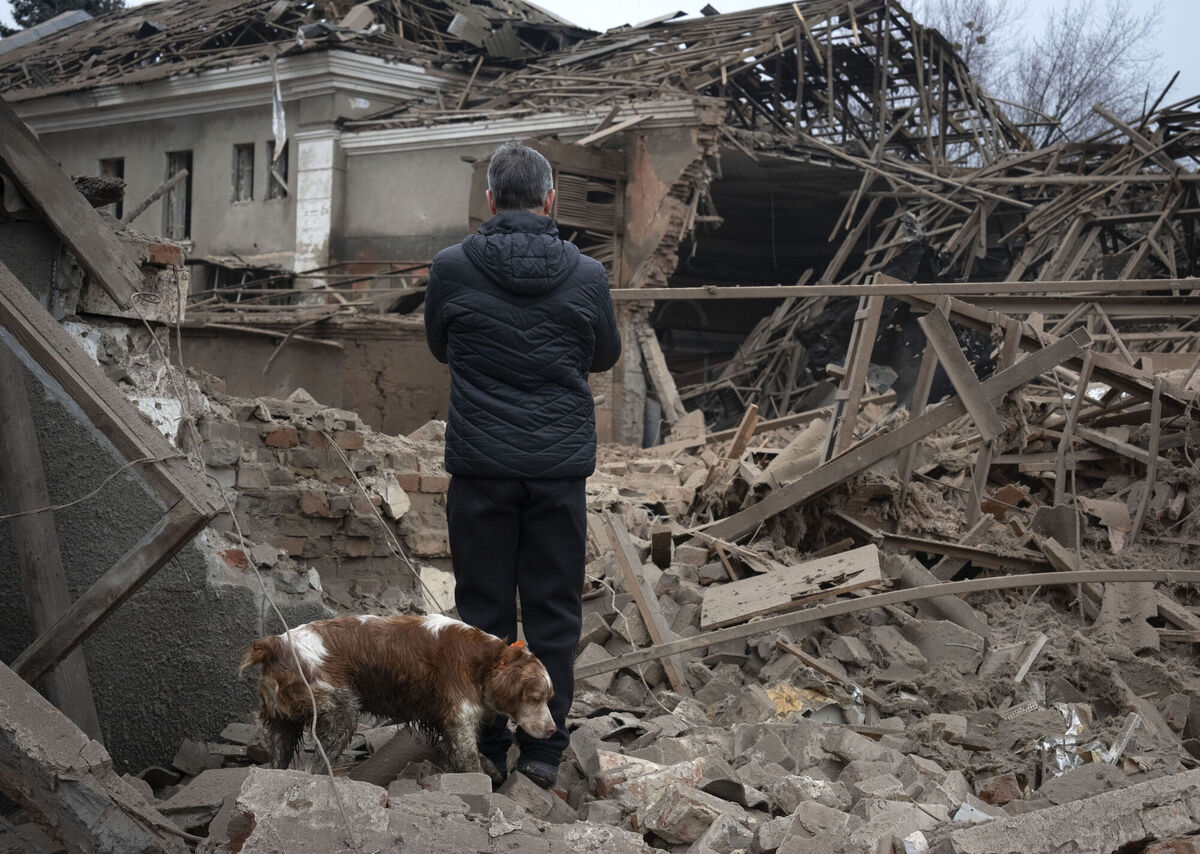
While the world marks the second anniversary of Russia’s war in Ukraine, Larysa Gerasko points out it is, in fact, 10 years of war.
That was when Russian-backed forces took control of parts of eastern Ukraine and when it annexed the entire Crimea.
“This week we commemorate 10 years of the war against Ukraine and two years of the full-scale invasion, because, as you know, Russia invaded Ukraine in 2014,” said the Ukrainian ambassador to Ireland.
She said that, despite the military onslaught since February 2022, Ukraine is still standing and fighting back.
“We have to defeat Russia because we don’t have any other option,” said Ms Gerasko. “For Ukraine and for Ukrainians, it’s an existential issue — it’s about our existence as a nation, as a country.”
The toll has been heavy.
“Unfortunately, we are losing a lot of civilians, we are losing our soldiers. Russia continues bombardment, launching missiles every single day. Russia is actually destroying our country, our infrastructure.”
The Ukrainian government has kept its losses a secret, but The New York Times reported last August that the death toll in Ukraine was close to 70,000.
In addition, some 11m Ukrainian civilians are displaced internally, trying to flee the war in the east, and up to 7m have left Ukraine — some 100,000 of them for Ireland.
Ms Gerasko said Ukraine is confronted with a Russian leader in president Vladimir Putin who has no respect for life, including for his own soldiers.
For him, human lives means zero.”
She said in the recent battle for Avdiivka, in the east, Russian forces suffered an estimated 50,000 casualties over six months trying to take it.
“It’s a small town and actually the town doesn’t exist anymore. They destroyed the town to ashes.”
Last December, declassified US intelligence reports assessed that Putin’s war in Ukraine had cost Russia 315,000 dead and injured troops.
The Ukrainian withdrawal from Avdiivka is down to the rapidly depleting resources of the army, said Ms Gerasko.
“Actually, we left Avdiivka because of our shortage of ammunition.
“President Zelenskyy underlined this issue at Munich [Security Conference]. He stressed that we need ammunition and more weapons.
“It’s an existential issue for our military forces right now.
“We are paying the biggest price — human lives. Our soldiers, our men and women are sacrificing their lives. We need this assistance from Europe and from the USA, to have weapons in our arms.”
In March 2023, the EU agreed to supply 1m rounds of ammunition by March 2024, but at an EU defence ministers’ meeting earlier this month it emerged that around half of that will actually be supplied and that would rise to over 1m by the end of the year.
“It will be too late, at the end of the year. We are very grateful to all our partners for their assistance, but, it seems to me, that Europe should wake up more quickly and react more quickly and should deliver military assistance more quickly.
“Putin uses this opportunity, these delays, for offensive attacks. Now Russian forces have launched offensive attacks in five directions.
His goal is to occupy more territories. To stop him we need more ammunition.”
She said Putin’s overall aim is clear: “He wants to destroy our country, to exterminate Ukrainians as a nation.
“His goal too is to undermine the security in the whole world, not only in Europe. This is a struggle of democracy against autocracy, against tyranny.
“We are fighting for the security in the whole of Europe, the entire Europe, not only for our country.
“So, we are fighting for you [Ireland] as well.”
She is diplomatic when asked about recent comments of Donald Trump and the prospect of a second Trump presidency in the US, saying it is a decision for US voters and that they will work with whoever is the next president.
However, she said she hoped the Republican Party block on the $118bn (€109bn) Ukraine military aid will be dropped and that the House of Representatives will approve the aid soon.
Following the meeting of the EU defence ministers earlier this month, the Department of Defence told the Irish Examiner that Ireland expects to contribute over €120m this year under the special EU fund for Ukraine to the supply of non-lethal military aid.
It said it has also contributed over €4m to training the Ukrainian military in demining and clearance, as well as casualty care and drill instruction, with all the training done in Germany and Cyprus.
Ms Gerasko singled out the demining training as of special assistance.
“When we talk about demining we are talking about saving lives, lives of citizens, so it’s very important.
Ukraine is the most mined country in the world, as 174,000sq km is mined — that’s two Irelands, it’s so huge.”
She said the military training also helped the armed forces and said the training was not in Ukraine, so it “doesn’t break your neutrality”.
Asked if she understood Ireland’s policy of military neutrality and why it could not provide lethal military aid to Ukraine, Ms Gerasko said: “It seems to me it is very hard to be neutral in this situation, because Russian aggression against Ukraine, Russian war against Ukraine, it is against the whole democratic world and we live next to your door, in Europe, we are very close.
“It’s your internal affairs, of course, but we really need support now, even more now than at the beginning.
“It’s a military matter of your country, I just think it’s more about the security of your country.”
The ambassador pointed out that Ukraine was neutral in 2014, but that did not stop Putin.
She said she noted the Government’s establishment last year of the Consultative Forum on International Security Policy and said it was “important” that Irish people examine this issue.
We live in a very fragile world and the peace is very fragile. Putin’s goals are to disrupt order in the world, in the democratic world.”
She questioned any talk that Russia was a long way from Ireland and that it posed no threat.
“For Russia, it’s very easy to approach the Irish west coast, as actually they did before [February 2022] and do some military operation, and before I came here [as ambassador in July 2021] there was a cyber-attack [by a Russian cyber gang] on the HSE.
“I want to underline that Russia conducts hybrid war and not only in Europe, in the Americas and in Africa.”
She likened the various Russian intelligence services to “an octopus with many tentacles”.
She said: “Russian [government] don’t spend money for the wellbeing of their population, they spend money for disruption and military operations around the world. Last year, they spent €2bn on disinformation and propaganda. So Ireland is vulnerable, could be.”
She’s not alone in her views.
Last September, European Commission vice president Vera Jourova said she is convinced the Kremlin is already active in trying to manipulate European voters as European Parliament and national and local elections are held this year.
In November, a US diplomatic cable to European countries, including Ireland, warned of Russian attempts to interfere in 11 elections in nine countries.
It said the aim was not necessarily to ensure one side wins, but to “sow enough division and doubt” to create instability and erode social cohesion.

Ms Gerasko echoed that: “Russia disinformation tries to sow doubt and discord in Europe and in the unity of our partners.”
She described as “interesting and strange” the relatively large number of diplomatic staff attached to the Russian Embassy in Dublin, even after it was reduced from 30, before the invasion, to 15 now.
“What are they doing, given such a poor relationship with Ireland?” she asked.
She said the Russian ambassador, in his statements, has “focused on disruption”, including when he said that Ireland’s military training of Ukrainian soldiers was “a breach of neutrality”.
She also referred to the circulation of fake letters purportedly from the Department of Justice which said Ukrainian men in Ireland were to be deported back to fight in the war.
Gardaí have told the Irish Examiner that Russian involvement was one of their lines of inquiry.
Ms Gerasko said another thing Ireland could do is take the Russian assets that have been seized and hand them over to Ukraine.
She said Ireland has frozen Russian assets worth around €1.8bn.
“So one method of assisting our country is to transfer these frozen assets to Ukraine.
“According to our assessment, all frozen Russian assets around the world would cover 80% of our needs and demands for recovery of our country.”
Ms Gerasko is also concerned at the recent upsurge in anti-migrant/anti-foreigner sentiment, seen both online and at protests outside planned or rumoured accommodation centres, and attacks at some of the facilities.
In some cases, far-right agitators have included commentary about the number of Ukrainian people here and the number of asylum seekers.
“As a human being, it’s very painful for me, because our people are not immigrants, they are not refugees — our people escaped the war.
They never had any intention to emigrate, they just took a small backpack and ran away from the country with their children. Most of the Ukrainians want to go back.”
She said estimates indicate that 70m people of Irish descent “live abroad” and that Ireland as a nation has this experience of mass emigration.
“Many of you have relatives abroad who emigrated and I’m sure they shared this experience of how to start a new life abroad from scratch.”
She said that perhaps some of those involved in the riots and protests “don’t understand there are commitments for Ireland under international law” in relation to taking asylum seekers, which Ukrainians are not [Ukrainians are in the EU under a temporary protection scheme].
“It seems to me it’s a moral obligation, or duty, of each country, democratic country, to help people escaping war.
“In general, most Irish people support Ukrainian people.”
On Saturday, the ambassador joins a major march from O’Connell St to Merrion Park in Dublin, where the documentary Glory to the Heroes, by French philosopher Bernard-Henri Lévy, will be shown, followed by a discussion.
On Friday, she joined the 50-strong group of protesters who have, in total or in part, been demonstrating outside the Russian Embassy every day for two years.
“They are a unique group of protesters. They are so dedicated. I think 100% of them are Irish. Every single day they come to the Russian Embassy.”
She reached for a book, We Stand With Ukraine, which was written by the group.
Inside, all the names are signed, with the dedication: “To President Zelenksy, from the peaceful protesters outside the Russian Embassy, Dublin, with our respect, admiration and unwavering support.”
Holding the book, smiling, Ms Gerasko said: “Last week, they presented me with it.”

Subscribe to access all of the Irish Examiner.
Try unlimited access from only €1.50 a week
Already a subscriber? Sign in
CONNECT WITH US TODAY
Be the first to know the latest news and updates