Cork's most vulnerable citizens 'at risk from severe floods, coastal erosion, and drought'
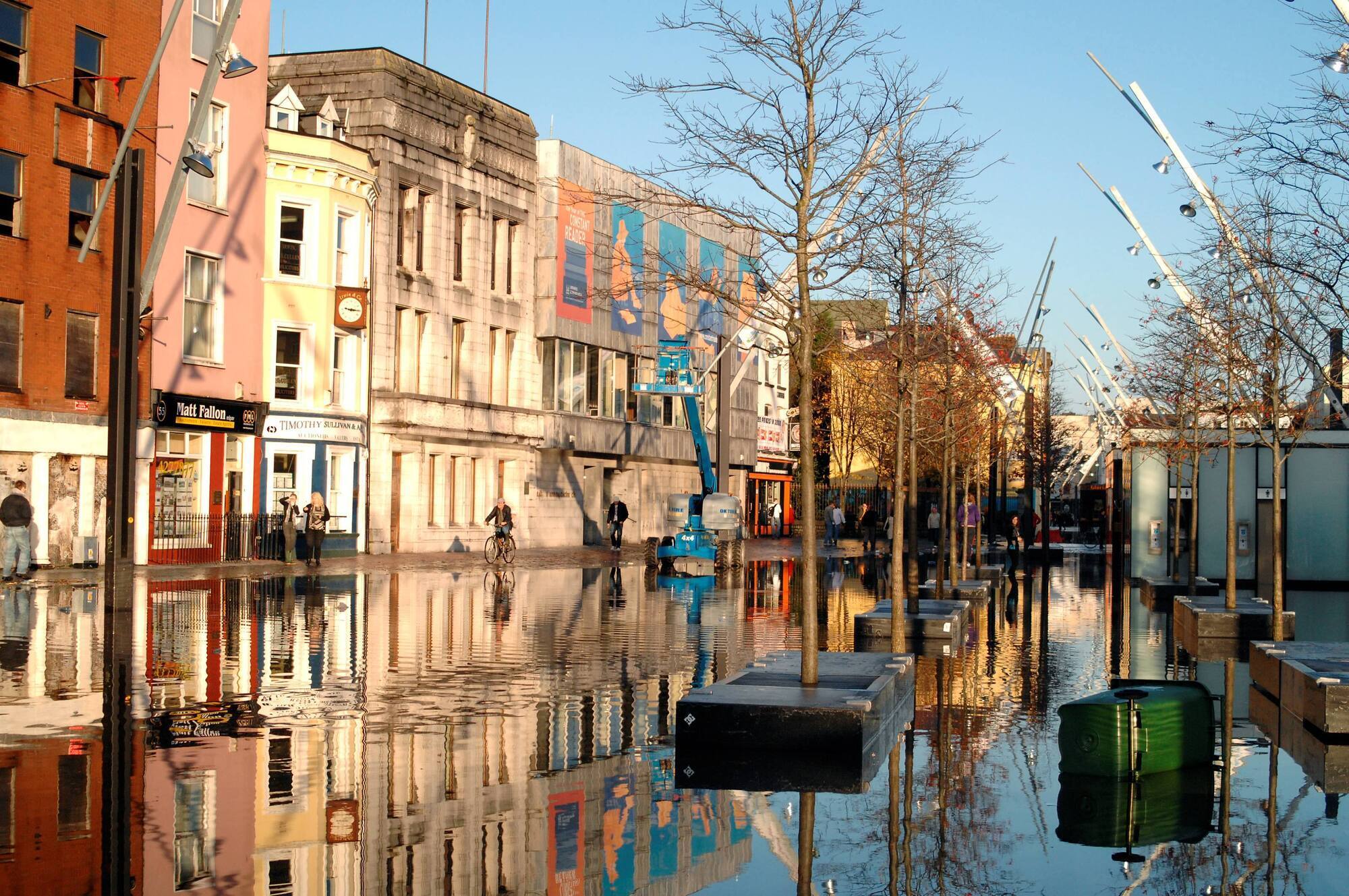
Flooding on the Grand Parade in Cork. Infrastructure will be put under increasing pressure as floods and drought damage roads.
Severe flooding, coastal erosion, and drought will leave Cork City’s most vulnerable citizens at risk by 2050 unless urgent action is taken to reduce greenhouse gas emissions.
Infrastructure will be put under increasing pressure as floods and drought damage roads and a growing population descends on limited green spaces and waterways during extended heatwaves in Cork, a new report predicts.
Increased tidal and river flooding will speed up coastal erosion and flood homes and businesses never previously impacted.
A 17% decrease in rainfall is predicted in summer potentially leading to drought, damaging water quality and biodiversity, while up to a 19% increase in rainfall is predicted in autumn and winter, both causing and amplifying existing tidal and river flooding.
Cork's growing number of elderly people will be at particular risk of heatwaves and isolation enforced by extreme weather.
The new study, commissioned by Cork City Council from KPMG Future Analytics, found that all types of river, surface and tidal flooding, droughts and heatwaves will be more frequent and severe by 2050 unless urgent action is taken to reduce emissions now, while some changes are already “locked in” due to the damage of existing greenhouse gas concentrations.
Spiralling costs, as emergency services and local authorities, homes, and businesses deal with extreme weather events are also predicted, with increased need for air conditioning, flood defences and maintenance.
The , led by Barry O’Dwyer, used the Government’s projections of what Ireland’s climate is likely to be by 2050 to estimate how the pattern of extreme weather events already experienced in Cork might change and affect its growing population.
A separate study by University College Cork (UCC), also commissioned by Cork City Council, found that two-thirds of greenhouse gases in Cork City are generated by home energy and road transport.
Cork City is releasing nearly 1m tonnes of greenhouse gases every year and the 78,856 homes in the city contribute 34% of total emissions.
Road transport, especially cars, account for another 29%.
Cork’s most congested roads, including the South Ring, N8, and Anglesea St, are emissions blackspots.
Cars accounted for almost 90% of road users.
Car ownership rates were almost double the national average in some areas, with 800 cars per 1,000 people in some areas compared to the average of 450 cars per 1,000 people nationally.
The vast majority of road transport emissions were from private car travel, with some from road freight, public service and other vehicles.
Commercial services and industry produced the third highest emmisions on 22%.
Home energy upgrades, increased use of public transport, and active travel are some of the most effective ways to tackle greenhouse gas emissions in the city, the research suggests.
In the housing sector, home heating demand accounted for 71.7% of energy and contributed 62.6% to total emissions.
The average BER was a C1 in Cork City in 2018, with 58% of the housing stock having a BER of C3 or higher.
The highest emitting housing type was detached while the lowest emitting housing type an apartment.
The study, completed by UCC’s School of Engineering and Architecture, MaREI and ERI and led by Dr Marguerite Nyhan, gathered data on emissions from homes, vehicles, and businesses.
The decarbonisation of Cork City is a complex problem, Dr Nyhan said.
"As we seek to decarbonise Cork City, it's important to highlight that this will come with significant environmental health benefits including cleaner air, better public transport, more liveable and walkable urban environments, and a healthier population.
"It's important that we maximise these co-benefits where possible," Dr Nyhan said.
"It's really important that we have extremely high-quality data and models underpinning our climate action plans.
"At UCC, we used the best available science to model and map Cork City's baseline emissions for multiple sectors.
"Our findings show that households, transport and commercial services and industry, are responsible for most of our urban CO2 emissions.
"We definitely need to drive more energy efficiency in homes and buildings.
"Retrofitting will be part of the solution going forward.
"We know that transport emissions are substantive in Cork City and we also know that our car dependence rate is very high.
"It's important that we keep investing in public and zero-carbon transport modes and infrastructure.
"We need to ensure that our cities are walkable and have excellent cycling infrastructure.
"It's really important that we design urban environments that will support behaviour change at scale going forward.
"The just transition is extremely important and as we rapidly decarbonise, we need to ensure that we don't leave anyone behind and we protect the most vulnerable in society.
"In addition to mitigating climate change in cities through emissions reductions, we unfortunately also need to adapt our cities to climate change.
"It's important that we design measures and develop infrastructure that will be resilient to extreme weather events such as flooding going forward."
Check out the Irish Examiner's WEATHER CENTRE for regularly updated short and long range forecasts wherever you are.
CONNECT WITH US TODAY



Be the first to know the latest news and updates