Irish group captures 'advanced image' of one of the youngest stars known to scientists
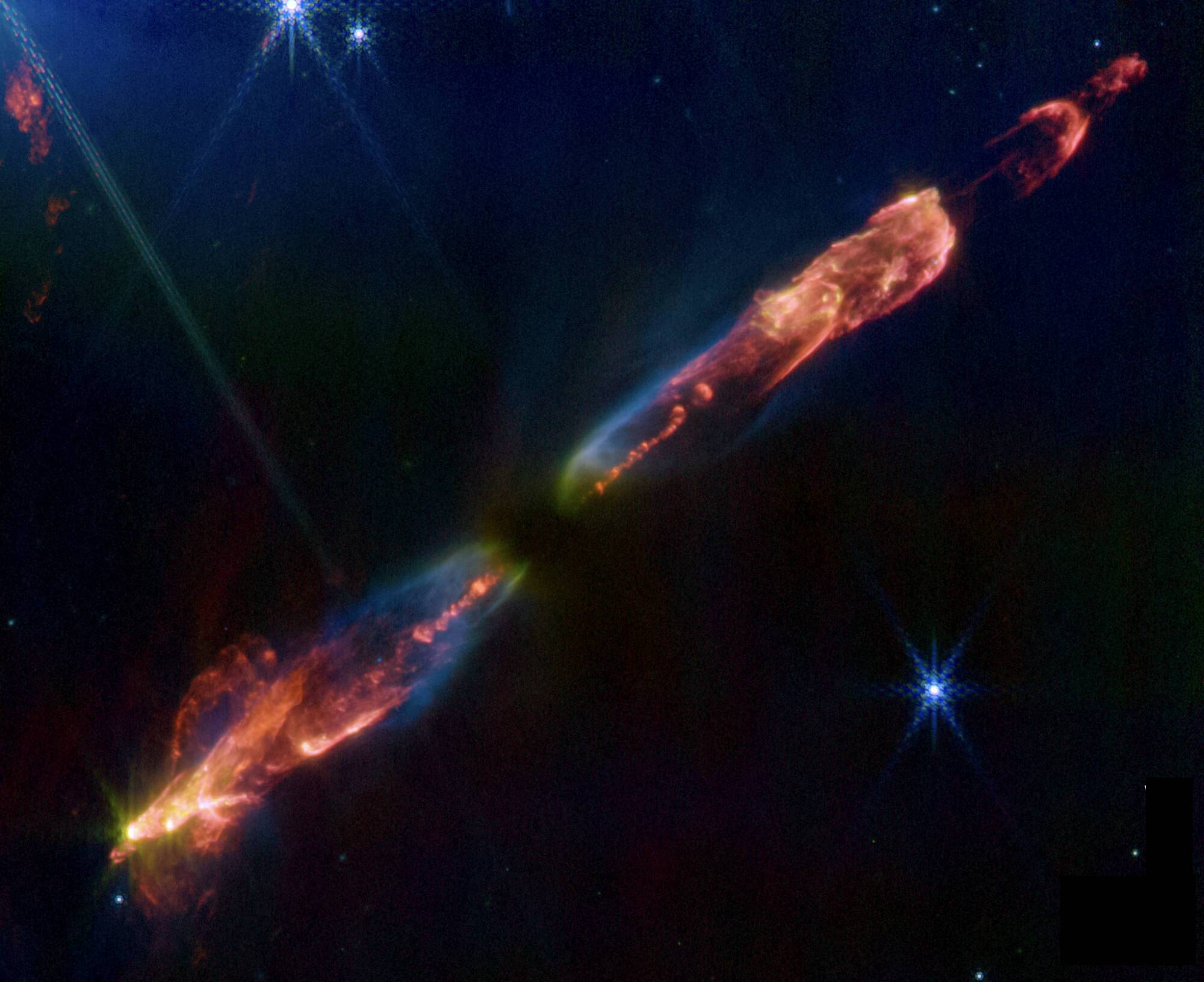
The James Webb Space Telescope view of the star named ‘Herbig-Haro 211-mm’.
A team of Irish astronomers have captured an out-of-this-world image of one of the youngest stars known to scientists.
The group, led by senior professor and director of cosmic physics at the Dublin Institute for Advanced Studies Tom Ray, published its “exciting discovery” in the scientific journal .
The discovery, made using the James Webb Space Telescope, allowed the crew to capture an image of the star named ‘Herbig-Haro 211-mm’. It is believed to be only a few thousand years old.
Prof Ray, who was the lead author of the paper, credited the “infrared light” used in the telescope to allow them to capture a clear picture of the young star.
These new stars are generally “enshrouded in gas and dust” and are difficult to view from Earth, he said.
“One very exciting discovery from this new image is that when a star comes into being it emits highly supersonic beams of matter that can stretch for several light-years."
With the use of infrared light which penetrates through the gas and dust surrounding the stars, the group can reveal the “stellar births” such as this.
The group also concluded that young stars such as Herbig-Haro 211-mm, are seen to emit beams of almost pure molecules, debunking what astronomers previously understood.
However, how such beams are produced is currently a mystery, he added.
Prof Ray described stars as having “a beginning and an end just like the rest of us”, albeit taking thousands of years.
“By developing our understanding about how they are born, through breakthroughs such as this, we are deepening our knowledge on how our sun and the solar system came into being,” he said.
The telescope, launched in December 2021 in collaboration with Nasa, the European Space Agency and the Canadian Space Agency, is currently the world’s largest.
The main aim of the telescope is to understand how stars and planets are formed, with plans to look deeper into space, collecting data from the earliest stars, planets and galaxies in the universe, over the course of its 10-year mission.
As a result of the group's involvement in the development of the telescope, the astronomers at the Dublin Institute for Advanced Studies
have been gifted access to the Webb telescope for the further study of star formation.
The study of Herbig-Haro 211 was conducted as part of the JOYS (JWST Observations of Young protoStars) programme.
CONNECT WITH US TODAY



Be the first to know the latest news and updates