'Entire world is vulnerable' if Greenland's ice sheets melt
'Entire world is vulnerable' if Greenland's ice sheets melt

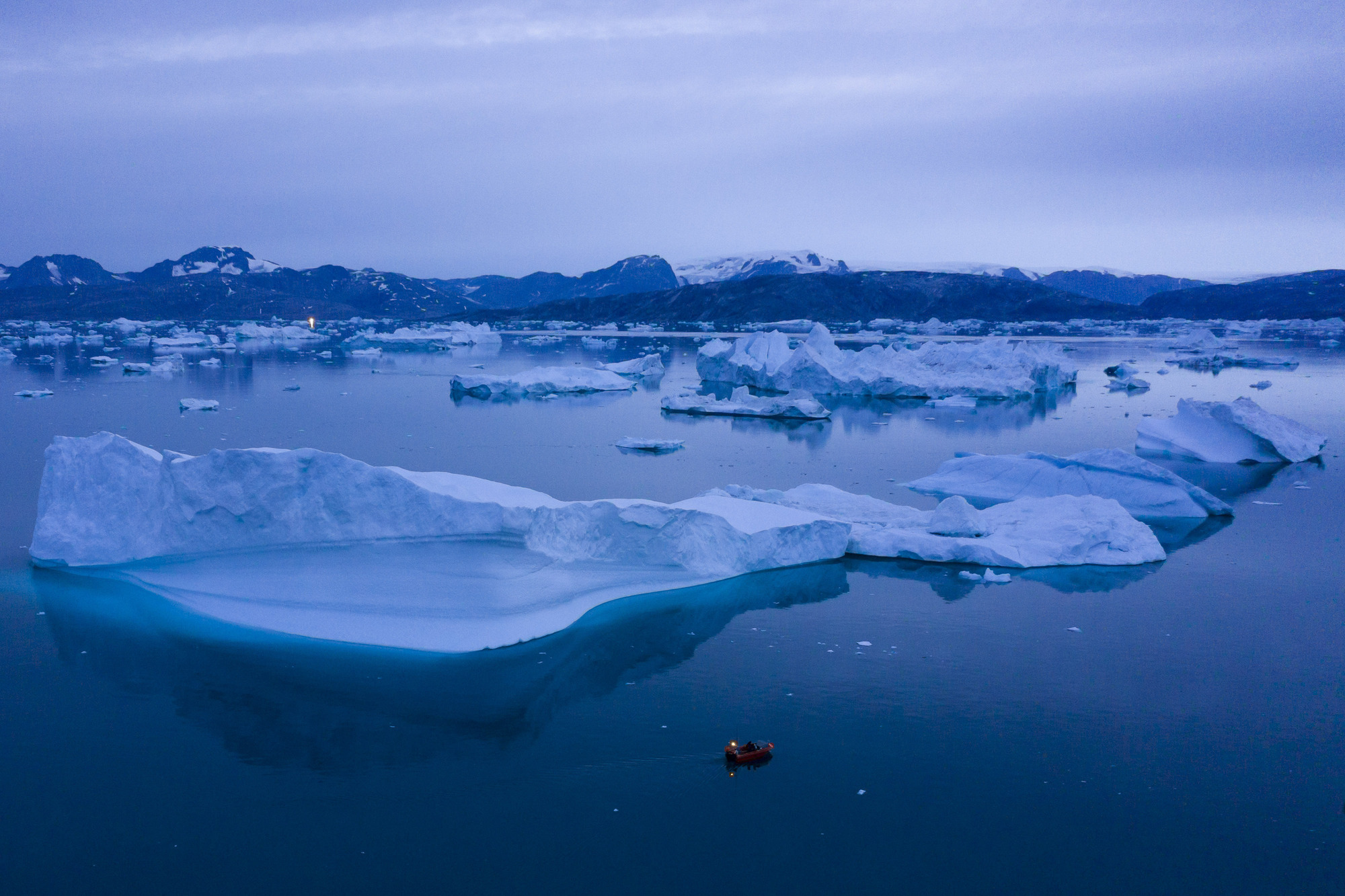
A boat navigates at night next to large icebergs near the town of Kulusuk, in eastern Greenland . Picture: Felipe Dana, File)

Greenland’s famed ice sheet may be more sensitive to human-caused climate change than previously thought, with irreversible melting likely over the coming centuries, an in-depth study has found.

The entire world would be left vulnerable with the rise in sea levels brought on by the ice melting, researchers warned.

Scientists from 16 institutions including Lawrence Livermore National Laboratory (LLNL), the University of Vermont (UVM), and Utah State University looked at the stability of the Greenland ice sheet over the last two and a half million years.

They found that moderate global warming nearly 400,000 years ago, similar to the rate today, led to at least one fifth of the entire Greenland ice sheet melting, and subsequent sea level rise of five feet.

The five foot rise in sea levels came despite levels of heat-trapping carbon dioxide in the atmosphere being far lower than is seen today.

This led to the scientists concluding that Greenland is more at risk than previously believed, and paints an ominous picture for the rest of the world.

University of Vermont scientist, Paul Bierman, who co-led the new study, said: “Greenland’s past, preserved in 12 feet (3.4 meters) of frozen soil, suggests a warm, wet, and largely ice-free future for planet Earth, unless we can dramatically lower the concentration of carbon dioxide in the atmosphere.” Every coastal region in the world is at risk because seven metres of sea level rise globally is tied to Greenland’s ice sheet, the scientists said.

Utah State University scientist Tammy Rittenour said: “If we melt just portions of the Greenland ice sheet, the sea level rises dramatically. Forward modeling the rates of melt, and the response to high carbon dioxide, we are looking at meters of sea level rise, probably tens of metres.

“And then look at the elevation of New York City, Boston, Miami, Amsterdam. Look at Bangladesh, India, and Africa — most global population centers are near sea level.” Ireland is also vulnerable to sea level rise, with areas such as Cork and the Shannon Estuary particularly in the firing line, previous modelling has shown.

The country is not taking the threat of sea levels rising nearly seriously enough despite Youghal, Midleton, and Cobh likely to be directly impacted, according to Cork East TD David Stanton.

Other countries are far ahead of Ireland, Mr Stanton said, as he called for a national strategy to mitigate against the coming changes.

“This is not a question of if, but when it happens, yet because of short-term political cycles, it does not seem to be pressing. There are three towns alone in my constituency that would have me worried — Youghal, Midleton, and Cobh — with dozens of others around the country that are vulnerable in the likes of Limerick and Waterford,” he said.

According to the UN-backed Intergovernmental Panel on Climate Change (IPCC), sea levels across the world have accelerated since the 1970s, rising more in the last century than any other over the past 3,000 years.

Recent research has shown it is too late to save Arctic ice in the summer, with the region to be ice-free in September in the coming years.

More in this section

Lunchtime News

Newsletter

Get a lunch briefing straight to your inbox at noon daily. Also be the first to know with our occasional Breaking News emails.

Cookie Policy Privacy Policy Brand Safety FAQ Help Contact Us Terms and Conditions

© Examiner Echo Group Limited