EU assistance key to helping secure Irish defence
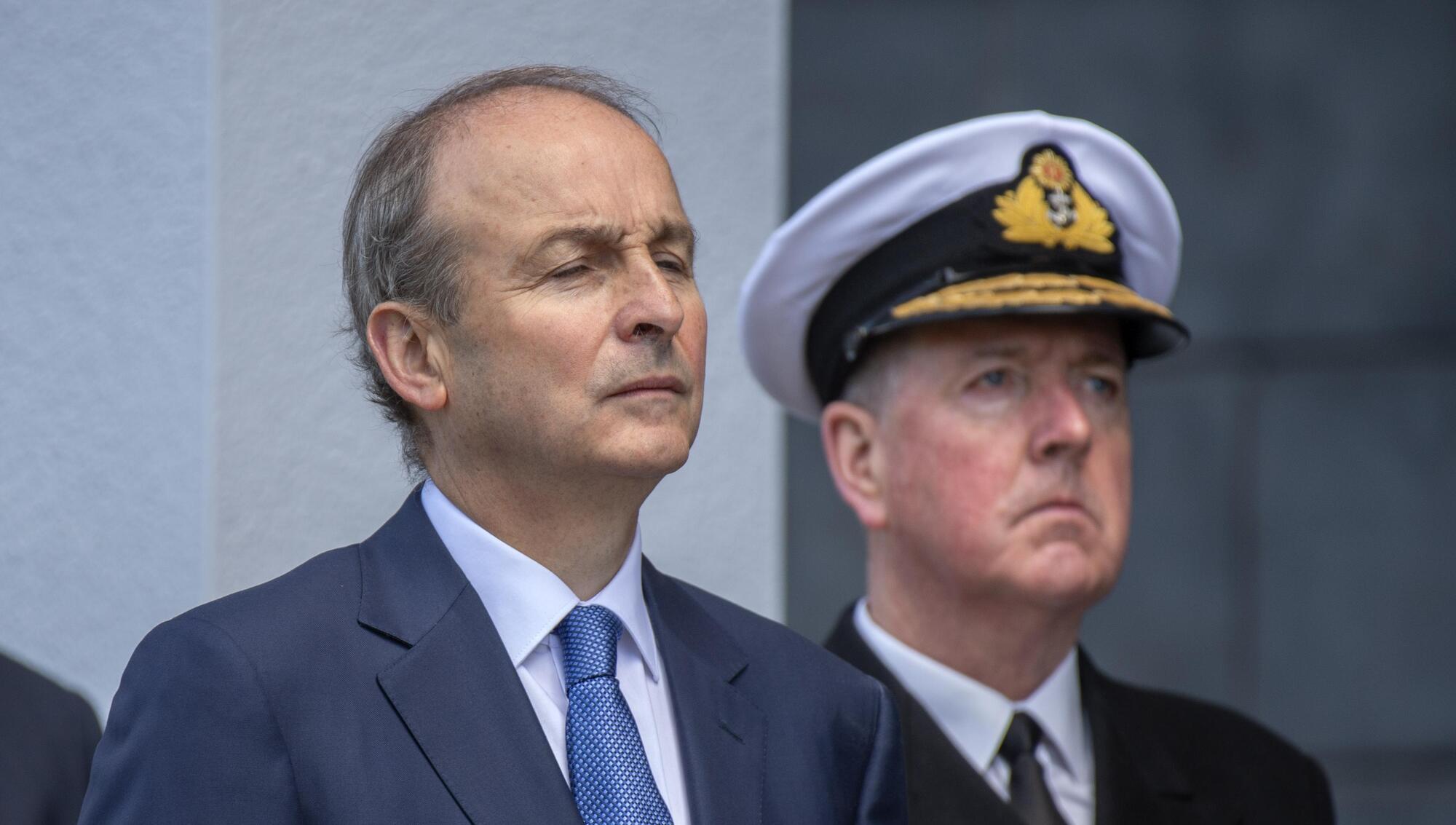
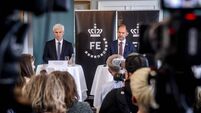
Retired Vice Admiral Mark Mellett with Tánaiste Micheal Martin. Mr Mellett said Ireland had massive maritime and air security responsibilities
Ireland needs to work with international organisations, like the EU, and with neighbours in order to secure its own defence, the former head of the Defence Forces has said.
Retired Vice Admiral Mark Mellett said Russia’s invasion of Ukraine has further pushed the EU’s defence and security capabilities onto the agenda.
He said Vladimir Putin’s invasion had created multiple implications for international bodies, with “increasing evidence” of Russian war crimes, crimes against humanity and even, possibly, genocide.
Addressing the Dublin-based Azure Forum for Contemporary Security Strategy, the ex-chief of staff said Ireland had massive maritime and air security responsibilities, geographically positioned on the western flank of Europe.
“In recent years, the activities of fundamentalist terrorists together with growing espionage are regularly reported as serious threat vectors in Ireland,” he said.
“Russian Federation plans for an expansion of its embassy have also been widely reported," he said.
"It is important to recall, in the lead up to the invasion of Ukraine, the hybrid operation and arrogance of the Russian Federation in declaring its intent to appropriate 5,000 square kms of Ireland’s Exclusive Economic Zone for five days in order to carry out artillery and rocket exercises.”
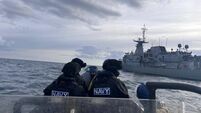
The former head of the Irish Naval Service said Ireland had one of the largest maritime jurisdictions in Europe, encompassing almost one million sq km.
“There has been a significant growth in the installation of subsea communications cables some of which land into Ireland while others transit through waters where the Irish State has jurisdiction," he said. "More recently, foreign interference of these cables has been reported."
He said airspace, where Ireland has competence, was “a gateway for over 90% of air traffic” between Europe and North America.
“Commercial air travel through the area has been subject to regular disruption by Russian Federation military aircraft,” he said.
He said the Russian Federation’s invasion of Ukraine has had multiple implications for international institutions.
“There is increasing evidence of war crimes, crimes against humanity and even perhaps the most grievous of all, the crime of genocide. Moreover, this war is bringing the matter of EU Strategic Autonomy more clearly on to the agenda.”
He said the national approach to defence needs to change “from one where it sits siloed in defence to a whole of government approach” that includes industry and civil society.
He said it should be accepted that “it is simply impossible” for an individual state to provide for its own defence unilaterally.
“Therefore, credible engagement in multilateral institutions such as the EU and bilaterally with neighbours, where necessary, is essential,” he said.