Nursing homes in Covid: 'I was clawing at the window, telling her I loved her'
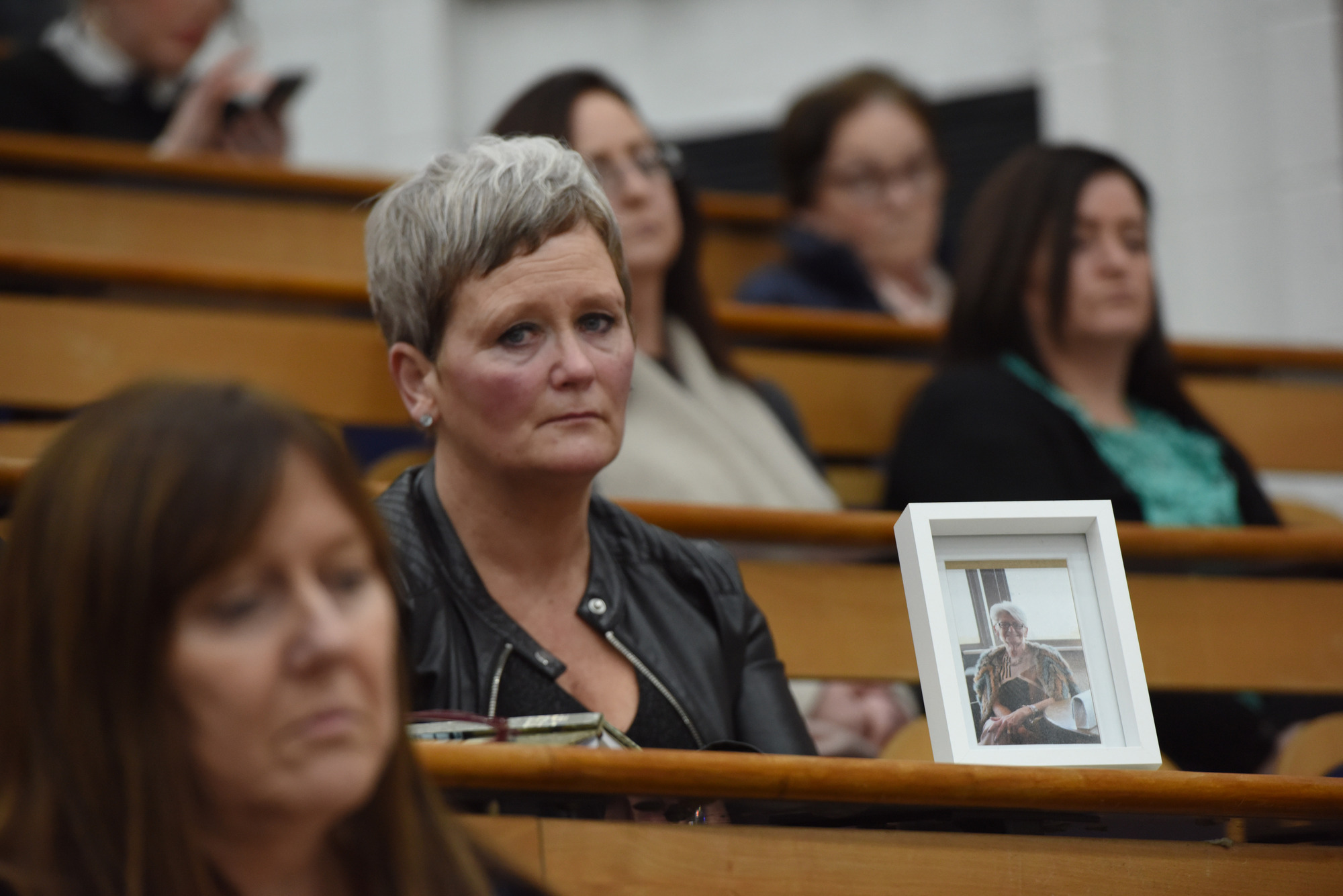
Alison Mc Carthy, Ballyvolane, listening to speakers at a seminar in DCU organised by Care Champions. The photograph beside Ms Mc Carthy is her of her mother Alice who passed away two years ago. Picture: Moya Nolan
The “traumatic” conditions in nursing homes during the Covid-19 pandemic has devastated families and care workers, a public conference has heard.
Advocacy group Care Champions is seeking an immediate public inquiry into the treatment of older people in residential care.
The group's founder Majella Beattie says many families remain traumatised by the suffering and deaths that marked the early phases of Covid-19.
“We will use our voices and we will remain vocal until residents and their rights are protected in law,” she said, before calling for a human rights-led public inquiry.
Families told the conference about not being able to comfort their loved ones in their final moments, while a "lucky few" were able to watch them pass away through windows.
“Luckily, my mummy was on a ground floor (near windows), so my heart breaks for those residents who were on a second floor or third floor,” said Martina Ferguson.
Mitchell Ryan, a former care worker, said he had to leave his job and required professional help to cope with what he witnessed.
He worked in numerous care homes and said the lack of interaction for residents led to depression and deteriorating health conditions.
Mitchell said one nursing home had just seven workers caring for more than 70 residents “on a good day”, which sometimes led to residents not getting out of bed until 3pm.
He said residents suffered bed sores because of the lack of movement.
“I had one where we could see the hip bone, it was that bad,” he said.
"We were raising concerns but were not given any help.
"The issues were systemic and severely impacted the quality of life for residents."
A letter written by Jim Foley, a resident in a Dublin nursing home, was read out, describing the “never-ending” loneliness.
“I never want there to be a time again where anyone in charge tells me that I cannot see my wife, especially my wife, or my children, and grandchildren," he wrote.
"I felt like I did not own my own life, like I was not a person who had any value, like I counted for nothing."
The Irish Association of Social Workers chair Vivian Guerin said there is an “out of sight, out of mind nature” to care.
Despite visiting restrictions being “understandable” during early stages of the pandemic, there was a failure to adopt solutions seen elsewhere, he said.
“In Denmark, for example, visiting restrictions were banned in summer 2020 recognising that people in care homes don’t want to simply exist, they want to live,” he said.
Mr Guerin said Ireland seems to have a “hangover” from its years of “institutionalising people” which he described as a “we know best approach”.

Christine Brohan, from Farranree in Cork, spoke of her mother Kathleen and the day she died.
Ms Brohan was told days prior to her mother’s death that staff members had tested positive but that everything was “fine”.
Days later, she rang to check on her mother and was told that she had had “a very bad night” and was on oxygen.
It was then she was informed of her mother’s diagnosis and was told 'I thought you knew'.
Out of 50 residents, 49 had tested positive for Covid-19.
Ms Brohan was told to come to the nursing home immediately on February 1, 2021.
“He pulled the curtains back and my mom was there, dying on her own,” she said.
“For over two hours, we stood outside that window in a storm watching her, I was actually clawing at the window telling her I loved her,” she said.
“I relive it every single day.”
Nursing Homes Ireland was contacted for comment.

CONNECT WITH US TODAY



Be the first to know the latest news and updates