Call for change in how women of colour are treated in maternity services
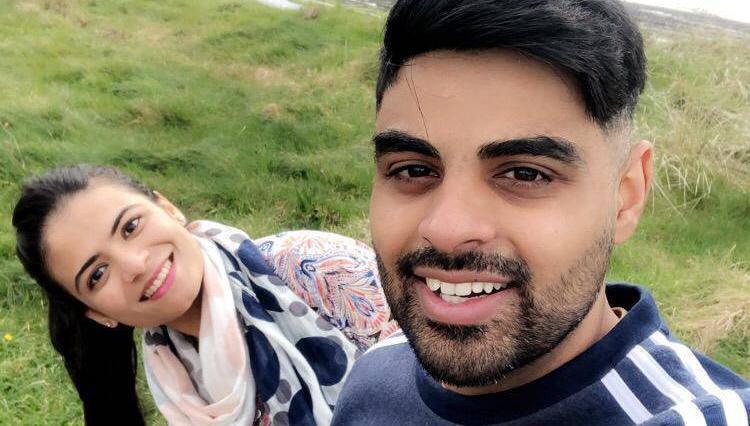
Nayyab Tariq and Ayaz Ul Hassan. Ms Tariq died four hours after giving birth at Mayo University Hospital.
The husband of a woman who died after giving birth in Mayo has called for change in how women of colour are treated in maternity services here and in Europe.
Ayaz Ul Hassan’s wife Nayyab Tariq, 28, died on March 22, 2020, at Mayo University Hospital, having given birth four hours earlier. An inquest last year recorded a verdict of medical misadventure.
Mr Ul Hassan will speak next week in Brussels at an exhibition of the Elephant Collective’s ‘Picking up the Threads' quilt.
The collective is a group of Ireland-based educators, midwives, midwifery students, families, birth activists, artists, and lawyers who campaigned for mandatory inquests following maternal deaths.
Between 2007 and 2021, there were 13 inquests on maternal deaths leading to 13 verdicts of medical misadventure. Six women whose deaths were examined in these inquests were women of colour.
Mr Ul Hassan said: “The exhibition is to raise awareness that this is not just happening in Ireland.
"The statistics that the collective see form a very similar pattern in the UK and Europe in terms of maternal care, especially to coloured females.”
He added: “The fight is to make maternal care equal for everyone, and better for everyone. We are trying to raise awareness, and get procedures put in place, anything that needs to be done to make the services better.”

He supports the campaign led by Dr Jo Murphy-Lawless from the collective.
He will be joined on the panel by Sean Rowlette, whose wife Sally, 36, died after giving birth at Sligo University Hospital in 2013.
“They asked me and Sean if we can speak a little bit, from our own experiences,” Mr Ul Hassan said.
“Speak about something which could have been avoided but here we are, and the impact it has had on us as a family, and our extended family. Change needs to happen, not just in Ireland but in other EU countries as well.”
Research fellow at the Centre for Health Evaluation, Methodology Research and Evidence Synthesis at University of Galway Dr Jo Murphy-Lawless has long campaigned for more transparency around these tragedies.
The 2019 Coroners (Amendment) Act brought “significant and important change” for bereaved families, she said.
“No family wants to face an inquest when they are burdened with deepest grief. But it is crucial for them to know how wives, partners, sisters, daughters, have lost their lives,” she said.
“It is also crucial for us, the wider society to know how and why our maternity services have failed women in their care, in order to ensure no repetition of such a tragedy.”
The next two maternal death inquests here involve Geraldine Yankeu from Cameroon and Tatenda Mukwata from Zimbabwe, she said.
The event will also highlight powers in the act enabling coroners to "compel hospital groups and the HSE to release their reports" to coroners.
The exhibition is hosted by MEP Claire Daly, who has always supported the collective’s work, she said.