'At last, I know whose funeral I was at': Families of missing persons demand action on cases
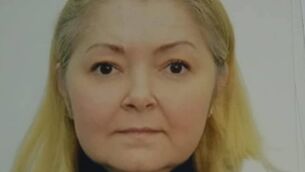
Claire Clarke-Keane sister of Priscilla Clarke who went missing while out horse-riding at the Dargle river close to Enniskerry, Co Wicklow in 1988
The sister of a woman missing for 35 years has bemoaned the fact that so many missing persons cases in Ireland “could have been solved earlier”.
The annual National Missing Persons Day event in Dublin, the first in-person since pre-pandemic times, heard from Claire Clarke Keane, whose sister Priscilla disappeared in Wicklow in 1988, that it should be “mandatory for coroners to hold inquests on all unidentified remains”.
Ms Keane told the event at Croke Park that she is deeply sceptical of the official figure of 26 for unidentified bodies in Ireland.
She said she had visited the gravesite of a man missing for 30 years in 2015 in Navan and had been shocked when told by the undertaker that “there’s a couple more of them buried down there as well”.
That man was recently identified as Paul McGinty, a Donegal man who had disappeared in 1990, following the media broadcast of an artist’s impression of what Mr McGinty would have looked like when discovered.
“It’s surreal. Now, at last, I know whose funeral I was at,” Ms Keane said.Â
“This could have been done in 1990. I cried at his grave, and felt the indignity where a person has no identity and no one to care for their grave.
“There’s a couple of them buried down there, meaning there are others buried at St Mary’s graveyard in Navan. Where else are they buried? And is my sister one of them?”
She called for An Garda Siochana to release any pictures they have when remains are found, and for families to be appraised of the genuine figure for unidentified persons across the country.
“Families must be given this information,” she said. “You’re not saving them pain by not telling them. You’re causing them more pain, you’re keeping a wound open, not creating a new one, and causing mistrust.”Â
She said that a public database of unidentified persons should be made available similar to one which currently exists in the UK.
Those gathered heard that 897 people are currently considered missing across the island, 836 in the Republic and 61 in Northern Ireland.
The Director of the National Missing Persons Helpline Dermot Browne told the event that 3,000 missing persons reports have been filed on average each year since the helpline was set up in 2003.
“That figure is coming up on 57,000,” he said, adding “why is this happening?”Â
The statistics show that 13-17 year-olds are by far the largest age demographic for missing people, the majority of whom are located inside 72 hours.
“We’ve had people telling us that they had gone missing in the past to see if anyone cared, or if anyone would notice,” Mr Browne said.
He said that every missing person case “has huge impacts on families and friends, physical, financial ... no matter how brief the absence”.
“Some describe it as more traumatic than dealing with death,” he said, adding that cases can be compounded by media intrusion and “sensational reporting”.
“These people are not entertainment, they should not be treated as such,” he said.