'My son Kevin Sheehy was killed in Limerick. I want his killer to serve his sentence here'

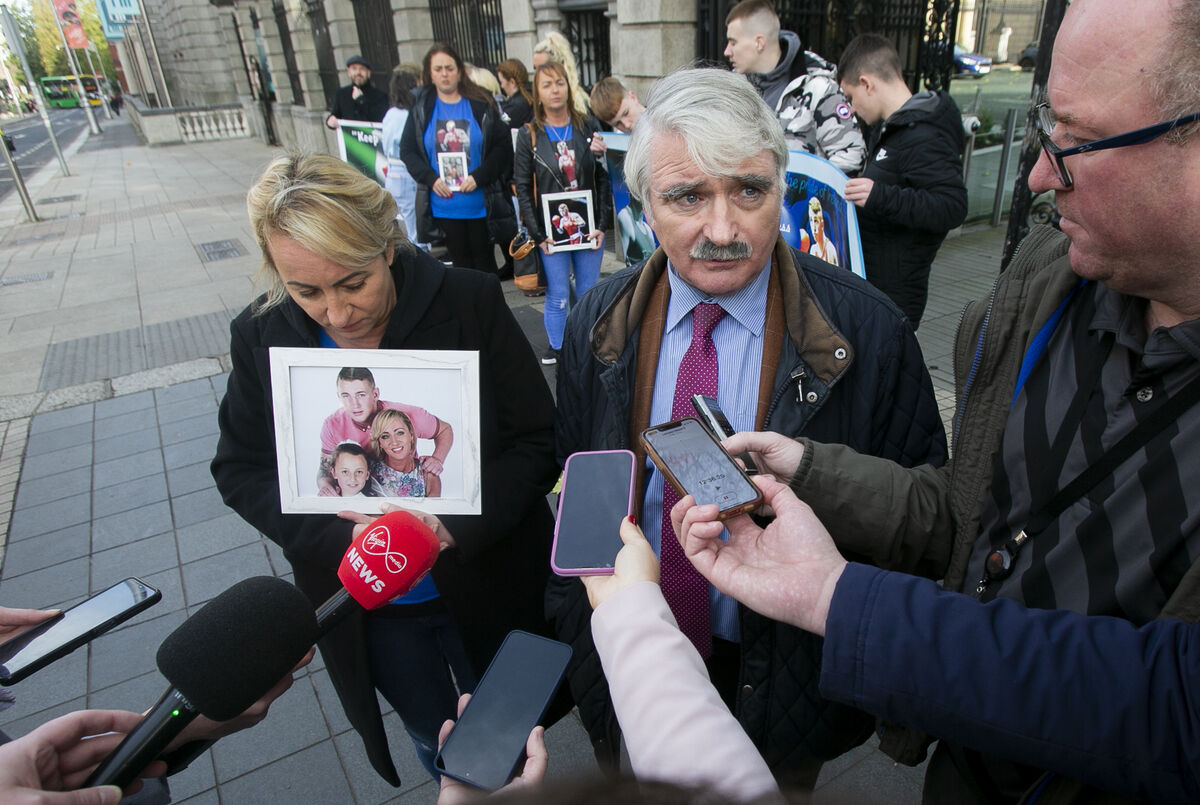
Kevin Sheehy's parents Kevin Sheehy Snr and Tracey Tully at a protest outside Leinster House on Friday as part of their campaign to keep their son's killer Logan Jackson in an Irish prison. Picture: Gareth Chaney/ Collins
"I am so tired," Tracey Tully says. "From day one I felt so powerless, I was portrayed as another grieving mother, which I am, but I am also Kevin's mother. I had to drag myself up and question this because no one else was."
Kevin Sheehy was a champion boxer and Olympic hopeful, and when he was murdered in a deliberate hit-and-run in Limerick in 2019 it set off a chain of events which still rumbles on to this day.
Kevin's killer, British-born Logan Jackson, was jailed for life last December, and yet Ms Tully has found herself back in the courts throughout the year after learning Jackson was to be granted a transfer to a British prison — something she vehemently opposes.
It has reopened the debate over the practice of removing or transferring people from the State, whether they are inside or outside the prison system.
For some survivors of serious crime, and the loved ones of those affected, the idea the perpetrator might be far away is an appealing one.

But Tracey Tully's viewpoint flips that argument: what if the transfer erodes even further any sense of justice there might be for something as heinous as murder?
Last July in the High Court, Ms Justice Siobhán Phelan granted Tracey Tully leave to appeal a decision by Justice Minister Helen McEntee to sanction the prison transfer last March.
Ms Tully says she still does not know the grounds for original decision, nor was she informed beforehand that a transfer was being considered.
"We had to wait two-and-a-half years for a trial, we were very respectable at the court, we honoured the court, we did everything we were asked to do," she says.
"When it was brought to our attention finally it was already decided."
Ms Tully's solicitor, Sinead Nolan of Mark Murphy and Co Solicitors, says "we were in the dark" about the move and agrees the reasons for the ministerial order are still unknown.
"We do have a submission from Logan Jackson himself, and what I would call a 'poor me' submission," she says, referring to the Englishman's references to being in solitary confinement 23 hours a day.
For Ms Tully and her legal team, a transfer to a UK prison is a win for Jackson, meaning they would lose their right to engage with any future parole application. They also believe his life would be made easier were he to be transferred.
The latest development is that the minister has said she would review the decision, and Ms Tully is due in court again on November 10.
Yet it was also indicated at a previous court appearance that the minister's legal representatives are reserving their position on costs — which in the view of Ms Tully and Sinead Nolan means the Limerick grandmother could be on the hook for the fees of the State and Jackson, who is notice party to the proceedings.
However, while it is understood this is unlikely to happen, a level of uncertainty persists.
It is not that prisoner transfer is that common in the first place. Figures provided to the by the Department of Justice show a total of 11 people detained in Irish prisons have been transferred out of this jurisdiction under the Transfer of Sentenced Persons Act in the past three years.

A far likelier route out of the country is a removal order, which also takes place under ministerial order. The figures show 138 people were the subject of removal orders across 2019 to 2021, inclusive, and that all were serving custodial sentences at the time.
A removal order is not, however, a one-way ticket. This newspaper reported in early 2019 on the case of Ioan Munteanu, of 2 Mill Road in Millstreet in Co Cork.
He had been convicted of rape in Manchester Crown Court on June 25, 2004 and sentenced to six years in prison. On his release, he moved to Ireland and by 2010 had come to the district court's attention over his failure to inform an employer of a sexual offence, contrary to the Sex Offenders Act 2001.
At the time, he was a driver for a Youthreach project in Cork. By 2014, he was the subject of a removal order for five years and left the State voluntarily. That, at least, is what the court was told in 2019, when it emerged he had returned to his native Romania, changed his name to Ioan Kovacs, and promptly returned.
Saoirse Brady, executive director of the Irish Penal Reform Trust points out that Ireland has had legislation since the late 1990s which provides a mechanism whereby non-Irish people serving sentences in Ireland may apply to serve the remainder of their sentences in their countries of origin, where those countries are party to the Council of Europe Convention on the Transfer of Sentenced Persons.
"In September 2022, there were 612 foreign national prisoners in custody in Irish prisons," she says.
"Looking at the 2021 report on the Transfer of Sentenced Persons Acts 1995 and 1997, only 13 transfers were requested in 2021. The main delay on progressing these applications would appear to be on the part of the receiving state.
"We do not know why the number of applications is so few, but we would welcome information being made available on whether a person was informed of their right to apply for a transfer in a language they can understand.
“Earlier this year, our report ‘Sometimes I’m Missing the Words’ highlighted the isolation felt by foreign national prisoners, which often impacted on their psychological health and wellbeing, as financial barriers meant that it was difficult for their families to travel to visit them from other countries.
"Each request for transfer should be decided on the individual circumstances of the case, in line with the set criteria which includes taking into account the human rights conditions in the country to which a person would be returned, whether it is in the interests of justice to return them, as well as the social reintegration supports that are in place.
"While a person will still have to serve their sentence in the other country, a longer sentence cannot be imposed."
The Department of Justice said it does not comment on matters that are the subject of ongoing judicial proceedings but did elaborate on prisoner transfer and removal orders more broadly: for instance, pointing out that because prisoner transfer is covered by a Council of Europe Convention dating back to 1983, Brexit has no impact.
Removal Orders are also covered by the European convention and a department spokesperson said: "Generally a removal order can be made where a person no longer has an entitlement to be in the State or where an individual is deemed a danger for public policy by reason of the fact that his or her conduct represents a genuine present and sufficiently serious threat affecting a fundamental interest of society.
Where an EU citizen has been residing in the State for more than ten years, they can only be removed on imperative grounds of public security.
"A previous criminal offence does not in itself constitute a ground for the making of a removal order. However, where a removal order is made in respect of somebody who has been convicted of a criminal offence, it would normally be effected just as that person is released from prison."
For those deemed a danger for public policy, a removal order must be carried out within two years of its making and can be accompanied by an exclusion order which can exclude the person from the State for a period specified on the order concerned.
Any failure to comply with either a Removal Order or an Exclusion Order is an offence and a person is liable for a fine or imprisonment if convicted.
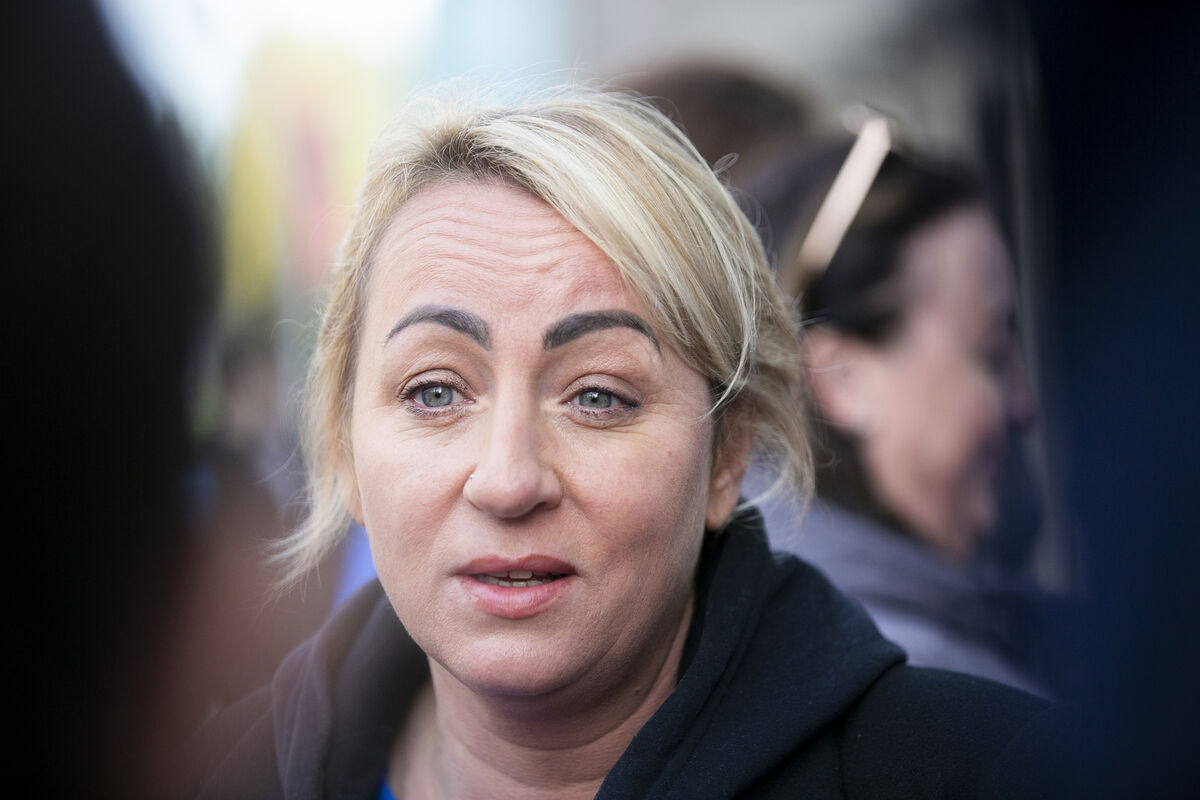
But for Tracey Tully, the crime of her son's murder means the sentence served by Logan Jackson should be served here, at least in large part. It symbolises Jackson being held to account, remaining subject to our prison system, and allows her to have continuing impact regarding any future parole application or early release date.
The fight so far has had its own impact. "It has taken a toll on me at the moment," she says. "I am drained, I am tired."
Far from looking ahead to the 2024 Olympic Games, she is instead grandmother to Keveah, born after Kevin was killed. The effect of Kevin's death has been "devastating".
"My granddaughter has never seen her daddy," Ms Tully says, adding she "deserves a reasonable explanation" over Jackson's transfer request, one she says has enraged her whole community.
"It is not through bitterness or anger," she says. "I just feel and felt it was wrong."

CONNECT WITH US TODAY



Be the first to know the latest news and updates