How to watch this morning's partial solar eclipse in Ireland
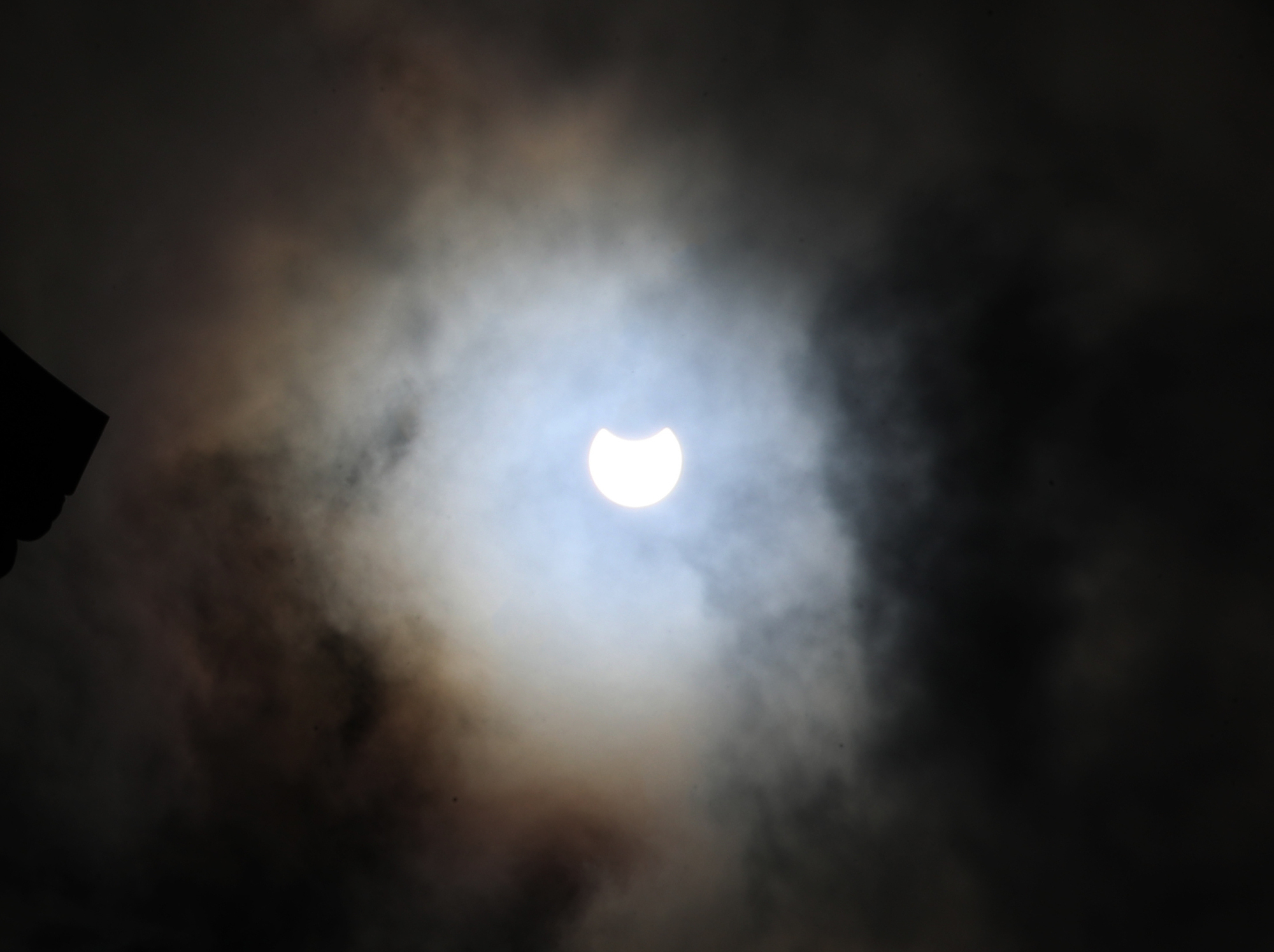
Partial solar eclipses happen when the moon comes between the sun and Earth.
A partial solar eclipse will be visible in Irish skies later this morning and experts say the sun will look like it's had "a bite taken out of it."
Partial solar eclipses happen when the moon comes between the sun and Earth.
The eclipse will begin at 10:07am and end at 11:36am.
However, optimal viewing will be at 10:51am when 20% of the sun's diameter will be covered by the moon.
Irish stargazers will get a "fairly decent view" according to Astronomy Ireland who say the eclipse will occur fairly high in the sky.
The partial eclipse will sweep across Europe, west Asia, northeast Africa, and the Middle East.
Observers in western Siberia, Russia will get the best view as up to 85% of the sun's surface there will be blocked by the moon.
Dr Robert Massey, of the Royal Astronomical Society in the UK said looking directly at the sun can cause serious damage to the eyes, even when a large fraction of the solar disc is blocked out.
It is also not wise not to look at the sun through binoculars, telescopes or a telephoto lens on an SLR camera.
He added: “The simplest way to watch an eclipse is to use a pinhole in a piece of card.
“An image of the sun can then be projected on to another piece of card behind it (experiment with the distance between the two, but it will need to be at least 30 cm).
“Under no circumstances should you look through the pinhole.”
Dr Massey said another popular method used to view an eclipse is the mirror projection method.
He said: “You need a small, flat mirror and a means of placing it in the sun so that it reflects the sunlight into a room where you can view it on a wall or some sort of a flat screen.
“You may also have eclipse glasses with a certified safety mark, and these are available from specialist astronomy suppliers.
“Provided these are not damaged in any way, you can then view the sun through them.”
Binoculars or telescopes can also be used to project the image of the sun.
Dr Massey said: “Mount them on a tripod, and fit one piece of card with a hole in it over the eyepiece, and place another between 50 cm and a metre behind it.
“Point the telescope or binoculars towards the sun and you should see its bright image on the separate card.”
For those keen to follow the event, the Royal Observatory Greenwich will live-stream the eclipse on its website and YouTube channel.