Leading Irish Muslim cleric condemns Rushdie attack
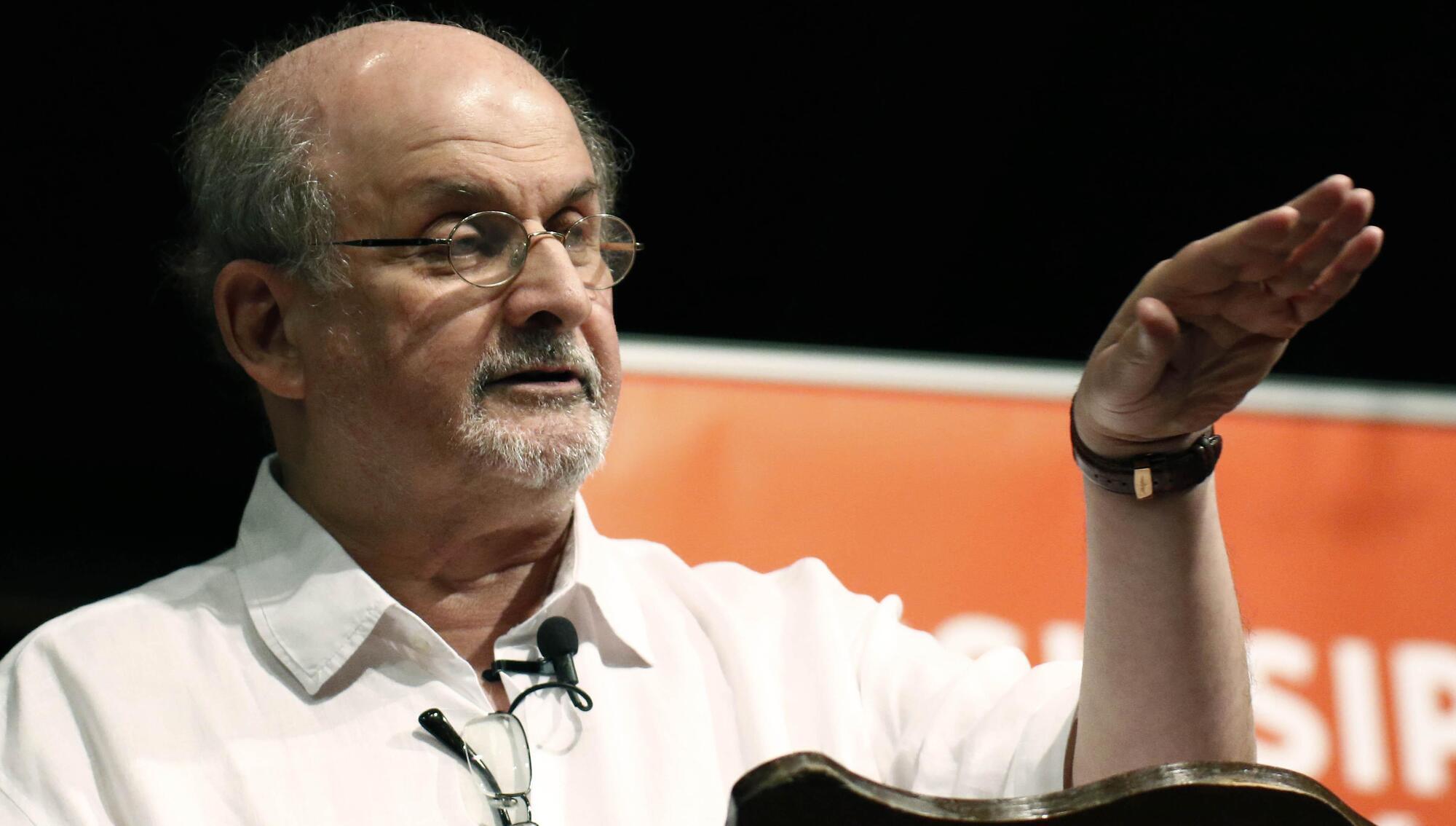
Author Salman Rushdie was attacked last Friday while giving a lecture in western New York.
A brutal attack that left writer Salman Rushdie fighting for his life in hospital has been condemned by a leading Irish Muslim cleric and theologian.
There is no justification for violence, especially not against someone for writing satire, Shaykh Dr Umar Al-Qadri, Islamic Theologian, founder and chairperson of the Irish Muslim Council and Chief Iman and Mufti at the Islamic Centre of Ireland, said.
“Most Muslims are upset," he said.
“We condemn this, just like we condemn violence against [French satirical magazine where employees were slaughtered in the name of Islam] Charlie Hebdo.
“I was shocked when I read the news that he was stabbed when he was about to speak at a conference in New York.
“I believe that the attack is absolutely not justified. There is no justification for violence, especially not when someone has written a piece of satire,” he told RTE.
He said that the Quran teaches Muslims to turn the other cheek when they feel insulted or disrespected by someone — not to turn to violence.
“People should, as Muslims, just do what the Quran says. The Quran says just ignore, if you don’t like someone, you feel like someone has insulted you or disrespected you, just turn your face and ignore it. That is what the Quran instructs us to do.
“I do not stand with the Fatwa and there are many Muslim scholars around the world that simply say there is no need to respond to it.”
Much unnecessary hardship has been caused by the Fatwa and the recent attack, Shaykh Al-Qadri said.
Outrage following the initial publication of was sadly exploited by a religious leader, probably just for political motivations which was very sad, he said.
“Salman Rushdie had been living quite a normal life. It’s so sad that somebody silly, among almost 2bn Muslims, that one silly, lunatic person has done this.
“Most Muslims are upset. Once again we will be in the headlines. We condemn this.”

Mr Rushdie was brutally attacked while delivering a speech at a literary festival in New York State on Friday.
A man rushed on stage and stabbed Mr Rushdie multiple times in the neck, an eye, the abdomen and thigh, leaving him hospitalised with injuries his family has described as “life changing.”
The suspect, Hadi Matar, 24, from New Jersey, has denied attempted murder.
Mr Rushdie had lived under death threats following the publication of his book, the Satanic Verses.
Angry protests erupted after its publication in the UK in 1988 and in the US in 1989.
Iran’s then leader, Ayatollah Ruhollah Khomeini, condemned the book as blasphemous and issued a Fatwa — a legal ruling which urged Muslims to kill Mr Rushdie and his publishers.
The Fatwa forced Mr Rushdie into hiding for years and he lived for some time under 24-hour police protection.
His Japanese translator, Hitoshi Igarashi, 44, was stabbed to death at Tsukuba University, northeast of Tokyo, where he had been teaching comparative Islamic culture for five years. No arrests were ever made.
A subsequent Iranian government dropped the Fatwa some 10 years later.
Iran has now “categorically” denied any links with Mr Rushdie’s suspected attacker but blamed the writer himself for the vicious incident which left him fighting for his life.
On Monday, Iran's foreign ministry "categorically" denied any link to the attack but said freedom of speech did not justify insulting religion in writing.
"In this attack, we do not consider anyone other than Salman Rushdie and his supporters worthy of blame and even condemnation," the spokesman said.