Almost 100 confirmed cases of monkeypox in Ireland as WHO reports 'new manifestations'
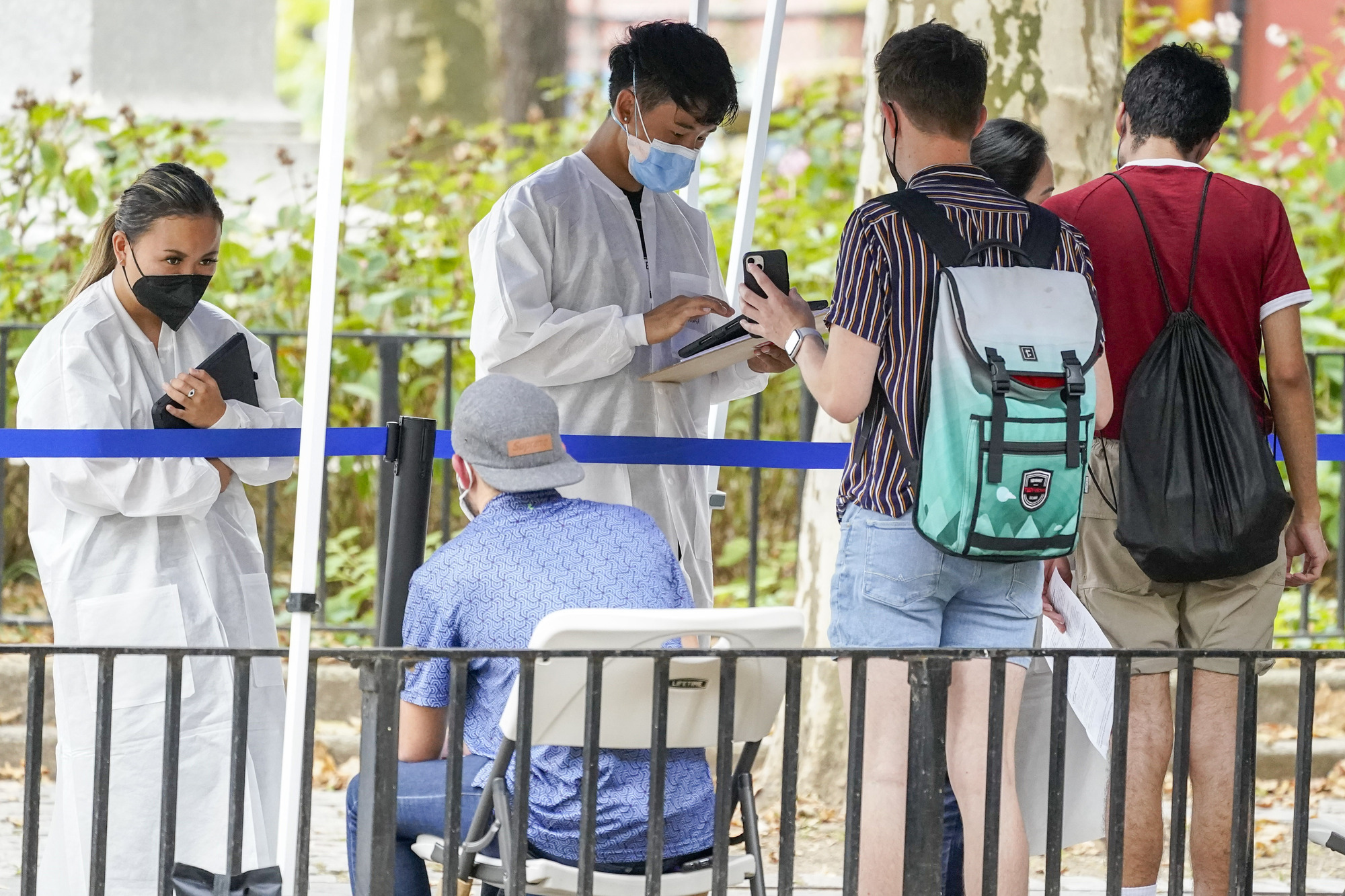
Healthcare workers with New York City Department of Health and Mental Hygiene help people register for the monkeypox vaccine at one of the city's vaccination sites last month. The World Health Organization recently declared that the expanding monkeypox outbreak is a global emergency. Photo: AP/Mary Altaffer
There have now been 97 cases of monkeypox identified in Ireland, as the World Health Organisation (WHO) says cases worldwide stand at 23,351.
The virus has been linked to eight deaths globally, including some where encephalitis, an inflammation of the brain, occurred.
A further 12 cases were reported here to the Health Protection Surveillance Centre (HSPC). There have not been any deaths, although 10 of the 97 people were hospitalised.
The latest WHO report shows 96 cases reported worldwide are among children under 17 including 25 children under four. Overall 98% of cases are among men.
It notes this is the first time cases and sustained chains of transmission have been reported in countries without direct or immediate epidemiological links to areas of West or Central Africa where the disease is endemic.
The virus is now in 83 countries. Most reported cases are in Europe, although reports from America are expected to increase as it has been declared a notifiable disease requiring reporting.
WHO technical lead on monkeypox, Dr Rosamund Lewis, said it can be transmitted in several ways including skin contact, talking at very close quarters, kissing (if one person has lesions in the mouth), contact with infected bed-clothes or in a household setting.
She could not yet confirm deaths reported in Spain, Brazil and India linked to encephalitis as they are waiting on notifications.
She said:
“There can be the occasional condition such as encephalitis which we had reports in the media over the last few days. This is very tragic, it is not totally surprising.”
The WHO is aware some of those who died had underlying conditions, she said, but others did not. She also warned vaccines being used against monkeypox need two weeks to take effect.
At the same briefing, WHO expert on HIV, hepatitis and STIs (sexually transmitted infections) Andy Seale said there is “a lot of misinformation” around this virus.
Read More
“What we have found is despite the fact there are these several modes of transmission, it seems to be very efficiently passed through sexual activity,” he said.
“This sexual activity could be between any group of people but it has found its way into networks of people who are connected because they are having sex between men essentially.”
He praised the strong reaction and messaging from some communities to the virus.
He said:
In Ireland, a collaboration between MPOWER, Gay Health Network/man2man.ie and the HSE has been recognised by the European Centre for Disease Control and Prevention and WHO as a best practice example for risk community and community engagement.
This campaign was included in July guidance documents for member states.