Fears tented facilities for up to 100 asylum seekers will create 'two-tier' accommodation
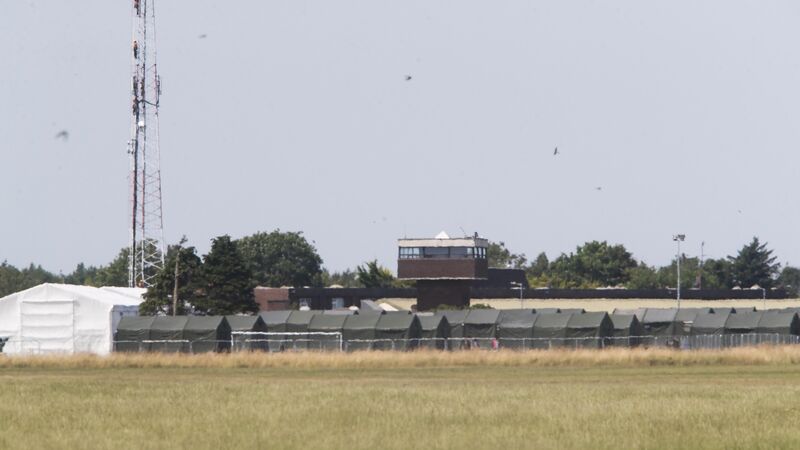
Tents to accomodate Ukranian refugees at Gormanstown Army Camp in Co. Meath. Support staff in Co. Clare hope tented accommodation there will only be a temporary measure.
The provision of tented facilities for up to new 100 asylum seekers in Meelick, Co Clare has prompted concern about “two-tier” accommodation.
Clare Immigrant Support Centre co-ordinator, Orla Ní Éilí is worried that what is being billed as short-term emergency accommodation could be in place for months or even years in a worst-case scenario.
“This is very worrying. Asylum seekers in the Knockalisheen Accommodation Centre can hang out in their bedroom whereas up to 10 asylum seekers could be living in one tent.
"It is introducing a new two-tier accommodation system for asylum seekers."
It is understood the tents in Knockalisheen will be used to accommodate single asylum seeker men.
Ms Ní Éilí said people are coming to Ireland seeking asylum from several different war-torn countries because transport has opened up again following the Covid-19 pandemic.
The Knockalisheen Accommodation Centre accommodates about 200 people including families.
Clare Immigrant Support Centre, along with other organisations working with the Ukrainian community and the international protection community, are concerned about the provision of tented facilities.
“We do want people to be accommodated somewhere safe, out of the elements. This is worrying because we have heard before about short-term solutions that have gone on to be in place for many years.
“We are urging that this must be treated as a short-term response.
Five months after the start of the Ukrainian war, this emergency needs to be upgraded into an immediate, short and long-term response.
"A lot of ideas put forward by the centre and councillors concerning accommodation need to be acted on.
"Any measures to respond to the accommodation needs of Ukrainian community and asylum seekers should also benefit the homeless and people requiring accommodation in Ireland,” she said.
From the first day of the Ukrainian war, it is estimated that Clare has attracted up to 10% of the influx of Ukrainian refugees because of its hotel accommodation.
The Department of Children, Equality, Disability, Integration and Youth confirmed preparations are underway to expand the capacity of specified State-owned International Protection Accommodation Service centres by erecting tented facilities. The department said the tented facilities at these IPAS centres will be used to provide short-term emergency accommodation to international protection applicants while additional accommodation capacity is being sourced.
The Defence Forces and OPW have been providing assistance in this regard, beginning with the facility at Knockalisheen in South-East Clare. This site will have capacity for 100 international protection applicants.
A department spokesman said a small number of people arriving from Ukraine have applied for protection under the International Protection Act 2015 but the majority have applied for protection under the European Unions Temporary Protection Directive.
Persons in the international protection system who request state accommodation may then be accommodated at these sites. The Government is working within the limits of accommodation availability to move people out of tented accommodation as soon as possible.
Ms Ní Éilí explained asylum seekers who obtain protection under the European Union’s Temporary Protection Directive get permission for one year to remain in the country without a visa on receipt of a so-called “yellow letter”.
They are entitled to a PPS number, social welfare, a medical card and to work.
People who apply under the International Protection Act 2015 want to be recognised by the Irish state as refugees. They are interviewed before the completion of a detailed questionnaire, which is followed by another extensive substantive interview in advance of a final decision on their application.
This process can take up to 12 months or longer. Living in state-owned IPAS centres, they are entitled to work after six months.


CONNECT WITH US TODAY



Be the first to know the latest news and updates