Playing away, longing for home: Ukraine-Ireland soccer match was about more than football
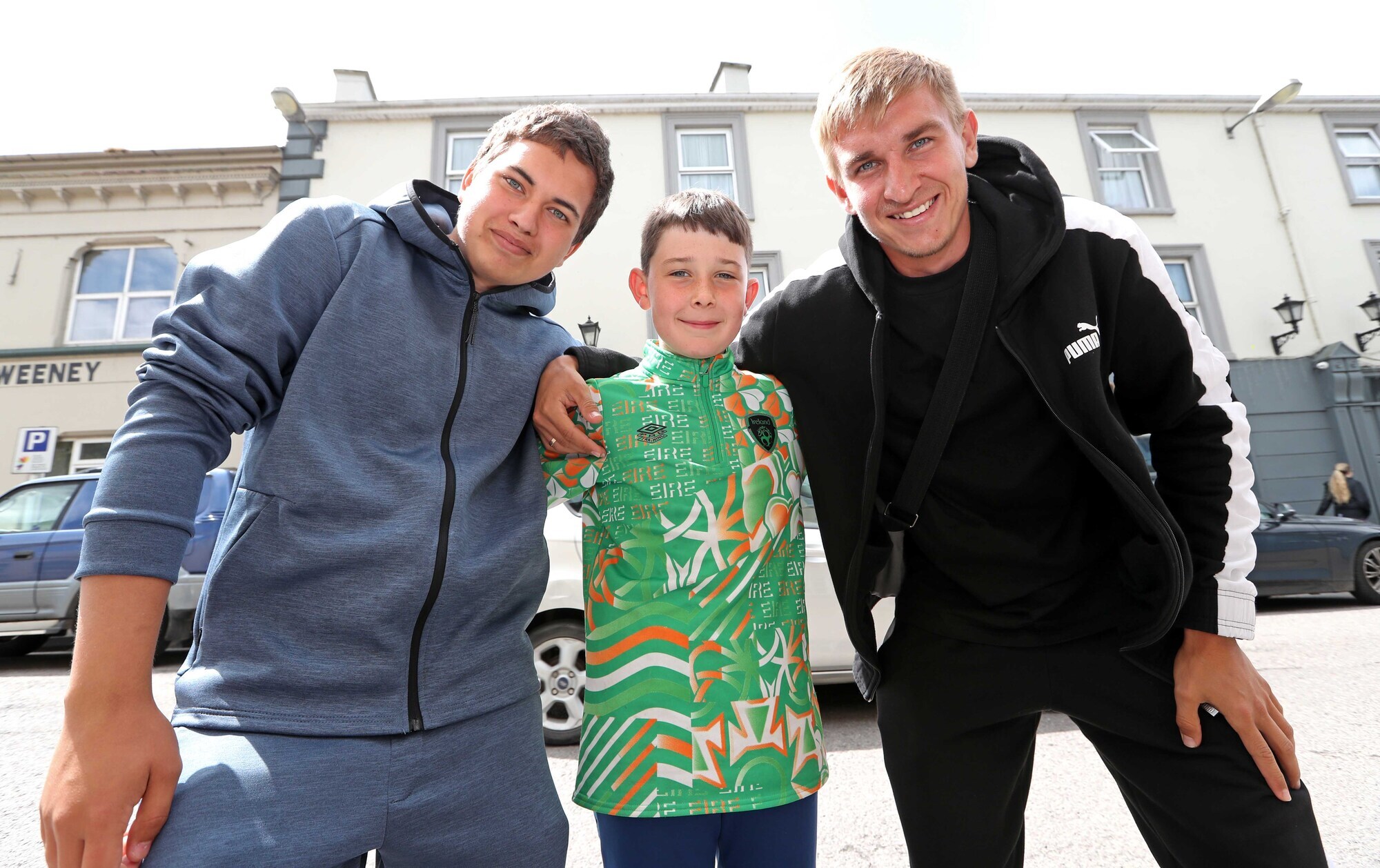
Serhii Burenkov, George Baker, and Viktor Serdeniuk, among the supporters leaving Bandon to watch the Republic of Ireland play Ukraine at the Aviva Stadium. Picture: Jim Coughlan
Football seasons have an ebb and flow, stops and starts. But not usually like this.
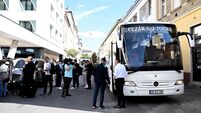
Until a few months ago, Viktor Serdeniuk, a 26-year-old from Odessa in Ukraine, was training with his teammates at FC Balkany Zorya, a team in the second division. This week, he was on a bus heading to the Aviva Stadium to see his national team take on Ireland in a Nations League gameĀ ā a match that became less about Ireland's inability to fashion chances and more about a people who have had to flee their country, uniting around a symbol of their threatened nation.
Ukraine's talismanic captain, Manchester City's Oleksandr Zinchenko, was absent against Ireland. Viktor had played alongside him at underage level for the national side, and while Zinchenko is one symbol of Ukrainian defiance, Viktor and his family are another potent reminder of theĀ war that has turned Europe upside down.
Because of the conflict, Viktor's life and career is on hold, just like that of many others on the bus from Bandon to Dublin.
Of those on the coach, organised by the Bus Ćireann Workers Charity Fund, some are staying at the Munster Arms Hotel in Bandon.Ā
A separate minibus brought some of the 30 or so Ukrainians currently staying at the old convent in Rosscarbery. AndĀ ā full disclosureĀ ā I brought Viktor from where he has been living: Our house.
They arrived late in the night in early March. Viktor, his wife Natalia, their baby son Alex, and dog Chucky, pulled in the gateway, having crossed the European continent and then, at the very last, driven up to the home of my next doorĀ ā and no doubt, puzzledĀ ā neighbour. It was almost a fortnight since they had left their home in Odesa. They were shattered.
Not long afterwards Natalia's mother Anzhela and her younger brother Serhii and younger sister Polina came to join them. Since then, many others have followed the same route, part of a huge displacement that means Ukrainian can now be heard from Ballybofey to Ballybunion.
Viktor has a classic footballer's haircut and elastic limbs which can control any type of pass, even a shanked Irish effort punted hopefully across the garden. He is a natural athlete, someone who can eat dessert for breakfast and not put on any weight. His English, initially limited, is improving. But as he says: "Football... is one language."
Natalia's English is good, meaning she is the main communicator. Her own career is also on hold, due to an invasion that beforehand seemed completely inconceivable.
"When they began to say that a full-scale war was possible, we frankly did not believe that this was possible," she says. "On February 24, I was supposed to meet with Alex's godmother, and when we called up on the 23rd, I also joked 'if they donāt attack us'. [Back] then it was ridiculous and unrealistic.
"On February 24, Victor woke me up. He said in a trembling voice: 'Zaya, the war has begun.'
Just a month before, the couple had moved back in with Natalia's parents because when Viktor was at training Natalia had found it difficult navigating her way down from the 19th floor with Alex in tow. Those inconveniences were swiftly overtaken by events.
"After everyone woke up on February 24, we got together with the whole family and decided to leave. Only dad had to stay at home with our pets. How Polina cried then... we could not calm her down."
It was similar situation for those on the bus from Bandon. Mother-of-two Tanya Rudenko, also from Odessa, discovered that she had lived quite close to Viktor and Natalia at home. Her English is pristine and she quickly became one of the main organisers and communicators on the bus. As a qualified teacher of English it comes naturally, more so than adapting to living in a hotel in a new country.
She is incredibly grateful, like almost everyone on the bus, to Ireland and the welcome they have been afforded. But she says: "If it was just me, if I did not have the children, I would have stayed."
Back in Ukraine, Viktor had first played for Premier League side Chornomorets Odesa in the reserves, followed by a brief spell at Real Pharma Odesa in July 2016, before then returning to Chornomorets, this time in the Premier League proper.Ā

According to Natalia: "Viktor had offers to [move to] other cities and even countries, but we wanted our son to be born in Ukraine, in Odessa. We also have a cat and a dog, Chucky, with whom moving is not so easy.
"We had our own business; we were engaged in cryotherapy. We had a cryosauna in Odessa. This idea came to us after Vitya tried it.
"We rented an apartment near the sea and a huge park. We [then] bought an apartment there, and planned to start doing repairs in the spring.
Alex was born last autumn. In their car there is a laminated photo dangling from the mirror, showing Viktor, Natalia, and Alex in the park, the snow lying thick on the ground. It is like a relic of another era. When I first saw it, I asked Viktor when it was taken. "Three months," he said.
How they came to Ireland is likely different to the experience of many of their compatriots. My wife is friends with an American who she met while they were both studying for a masters in DCU. That American, Ben, has worked as a photographer in Ukraine, making annual visits.Ā
It was there that he met Natalia, who in addition to her work in the cryosauna, was also a photo model. Sometimes there are unexpected reminders of their old lives, like when they discovered a recent online issue of a wedding magazine called Ā ā still being published āĀ that features a photo of Natalia on the cover. The picture was taken four years ago. "I miss this life very much," she says.
The son of a friend of Viktor's football coach was already living in Cork and got Viktor an invitation to train with Cork City FC. The old motto "have boots, will travel" didn't quite hold true. The family had departed Odessa so quickly, he'd forgotten to pack them. According to Natalia: "He also forgot his only sneakers in Paris at the hotel. Therefore, he came to Ireland in slippers."
I watched from the back of the stand that first day, and Viktor didn't play like a man in the wrong footwear, but he wasn't happy afterwards, feeling it could have gone better. As a club, City could not have been more welcoming. Assistant manager Richie Holland was out front to greet him, then manager Colin Healy beckoned Viktor into his office. Everyone sought to put him at ease. "Just train," Colin had said.
And he did, increasingly successfully, if Viktor's feedback was anything to go by. We got him a proper pair of boots through the mail and he seemed like he was running into form, but as City forged ahead in Division One, there was always a chance that his relatively advanced age and the quality of the players already at the club would count against him.
After four very welcome weeks of training, the experience came to an end. Viktor then began training with Cobh Ramblers, another stalwart club of the League of Ireland. Again, they have facilitated him, helped keep his game ticking over, even offering him tickets to the Ed Sheeran concert in Cork. But the dream of a contract here still appears out of reach, at least for now. All eyes are on the opening of the transfer window across Europe on July 1.
There is unlikely to be a deluge of players from Ukraine landing in Ireland any time soon. According to Stephen McGuinness from the Professional Footballers Association of Ireland (PFAI), a list of free agents did circulate some months ago, courtesy of the World Players Union, but they were of non-Ukrainians who had been playing in the Ukrainian league. The list included player details and also their wage levels; it quickly became apparent that they were beyond the reach of LOI clubs.
There has been no equivalent list of Ukrainian players who may become available, and according to Stephen, it's likely to stay that way, not least because those still at home are effectively now part of the war effort. The Ukrainian league is unlikely to resume any time soon. As if to drive home the ever-present uncertainty the war has wrought across Ukraine, on the day the national team were playing a crucial World Cup play-off against Wales, the first Russian bombs were dropped on Kyiv since last April. It was yet another reminder that, as the war grinds on, nowhere is ever entirely safe.

For some there is a constant internal tussle between the desire to go home, and the worry over whether it is safe. Tanya, on the bus from Bandon, says she felt "scared" about what was going on in Ukraine. "It is impossible to go back to normal," she says, outlining how so much of daily life, including schools, is still on hold. Many of those, like best friends Lisa Vakulova and Lisa Krupenko, from Melitopol, or Igor Dakhov, who grew up in the east of Ukraine, are in their teens, sent here by or with their parents or older siblings.Ā
They say they can approach their stay here like a student exchange, but for Anna Kuzmenko, 22, from Kyiv, it's a little different. She wants to work. And for Tanya, her gratitude at being in Ireland is accompanied by a sense of anxiety: Where can I work? When can I resume my career?
Viktor and Natalia say they lived under shelling for a week. "Leaving was scary and dangerous," she recalls.Ā
Following a muddled border crossing came a brief stay with relatives in Moldova, then on to Romania. They deliberated over whether to remain there, but felt it was still too close for comfort. They drove across the continent, finishing up with a ferry to Rosslare and ultimately, here. Natalia ruefully recalls that they had planned to go to Paris for her birthday, and ended up there early and in very different circumstances.
I sometimes wonder whether the distance between Ireland and their home seems too big, but the family seem as content as you can imagine, given the circumstances. But sometimes Anzhela will stand by the cooker, in a quiet moment or having just got off the phone to home, and seem utterly lost in thought, her brows knitted together. They have PPS numbers, financial support through the social protection system, even an increasing number of people they know. But everyone is in a state of suspended animation.
Football, and Wednesday's match, offered a shared outlet. One of the joys of the occasion was how the Ukrainian end began cheering as soon as play entered the Irish half, the noise many octaves higher than usual, reflecting the fact that it was mostly populated by women and children. Viktor and Serhii enjoyed the win, but in some ways it highlighted the sense of stasis being experienced by Ukrainians here.
"Viktor wants to play," Natalia says.
"He has a lot of strength, desire and inspiration. For almost half a year, Victor had no games. First vacation, then training camp, then got injured. In the first days of training with FC Cork, it was hard for him. Then it got easier. Football is different. but Vitya (Viktor) likes it and he got used to it.
"Viktor constantly communicates with his [former] teammates. Many have small children. Many still live in basements. They train, but football is not financed, they pay the minimum wage. And prices have risen. For many it is not easy."
She recalls how Viktor and Zinchenko, who plays for Manchester City, played together in the Ukrainian youth team. "They were on the same level," she says, before adding, with a laugh: "But then Viktor met me."
She describes Viktor as "insanely talented and a good football player", someone who growing up put in the effort to maximise his ability.
"I believe that Vitya will be able to sign a football contract here. And provide for us. When I married him, I knew that I would have to go after him, to where he would have a football contract. I try to think that we have now left under a contract. Just a temporary move."
Natalia has friends living in Spain, in Poland, all pondering the same question: When can I go back? She refers to "scary content" from home, "Like how a rocket flies. The sky is red. My friend, a photographer, distinguishes weapons by sounds."
The return journey from Dublin was quiet, the children falling asleep as the bus rumbled down through Cashel and Cork and finally into Bandon, and home; home for now.