'How can children be this forgotten about?' — Sadie, 3, loves dancing but can't feed herself or speak
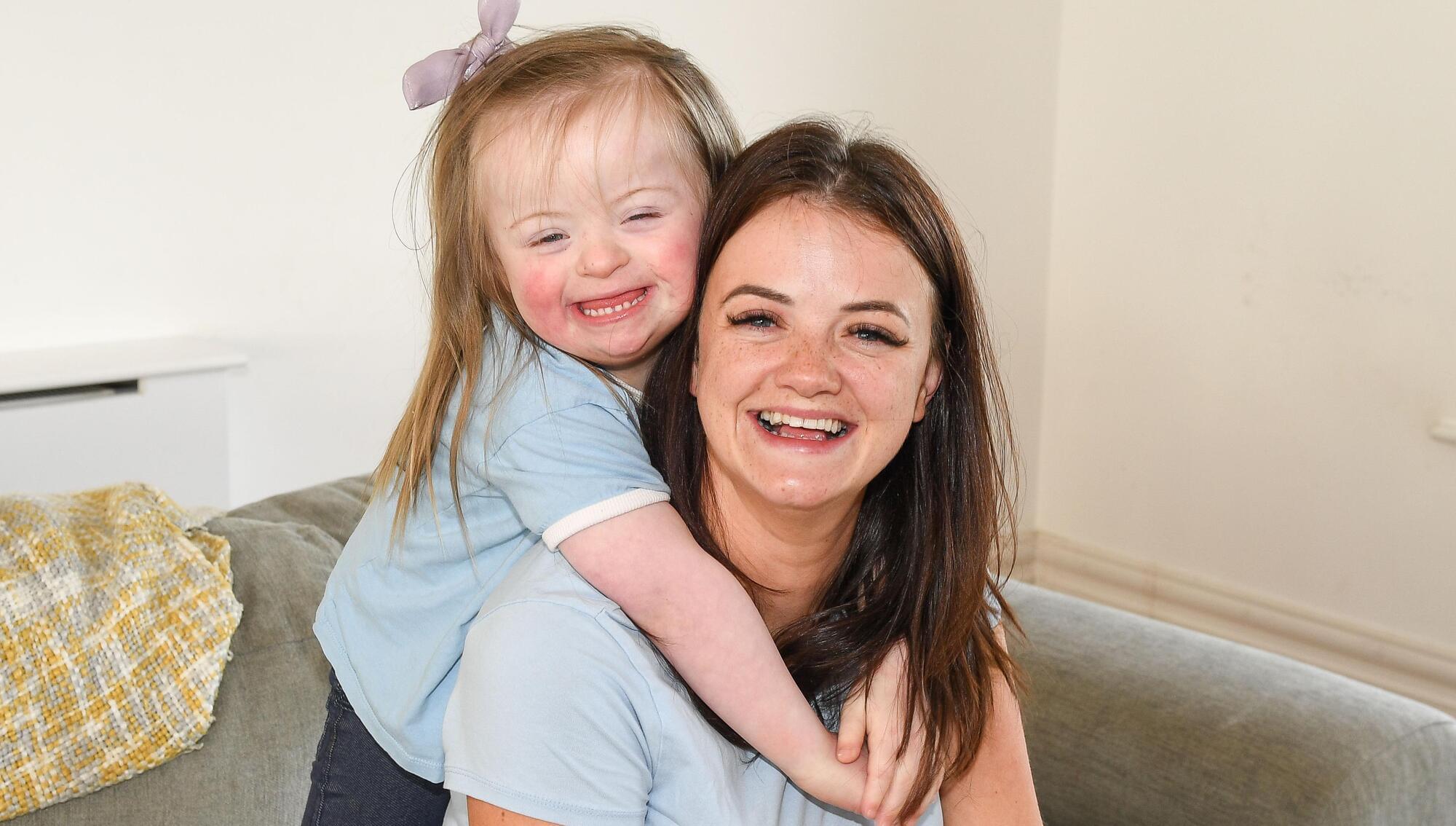
Sadie O’Brien’s little face lights up when she nears Down Syndrome Centre Cork, knowing that her class is about to begin.
There, three-year-old Sadie, who is non-verbal, learns communication skills, listening, painting, and play therapy with three other little girls and one teacher.
The centre has been a lifeline to Sadie and her mum, Sally O’Brien, who drives almost one hour from their home in Youghal to the centre on Forge Hill in Cork.
But aside from charitable and privately funded help, Sadie has received very little care.
She has had no public therapies since 2019 — almost all her life.
Sadie has a visual impairment and Down syndrome.

Although born blind, with thick cataracts coating her eyes, surgery and permanent lenses have made seeing possible for Sadie.
Although the lenses impact her sense of balance, resulting in frequent falls, they have nevertheless been life-changing.
Sadie needs speech and language therapy (SLT), occupational therapy (OT), and physiotherapy with her diagnoses.
But Ms O’Brien said that Sadie’s service provider only has one full-time speech and language therapist, and one part-time, to serve all children aged up to the age of 18 in an area stretching from Youghal near the Waterford border to Glounthaune near Cork city.
She was told that approximately five full-time SLTs were needed there.
Sadie remained with the same service provider when the HSE’s reorganisation of children’s disability services, called Progressing Disability Services (PDS), was introduced in recent years.
This at least meant that no files had to be transferred, but staff who had been treating Sadie were moved to other teams.
Although the theory behind PDS was good — to provide better and more equitable access to disability services for children across the country — in reality, it has stripped many families of services.
"It should be called Regressing Disability Services — that’s what it’s done,” said Ms O’Brien.
“Sadie’s had no speech and language or occupational therapy since December 2019.
“She’s three and a half, and has never had continuous support from the HSE.
"It’s really frustrating. The Government is completely ignoring our children.
"And it’s only going to catch up on them eventually when all these kids get to a certain age having had no help and no support. The parents are going to have burnout, and there’s only so much they can do.
"I’m not a qualified OT or SLT. There are no supports there for parents either. All these professionals have gone to college for years upon years to train, and we’re expected to just know what to do and go with it.
“I do empathise with the staff as well. They’re fantastic, they’re just so overwhelmed. There are thousands of children to be seen. Sadie’s one of the lucky ones, she has had her face in front of someone.
"But the amount of children who have never been seen by anyone for therapies is sinful.”
Prior to Covid and PDS’ introduction, Sadie would be seen every six weeks by an occupational therapist and speech and language therapist together.
“At least that was something,” said Ms O’Brien.
"From a low base, it went even lower. Cork is the worst at the moment for access to services, but I haven’t heard of anywhere that’s great. How can it be this bad all over the country?
In recent weeks, the HSE said that none of its children’s disability network teams (CDNT) — established to provide services for all children with more significant needs and who require a team of professionals working together — were fully staffed.
While the HSE had an average vacancy rate of 25% across teams, some of the CDNTs were only staffed to about 50%.
A survey from Down Syndrome Ireland found that some children are waiting up to four years to access vital early-intervention services.
It found that 65% of respondents said their children received no SLT sessions in 2021. It also found that almost half of all those aged up to 18 years had no appointments at all during the past year.
Missing out on necessary therapies would have “lifelong negative consequences” for children with Down Syndrome, the charity warned earlier this year.
With the right help and support, Sadie is very capable of talking and feeding herself in the short term. But that help is not forthcoming at the moment.

“We had a meeting in February with her key worker and the CDNT manager, who was an SLT, but they were totally overwhelmed,” said Ms O’Brien.
"All we got was paperwork in the post and no date of when we would be seen again by them.
“Sadie can’t feed herself, so she needs OT. She’s non-verbal, so she needs SLT. Physio is her strongest point, but again she has balance problems, so she needs physio. But they couldn’t give me a date or say: ‘You’ll have a block of SLT sessions.’
"I’d say they’re just trying to wade through all the caseload they have.”
In a family impact plan, a system under PDS where the family identifies three goals for their child’s development, the O’Briens requested being able to feed herself, toilet training, and managing difficult behaviours. But all she has got so far to help her achieve these goals is literature and paperwork — not vital therapies.
“She’s quite a sociable little girl, but she is non-verbal so she needs to learn how to communicate,” said Ms O’Brien. "And she needs other basic things, like learning how to feed herself. And parents need help with all this.
“I feel sorry for the staff, they’re doing their best, but they’re grappling with a faulty system that was imposed on them. They often get the blame, but it’s really not their fault.
"The new system has been detrimental to our children. Something needs to change dramatically. They’ve ruined an already flawed system.
“I’m just hoping there can be a miraculous turnaround for our children’s sake.
“Before Covid, a nurse was supposed to come to my house, one hour a week for a six-week block. But that never happened because Covid came and then PDS, and I can’t see it happening under that.”
Sadie started pre-school in September, which she loves. But due to her poor balance, an application was made for special seating to help her sit in a more stable and safe way.
But by mid-April, there is still no sign of it.
When Sadie moves schools, Ms O’Brien does not know if she can take that equipment with her, or if she’ll have to apply again.
And next year she will need a psychologist to perform a psychological assessment to help determine where she can go to school.
"Not one child with Down syndrome in east Cork has had a psychological assessment with this new system, as far as I know," said Ms O'Brien. "Sadie will need that next year. At the moment, there’s no psychologist here.
"The survey by Down Syndrome Ireland found that no child in East Cork had seen a psychologist.
"She really loves school, getting stuck in with things, with her friends. She’s started walking now. She’s the happiest little girl. She loves music and dancing. She loves school and her teachers.
"For Sadie, I hope she can go to a mainstream school with an SNA. There’s a fabulous school here that my daughters go to, but we need that psychological report.
"I can't understand how Government has been working towards this new system for 10 years, yet it feels like it’s being pushed through now on the kids.
"I only see things getting worse. All these children being added to waiting lists that are swamping staff.
"And we need continuity of services for our children to grow into contributing members of society. It has to start now. It needs to continue throughout their lives. I don’t know how they think these children will be able to grow up and contribute without getting supports now."
She said that moving staff around has been a further problem in PDS as some professionals the O'Briens dealt with before were redeployed elsewhere, further destabilising any care.
CONNECT WITH US TODAY



Be the first to know the latest news and updates