Bessborough: Survivors reject study casting doubt on presence of unmarked graves
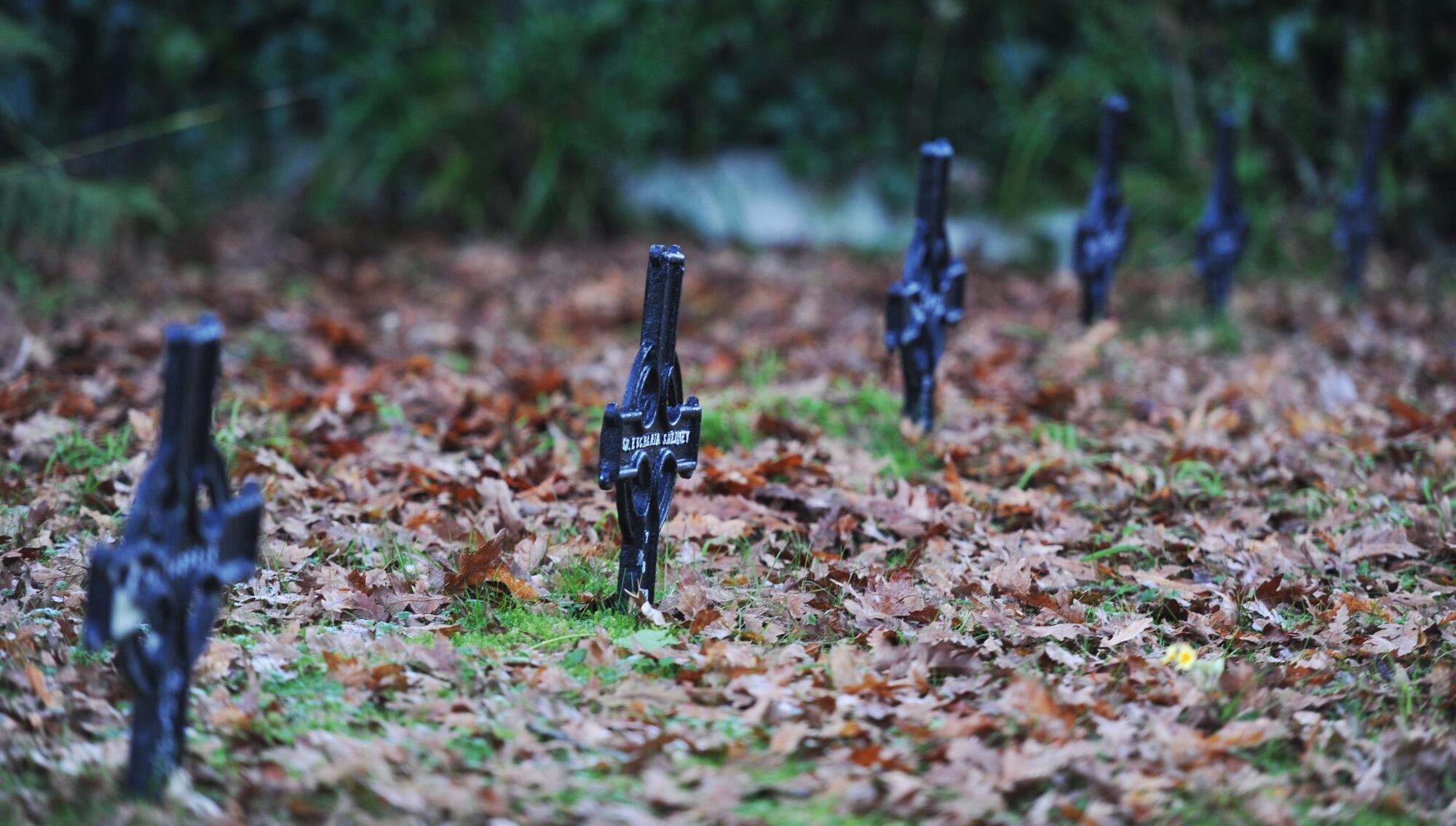
Grave markers at the graves of nuns in the burial grounds on the site of the former mother and baby home at Bessborough in Cork. Picture: Larry Cummins
Survivors of the Bessborough mother and baby home in Cork have rejected a new report that casts doubt on the existence of a large unmarked burial ground at the site.
A report, commissioned by the Sisters of the Sacred Hearts of Jesus and Mary, has asserted that nuns and children were all buried in a marked congregation burial enclosure on the Bessborough site.
Historian Dr Aoife Bhreatnach carried out a report into the historical context of burial during the period the mother and baby home was operational, while an archaeological assessment was carried out by Eachtra Heritage.
The archaeological report concludes that it is most likely there was only one burial ground in Bessborough demesne and that it contains burials of both children and nuns — a different conclusion to that of the Commission of Investigation into Mother and Baby Homes.
"The suspicion that there is a ‘vast burial ground’ somewhere within the estate is an artefact of the poor historical records for burial practices in both Bessborough and Cork City," the report commissioned by the nuns found.
"We concur with the Commission of Investigation's statement that historical research shows that the ‘vast majority of children who died in Bessborough are not buried there’ but we believe the Commission got it wrong when it came to identifying where the remaining, minority of children may be buried."
Dr Bhreatnach's report suggests that children who died at Bessborough could have been buried at a number of cemeteries around Cork City, including Carr's Hill and St Michael's Cemetery, and that some children may have been buried at Bessborough, most likely in the 1940s when, according to the Eachtra report, the normal system became overwhelmed.
Both Dr Bhreatnach and John Tierney, director of the Historic Graves project and co-author of the archaeological assessment, said an Ordnance Survey map dating from circa 1950 which indicated a 'Children's Burial Ground' at Bessborough also featured something new — a square box attached to the two-storey stone folly, which formed a burial enclosure where nuns themselves were buried from 1956 onwards. They argue that the reference to the burial ground is likely to refer to this feature.

The archaeological assessment recommends a non-invasive survey involving drone-mounted light detection and ranging system (LiDAR) — in which a laser is used to detect grave sites — to further test the hypothesis.
Last May, developers were refused permission to build apartments on the former Bessborough mother and baby home estate amid concerns about the possible location of a children’s burial ground on the development site.
Maureen Considine of the Cork Survivors and Supporters Alliance (CSSA) said maps, including one from circa 1950, indicate a children's burial ground on the site.
"These reports are not credible," she said of the archaeological and burial studies.
"They offer no new evidence. The mapping evidence was tested at a three-day oral hearing by the developer's senior counsel. We, the CSSA, won our case.
"The survivor mothers are traumatised and deserve better treatment than ongoing denials and failings of the nuns to document burials.
"Our pro bono legal team will respond to this in detail in due course."