Paul Givan resigns as NI first minister in Brexit protocol protest
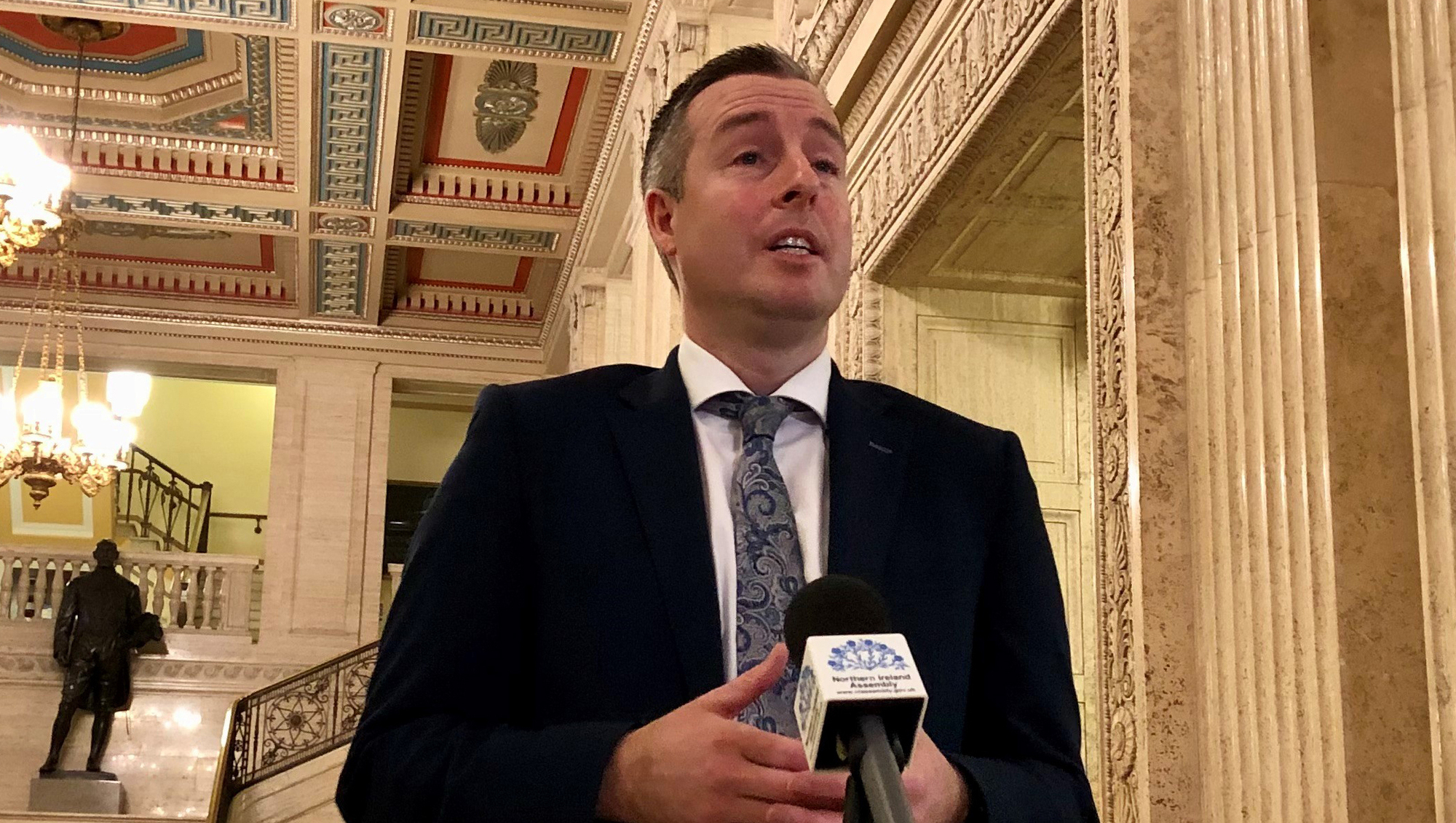
Paul Givan (PA)
Northern Ireland first minister Paul Givan has announced his resignation from Stormont’s powersharing Executive.
The move by the Lagan Valley MLA is part of the DUP’s escalating protest strategy against Brexit’s Northern Ireland Protocol.
Mr Givan said the protocol, which has created trade barriers between Northern Ireland and the rest of the UK, had undermined a cornerstone of powersharing in the region – governance with the consent of both nationalists and unionists.
“Today marks the end of what has been the privilege of my lifetime – to serve as the first minister of Northern Ireland,” said Mr Givan, who was appointed to the role last summer.
“When I first entered the Assembly 12 years ago, I never expected to have the opportunity to lead the Government and serve the people of Northern Ireland as first minister.”
"Our institutions are being tested once again, and the delicate balance created by the Belfast and St Andrews Agreements has been impacted" by the Northern Ireland Protocol, Paul Givan says, as he resigns as first minister of Northern Irelandhttps://t.co/epJN6teLuv pic.twitter.com/g6DtbiSsTK
— BBC Politics (@BBCPolitics) February 3, 2022
Foreign Affairs Minister Simon Coveney said "no positive agenda" is served by the breakdown of the Good Friday Agreement and claimed the resignation of the First Minister has "wider implications" for the Northern Ireland Executive and its important work.
"People in Northern Ireland want to see a positive commitment from everyone to resolve issues, not the creation of new cliff edges, threats and instability," he told the Dáil on Thursday night.
Mr Coveney said he had a lengthy discussion with EU Commission Vice-President Maros Sefcovic ahead of his meeting with British Foreign Secretary Liz Truss on Thursday.
He said the Brexit talks are progressing and should be given the space and support needed to try to reach accommodation and agreement.
"This is an important month in the context of the protocol issues and I know that there are significant efforts underway on the EU side and on the British government side to try to find accommodation on key issues, like customs and SPS before the end of the month. So we need to ensure that despite all of the politics that's being played with this issue, that we give the negotiators time and space to try and find accommodation to settle some of these issues in February if we can."
He said the requirement for checks in Northern Ireland is part of the protocol which was negotiated and agreed over four years.
"Together with the European Commission, we will continue to closely monitor developments in Northern Ireland. It is ultimately the responsibility, however, of the British government to honour its commitments and to respect its international obligations," Mr Coveney said.
Mr Givan's announcement comes 24 hours after DUP Agriculture Minister Edwin Poots acted unilaterally to order a halt to agri-food checks required under the post-Brexit trading arrangements.
Civil servants have yet to implement the instruction and checks are continuing.
Mr Givan’s resignation, which comes into effect at midnight, will automatically remove Sinn Féin deputy first minister Michelle O’Neill from her job because, under Stormont’s powersharing rules, one cannot hold office without the other.
Other Stormont ministers can remain in post but the Executive can no longer meet and is unable to take significant policy decisions.
Sinn Féin has denounced the move as an electoral stunt designed to consolidate DUP support in the face of recent poor opinion poll performances.
Party president Mary Lou McDonald branded the DUP tactics a “disgrace” and called for May’s already scheduled Assembly election to be brought forward.
The events in Northern Ireland unfolded as UK Foreign Secretary Liz Truss and European Commission vice president Maros Sefcovic met to take stock of negotiations aimed at reducing the red tape associated with the protocol. The pair will meet again in London next week to continue discussions.
In his resignation speech in a Belfast hotel, Mr Givan said: “Our institutions are being tested once again. And the delicate balance created by the Belfast and St Andrews agreements has been impacted by the agreement made by the United Kingdom Government and the European Union which created the Northern Ireland Protocol.
“The consent principle is a cornerstone of the Belfast Agreement and it is my earnest desire that all sections of the community will soon be able to give consent to the restoration of a fully functioning executive, through a resolution to the issues that have regrettably brought us to this point.”
There was emotion in Mr Givan’s voice as he added: “Most of all I want to thank my family, especially my wife Emma.
“It’s often those that we are close to in our families that feel the pressure, even more so than those of us in frontline politics.
“It wouldn’t have been possible without their support.”
After Mr Givan’s announcement, DUP leader Jeffrey Donaldson delivered a speech to senior party figures in a different room in the same hotel.
He said unionist concerns about the protocol had been disregarded for too long.
“Now is the moment when we say ‘enough’,” he said.
Mr Donaldson added: “If we are to move to the next stage of building a shared future, then humiliation of one side by the other is not the answer. We will not achieve reconciliation through retribution.
“Therefore, now is the moment to repair our politics, reset relations and restore fairness for all.
“Now is the moment to send the clear signal that we want Stormont free from the long shadows of the protocol – the Irish Sea border must go.”
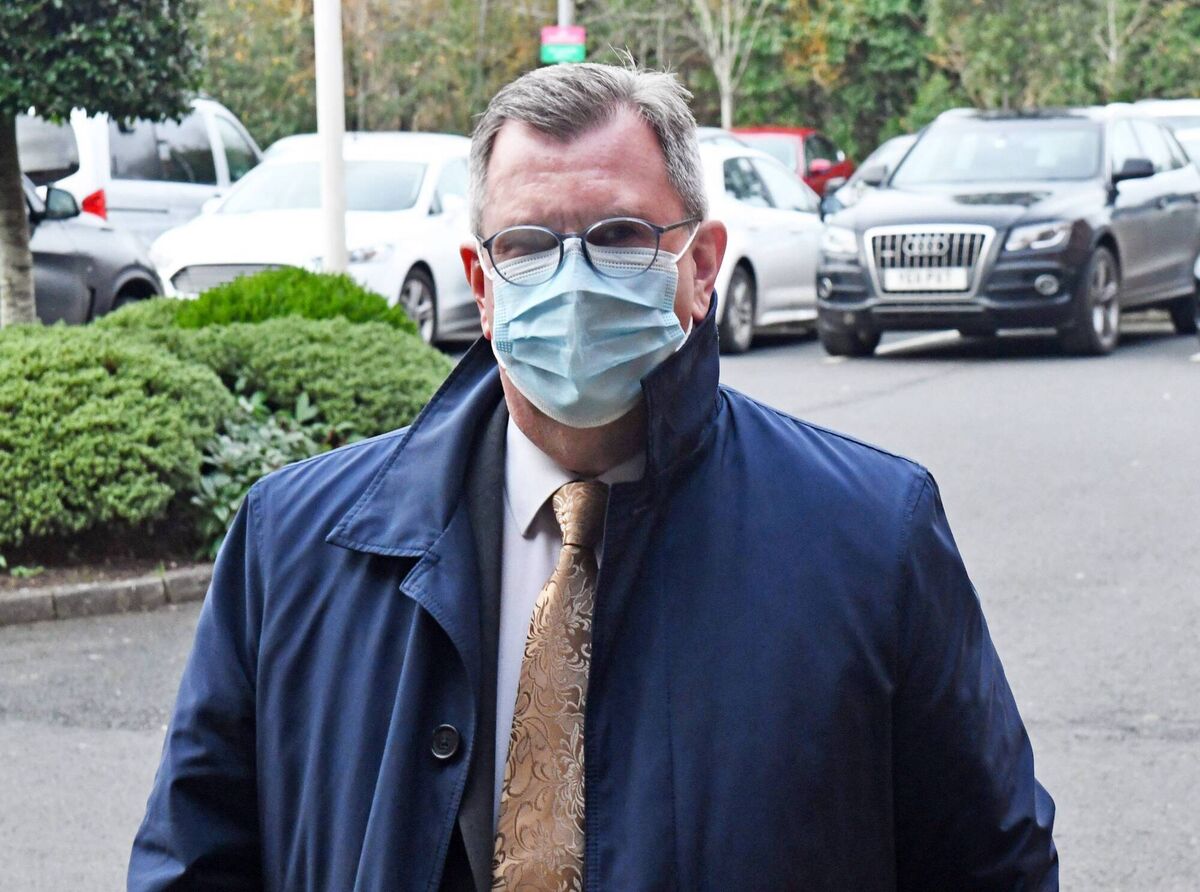
Mr Donaldson later said he had told Ms Truss that January 31 had been his deadline for securing movement on protocol logjams.
He said trade checks on GB produce should only be applied to goods set for onward transportation into the Republic of Ireland.
Mr Donaldson said the DUP had given the UK and EU space to find solutions but he warned that sufficient progress had not been made.
“We wanted to be reasonable rather than reactionary,” he said.
“We wanted to be practical rather than pedantic. I want devolution to work and to be respected across all communities in Northern Ireland.
“But for it to work, unionists as well as nationalists must be respected.
“We want a devolved government that delivers for everyone in Northern Ireland and that can build on stable foundations.
“These institutions only have value if they enjoy the confidence and support of the people they were established to serve.
“They only have meaning if they are delivering fairly for all our people based on the principles of equality and mutual respect on which they were founded.
“It’s time to restore fairness.”
Mr Donaldson added: “There comes a moment when we have to take tough decisions if we are to build for the future. Such a moment has arrived.
“Despite the sometimes positive noises, the talks on the protocol have thus far failed to come to a conclusion – not because of a lack of time, but rather because minds do not seem to be focused on fixing our problems.
“Without resolute action on our part these talks could drift on for many further months or years. That is bad for Northern Ireland.”
Reacting to Mr Givan’s move, Sinn Féin leader Mrs McDonald called for an early Assembly poll.
“I want to be clear, we cannot stagger on in the months ahead without a functioning executive. Sinn Féin will not facilitate this,” she said.
“So in the absence of a functioning executive, an early election must be called and the people must have their say.
“This is one of those defining moments. We can do so much better than this chaotic theatre. Powersharing can work, but it can only work if parties involved are committed to it.
“Good government can deliver, of that there is no doubt. And that is what we, and we believe the other parties, wants to see happening.
“So if today’s behaviour and decisions of the DUP show anything, it is again demonstrable evidence that we live in a time for real change, and this includes the prospect of constitutional change, as set out in the Good Friday Agreement.”
CONNECT WITH US TODAY



Be the first to know the latest news and updates