Covid spread leads to temporary relaxation of driving and resting time rules
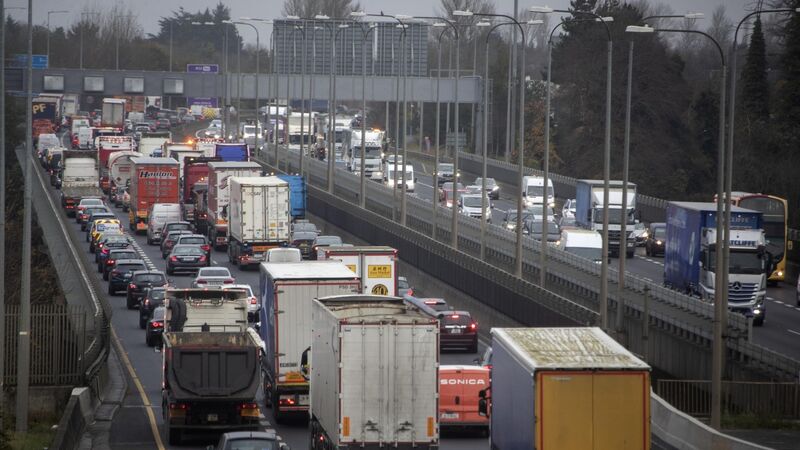
The derogation, which was described as “urgent” by the RSA, will be in respect of certain provisions of the EU driving and resting time rules. File picture: Collins
A temporary relaxation in driving and resting time rules for heavy goods vehicle (HGV) drivers has been agreed by the Road Safety Authority (RSA) and the Department of Transport.
The derogation comes due to a driver shortage caused the spread of the Omicron variant.
The Omicron variant accounts for around 96% of all cases in Ireland and daily case totals have hit records numbers in recent days.
The derogation, which was described as “urgent” by the RSA, will be in respect of certain provisions of the EU driving and resting time rules.
It will see rules around the fortnightly driving limit be relaxed as well as a relaxing in the rules relating to weekly rest.
The authority said that Covid is having an impact on HGV operations and that the decision was made due to the importance of ensuring continuity of supply chains, the importance of the road haulage sector to the national economy and in response to requests from the haulage industry.
Hildegarde Naughton, the Minister of State for Transport, said the relaxation measures “maintain a balance between driver welfare, operator flexibility, road safety and minimising disruption to supply chains”.
She added:
According to the RSA, the measures being introduced will see:
- The driving time rules are being relaxed by lifting the fortnightly driving limit from 90 hours to 112 hours. Because of this approach, drivers will be entitled to drive a maximum 56 hours in each consecutive week until the derogation expires. There is no change to the rules relating to working time.
- The maximum of three reduced daily rest periods between any two weekly rest periods is also being increased from three to five to provide drivers with some extra flexibility should they encounter delays on their journeys. However, it is important to note that the applicable spread must continue to be complied with, on whatever day that a daily rest is extended to make a weekly rest. For example, if a driver avails of the maximum of five reduced daily rest periods on the first five days since the end of the previous weekly rest period and then continues to drive on the sixth consecutive day his/her daily spread shall not exceed 13 hours on day six.
- The rules relating to weekly rest are also being relaxed by allowing drivers to take a reduced weekly rest of at least 24 hours in each consecutive week during the relaxation period. There will be no obligation on a driver to take at least one regular weekly rest period in any two consecutive weeks until the derogation expires. Furthermore, there shall not be any requirement for compensation where reduced weekly rest is being taken.
The derogation will apply retrospectively from January 9, 2022, up to January 30, 2022, and will be reviewed every week as regards application and scope.
It will apply to all operators and drivers subject to the EU driver’s hours and tachograph rules engaged in the carriage of goods.
Ms Naughton stressed that driver safety and other road users’ safety "must not be compromised at any stage".
The RSA added that drivers should not deviate from the rules if it jeopardises road safety and that they should not be expected to drive whilst tired.
"Employers remain responsible for the health and safety of their employees and other road users."


CONNECT WITH US TODAY



Be the first to know the latest news and updates