Hauliers say Northern Ireland Protocol is ‘lose-lose scenario’
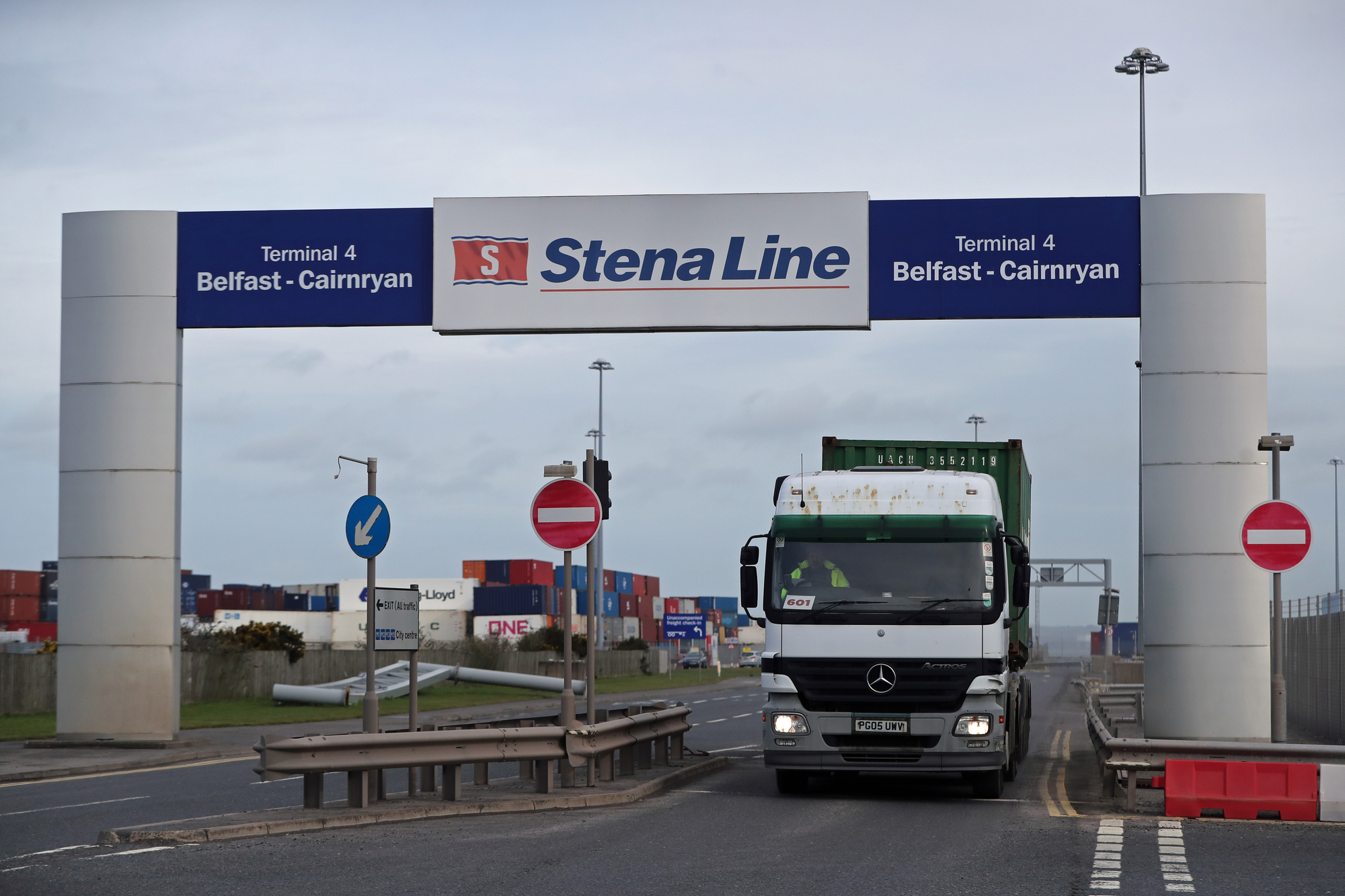
Hauliers have described the Northern Ireland Protocol as a “lose-lose scenario” for their trade, during an appearance before MLAs in the North.
One small business owner told the Stormont Finance committee that the actions of the UK Government and the EU over the next few months would determine whether his company could survive.
The protocol is part of the Brexit deal, which introduced checks on goods crossing the Irish Sea as a compromise in order to avoid checks on the land border between Northern Ireland and the Republic.
The UK Government and EU remain locked in negotiations over difficulties with the trading arrangements.
Hauliers told the committee that the extra bureaucracy they had faced was “almost unsustainable”.
John Martin from the Road Haulage Association (RHA) said: “It is accepted that some businesses may have benefited from the new trading arrangements, if their sole or main market is the EU.
“However the vast majority of trade by Northern Ireland businesses is with GB and in particular the strong agri-food and manufacturing sectors in Northern Ireland.
“Any distortion to this trade has a knock-on effect on logistics as most of the product moves via road transport.
“Logistics is a low margin, highly efficient service which has been blown apart by these new trading arrangements.
“This will affect the vast majority of consumers in Northern Ireland, it will also affect the vast majority of businesses.”
Geoff Potter, managing director of Gray & Adams, said: “Undoubtedly there are benefits of the protocol in terms of access to European mainland markets, but for a company like ours, 90% of our business would remain in Northern Ireland or go back to GB, I have to say that it has been a lose-lose scenario.
“We are in the situation where the current system as it exists today is dysfunctional, it is bureaucratic and it is basically not sustainable.”
Mark Tait, owner and manager of Target Transport, said the protocol did not work for his business.
He added: “Haulage is clearly at the forefront of having to get goods across the Irish Sea.
“The bureaucracy that we face as a small family-run company, it has got to the stage where it is almost unsustainable for us.
“We know there is going to be more coming down the pipeline when grace periods end and I don’t think we can possibly cope with that.
“It is a bureaucratic mess.
“Whether or not we can continue up until the end of this year will depend on what comes in the next few months between the UK and the EU.”
Peter Summerton, from McCulla Ireland Refrigerated Transport, said the protocol was putting companies from the rest of the UK off dealing in Northern Ireland.
He said: “What has happened is an international supply chain model has been applied to a regional, fully integrated delivery network throughout the UK.
“How did government actually expect the protocol to work?
“Whenever you apply these international rules to the domestic integrated supply chain, it increases time, it increases cost, it increases complexity.
“The feeling in GB is really clear, why would I bother starting trying to do business with Northern Ireland?
“It is too complex, too costly, it takes too much time.”
The committee also heard from representatives from the Ulster Farmers’ Union who said that the agricultural sector is continuing to face problems following Brexit.
Deputy president David Brown said: “We were aware that there were issues were going to come along.
“We have had warm words and reassurances from Lord Frost and Maros Sefcovic.
“But the issues that existed on January 1 still exist and that is where farmers get extremely frustrated, their expectations were too high that there would be common sense, that there would be some level of compromise.
“I am hoping there will be flexibilities because these things that don’t work need fixed.”