Covid vaccine boosters not needed for general population, experts say
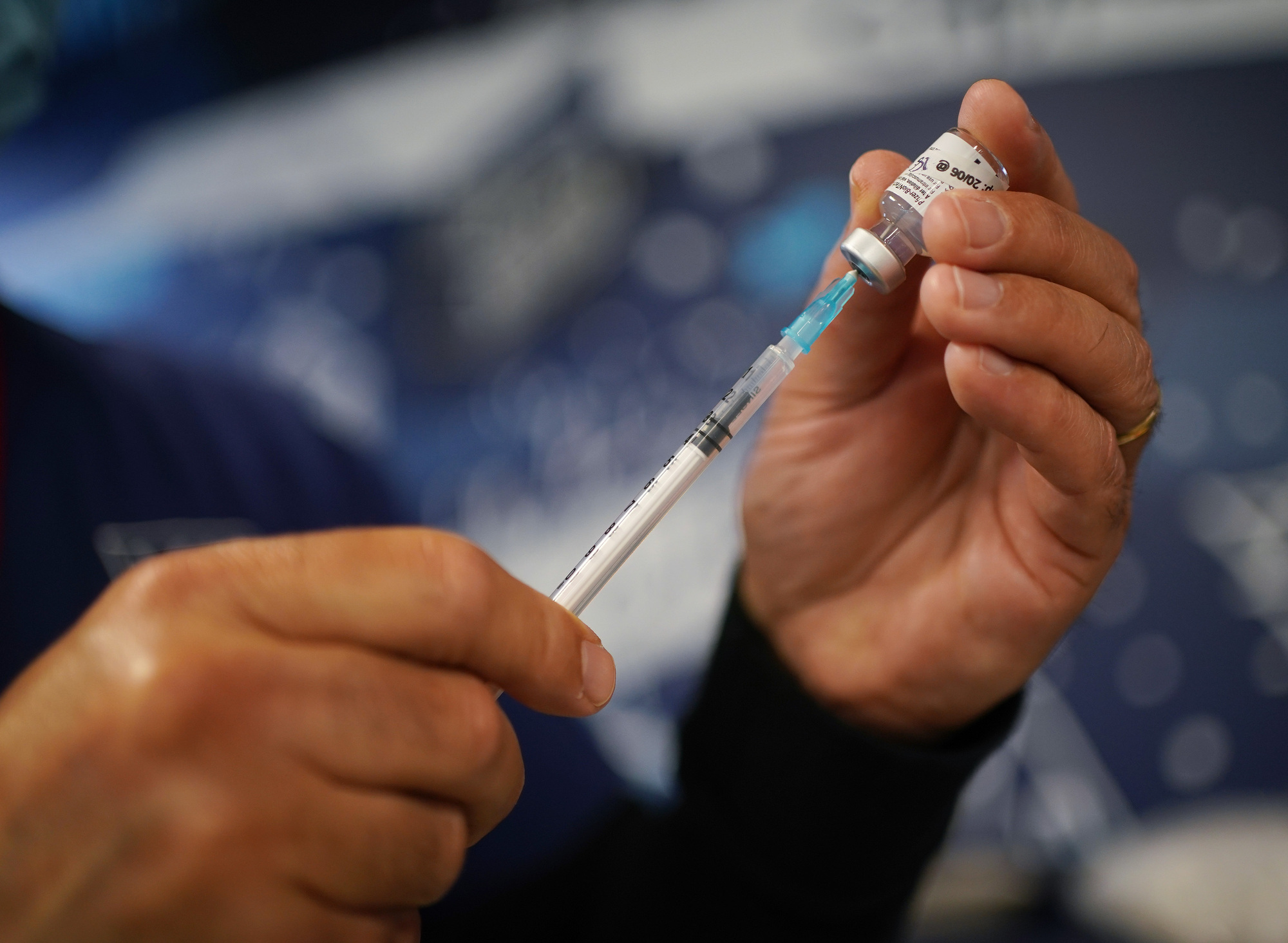
‘Covid-19 vaccine efficacy does not support boosters for general population’ (Yui Mok/PA)
Covid-19 vaccine boosters are not appropriate for the general population at this stage of the pandemic, experts have suggested.
A review by an international group of scientists found that vaccine efficacy against severe Covid-19, even the Delta variant, is so high that top-up doses are not currently needed.
Experts looked at the available evidence from randomised controlled trials and observational studies published in peer-reviewed journals and pre-print servers.
The observational studies revealed that vaccines remained highly effective against severe disease, including that from all the main viral variants.
Averaging the results reported from the observational studies, vaccination had 95% efficacy against severe disease both from the Delta variant and from the Alpha variant.
The jabs were more than 80% effective at protecting against any infection from these variants.
Across all vaccine types and variants, vaccine efficacy is greater against severe disease than mild disease, the review suggests.
Although vaccines are less effective against asymptomatic disease or against transmission than against severe disease, even in populations with high vaccination coverage the unvaccinated minority are still the major drivers of transmission, as well as being themselves at the highest risk of serious disease, experts said.
Last week, the Health Minister announced that vaccine booster shots will be given to older members of society in the coming weeks.
The announcement came after advice from the National Immunisation Advisory Committee (Niac).
Niac recommended a booster dose for those who are aged 65 and over who are living in long term residential facilities and for anyone over 80 living in the community.
“The booster dose can be given after a minimal interval of six months following completion of the primary vaccination schedule,” the Department of Health stated.
The Department added that in coming to the advice, Niac “considered the emerging evidence relating to decreasing immunity, vaccine effectiveness of a booster dose against the Delta variant of Covid-19 in protecting against serious disease including hospitalisations, ICU admissions and death, as well as safety data in respect of a booster dose.”
The Chief Medical Officer, Dr Tony Holohan, has endorsed the recommendations.
"Vaccination remains our pathway out of this pandemic, and as with the earlier phases of our vaccination programme, this update to the programme ensures that we continue to prioritise our most at risk loved ones from the risks posed by Covid-19," said Health Minister Stephen Donnelly.
Dr Ana-Maria Henao-Restrepo, of the World Health Organisation (WHO), is lead author of the new review published in .
She said: “Taken as a whole, the currently available studies do not provide credible evidence of substantially declining protection against severe disease, which is the primary goal of vaccination.

“The limited supply of these vaccines will save the most lives if made available to people who are at appreciable risk of serious disease and have not yet received any vaccine.
“Even if some gain can ultimately be obtained from boosting, it will not outweigh the benefits of providing initial protection to the unvaccinated.
“If vaccines are deployed where they would do the most good, they could hasten the end of the pandemic by inhibiting further evolution of variants.”
The Department of Health said when it updated the vaccination programme that consideration was given to global vaccine equity and upholding the principles of minimising harm, fairness and moral equality as outlined in the National Vaccine Allocation Framework.
The authors of the report in note that even if antibody levels wane in vaccinated people over time, this does not necessarily predict reductions in the efficacy of vaccines against severe disease.
This could be because protection against severe disease is not only provided by antibody responses – which might be relatively short lived for some vaccines, but is also provided by other immune responses created by the body.
The experts say that if boosters are ultimately to be used, there will be a need to identify specific circumstances where the benefits outweigh the risks.
As more people are vaccinated there is likely to be an increasing proportion of all cases being breakthrough cases, especially if vaccination leads to behavioural changes in those who are jabbed.

However, the ability of vaccines to elicit an antibody response against current variants indicates these variants have not yet evolved to the point at which they are likely to escape the memory immune response induced by the vaccines.
The researchers suggest that even if new variants evolve that can escape the current vaccines, they are most likely to do so from strains that have already become widely prevalent.
Therefore, the effectiveness of boosters developed specifically to match potential newer variants could be greater and longer lived than boosters using current vaccines.
Co-author Dr Soumya Swaminathan, WHO chief scientist, said: “The vaccines that are currently available are safe, effective, and save lives.
“Although the idea of further reducing the number of Covid-19 cases by enhancing immunity in vaccinated people is appealing, any decision to do so should be evidence-based and consider the benefits and risks for individuals and society.
“These high-stakes decisions should be based on robust evidence and international scientific discussion.”
CONNECT WITH US TODAY



Be the first to know the latest news and updates