Two weeks 'too long' for children who are close contacts to miss school, says expert

If a positive case was identified in a classroom, it could in effect be day two or three not day zero and if a child had a negative test on day five then they should be allowed to return to school, she said.
Children should not have to stay out of school for two weeks when they have been identified as close contacts according to Professor of Immunology Christine Loscher.
In her view 14 days was too long, she told RTÉ radio’s Today with Claire Byrne show.
If a positive case was identified in a classroom, it could in effect be day two or three not day zero and if a child had a negative test on day five then they should be allowed to return to school, she said.
Prof Loscher acknowledged that mitigating factors needed to be kept in place to break the chain of transmission, but pointed out that a “simple streamlined process” for schools would speed up matters as they would know exactly what to do when a case was identified.
It had been a mistake to close the walk-in centres, she said, as it was important for parents to have quick access to testing if a case was identified in their child’s class.
The closure of the walk-in centres seemed to indicate that the testing system was coming under pressure, she added. Testing was a vital mitigating factor in the fight against the Delta virus.
Prof Loscher said she was confused about the most recent advice on asymptomatic contacts not having to restrict their movements. They could still carry a viral load and transmit the virus, so they should restrict their movements.
The decision on booster shots for over 80s in the community and over 65s in care homes was very welcome, she said, to avoid the devastation of last year.
The immune response in older people was never as strong as in a younger person, she said.
The Health Service Executive’s chief clinical officer says only time will tell if everyone will need a booster vaccine.
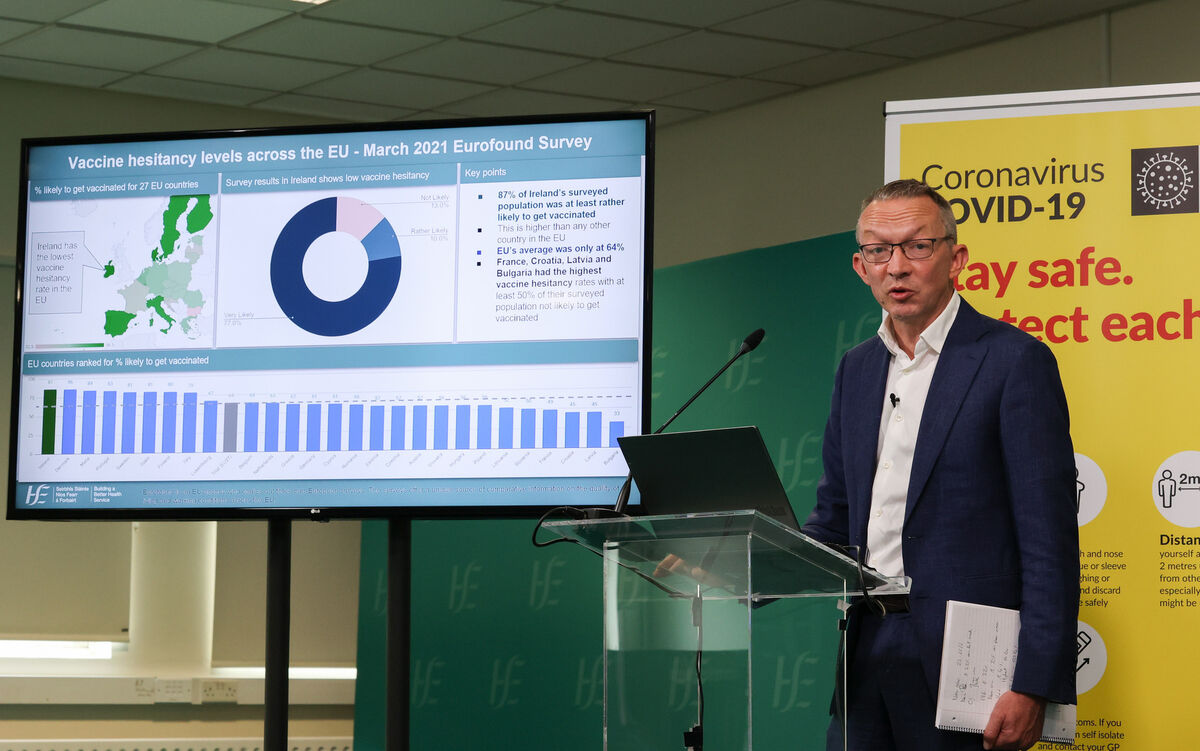
Dr Colm Henry says that the challenge for the HSE now will be putting Niac’s advice on booster vaccines into action.
The “waning” immunity of the first round of vaccines for vulnerable groups such as the elderly and immunocompromised will require booster jabs, he told Newstalk Breakfast.
"Time will tell. I know it’s a frustrating answer for people to hear, but we do rely on the evidence. We want to make sure it’s safe - and it appears giving a booster is safe in the groups we mentioned," Dr Henry said.
“We need to know it translates into immunity that means something."
The booster vaccines will be mRNA brands such as Pfizer and Moderna, even if the original doses were AstraZeneca, he explained.
Research had indicated that the mixing of vaccines was effective and would have a good response, said Dr Henry.
Among the first groups will be over-80s in the community and over-65s in residential settings.
"Time will tell" if everyone in Ireland will need a COVID-19 vaccine booster The booster campaign will have to be safe and effective, the purpose of it will be to build on the gains achieved from the vaccine programme, he added.
There was a lot to be optimistic about now, said Dr Henry. Daily numbers appeared to be stabilising and there were good signs about the rates of hospitalisation, those requiring ICU treatment and the mortality rate.
“The vaccination programme has protected us from the worst of the virus. We’re playing a rule set that has protected us.”
Dr Henry said that the policy on children having to stay away from school when they were identified as close contacts, would be reviewed by Nphet in the coming weeks, but would remain in place in the meantime.
When asked about plans in the UK for mandatory vaccination for frontline workers, Dr Henry said that the approach of the HSE continued to be “persuasive” which had been more effective to date. However, any frontline staff who had not been vaccinated would continue to be redeployed.
Dr Henry also said that the two members of Sláintecare who had resigned on Wednesday would be missed.


CONNECT WITH US TODAY



Be the first to know the latest news and updates