Help our families reunite: Plea of Afghans in Ireland
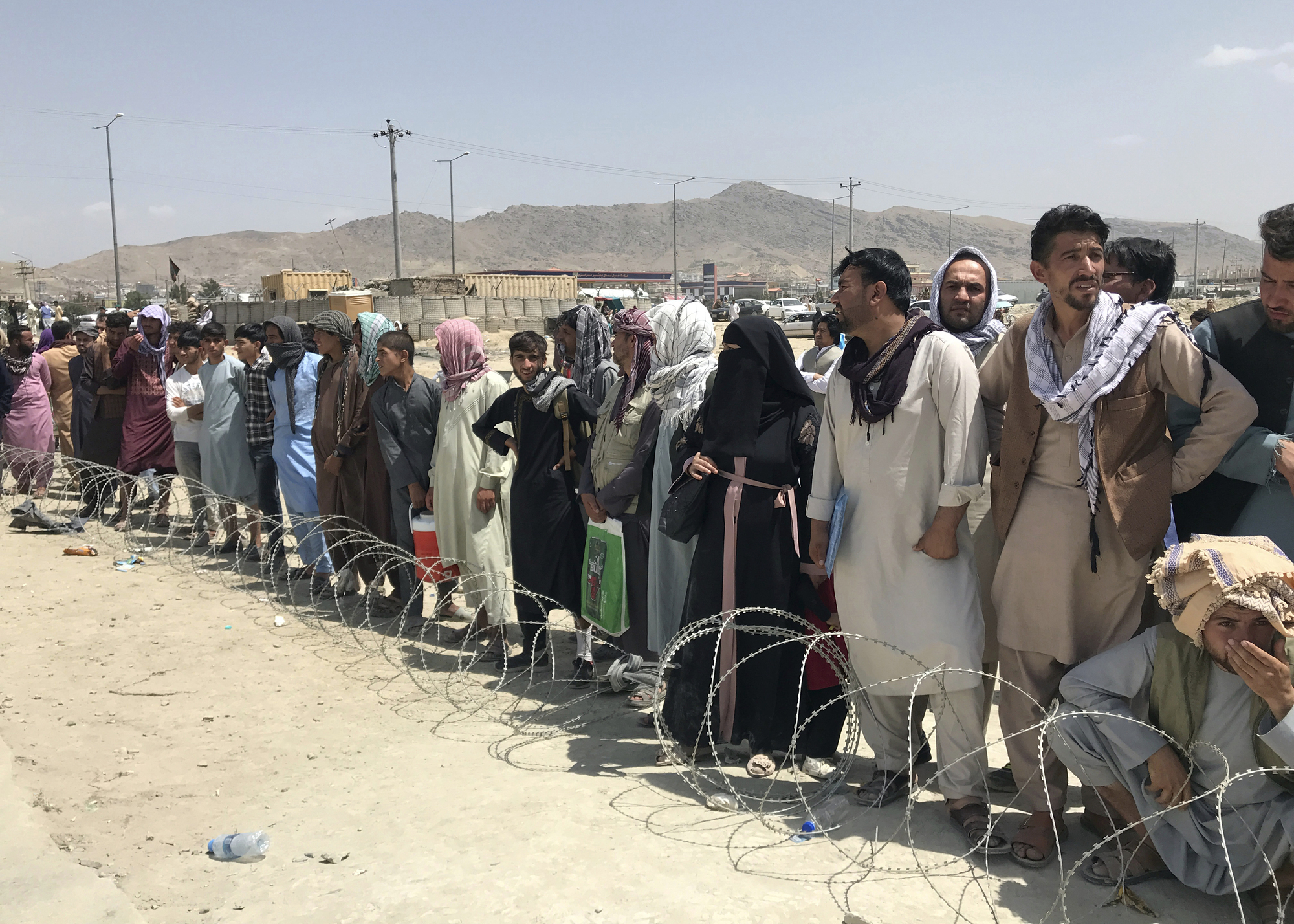
Hundreds of people gather outside the international airport in Kabul this week as desperate crowds try to flee the country. Picture: AP Photo
When Nasruddin Saljuqi arrived in Ireland as a refugee in 2000, he was one of very few Afghans living here at the time. He travelled with his wife and four children – all of whom went on to university and PhD-level education.
As the world's eyes turn to Afghanistan in 2021 – Mr Saljuqi's life demonstrates how the conflict there goes back decades. He fled Afghanistan for Iran in 1991, more than 10 years after the Soviets invaded his country.Â
The collapse of the Soviet Union in 1989 meant its army withdrew from Afghanistan and a bloody civil war ensued, setting the stage for the Taliban to assume power in 1996.
"I came to Iran with my family and we were there for nine years. But the Iranian government didn't give me any documents to live - I was illegal," explained Mr Saljuqi from his Dublin home this week.
After spending nine years as undocumented residents, his family was accepted on to a United Nations resettlement programme – Ireland was to be their new home.
"On October 22, 2000 I was resettled from Iran to Ireland by the help of the Irish government.
"The Irish government helped me come to Ireland with my wife and four children, three sons and one daughter, who all studied and have degrees and PhDs and are working in Irish society, the UK, Switzerland and the US now," he said.
When they arrived initially, finding private housing to rent was a challenge – an issue that asylum seekers still experience to this day. Their first six months were spent in a B&B.
"When we arrived here the government could not find a house for us, we were in a B&B for six months until they could find a house for us – 20 years ago a landlord wouldn't give a house to an unemployed person.Â

"But I started working as an interpreter, and my son was studying and working. Then when we were working, we could get a reference.
"The only problem we experienced was finding a house – we wanted a home to live in and it was very, very good when we got a home. Our lives settled and we were all studying or working," said Mr Saljuqi.
The Afghan family integrated into Irish society with ease – something he credits to Irish people's kindness.
"We integrated really well, Irish people are very kind," Mr Saljuqi said.
As well as working as an interpreter, the father of four got busy writing more than a dozen books on Afghan history and culture, three of which were published here and the rest in Iran and Afghanistan.
He also set up the Afghan Community and Cultural Association of Ireland – an organisation he chairs today, and which connects him with the several thousand Afghan people now living in Ireland.

And how do they feel about the Taliban takeover of their country?
"Many have family there, they are upset, they have fear of the situation and they fear another war will start. They are just afraid and concerned," said Mr Saljuqi, whose own brother lives in Afghanistan.
"I have a brother there now, he has four daughters and two sons and they are in university and school, he is a professor and doctor. But he is afraid for his children about what's going to happen in the future," he said.
What if anything can Ireland or Irish people do to help?
"In the last 20 years since the Taliban was defeated we have many, many universities in Afghanistan, many people are studying and working, they are professionals and have good skills, I would urge the international community to listen to these people and their advice," Mr Saljuqi said.
But there is something far more specific and practical that Irish people can lobby for and which relates back to his own Irish story that began 21 years ago.
"Afghanistan is very far from Ireland but assisting in the reunification of Afghan families already living here with those fleeing is something Irish people can call on their Government to do," Mr Saljuqi said.