Building my dream home became a nightmare
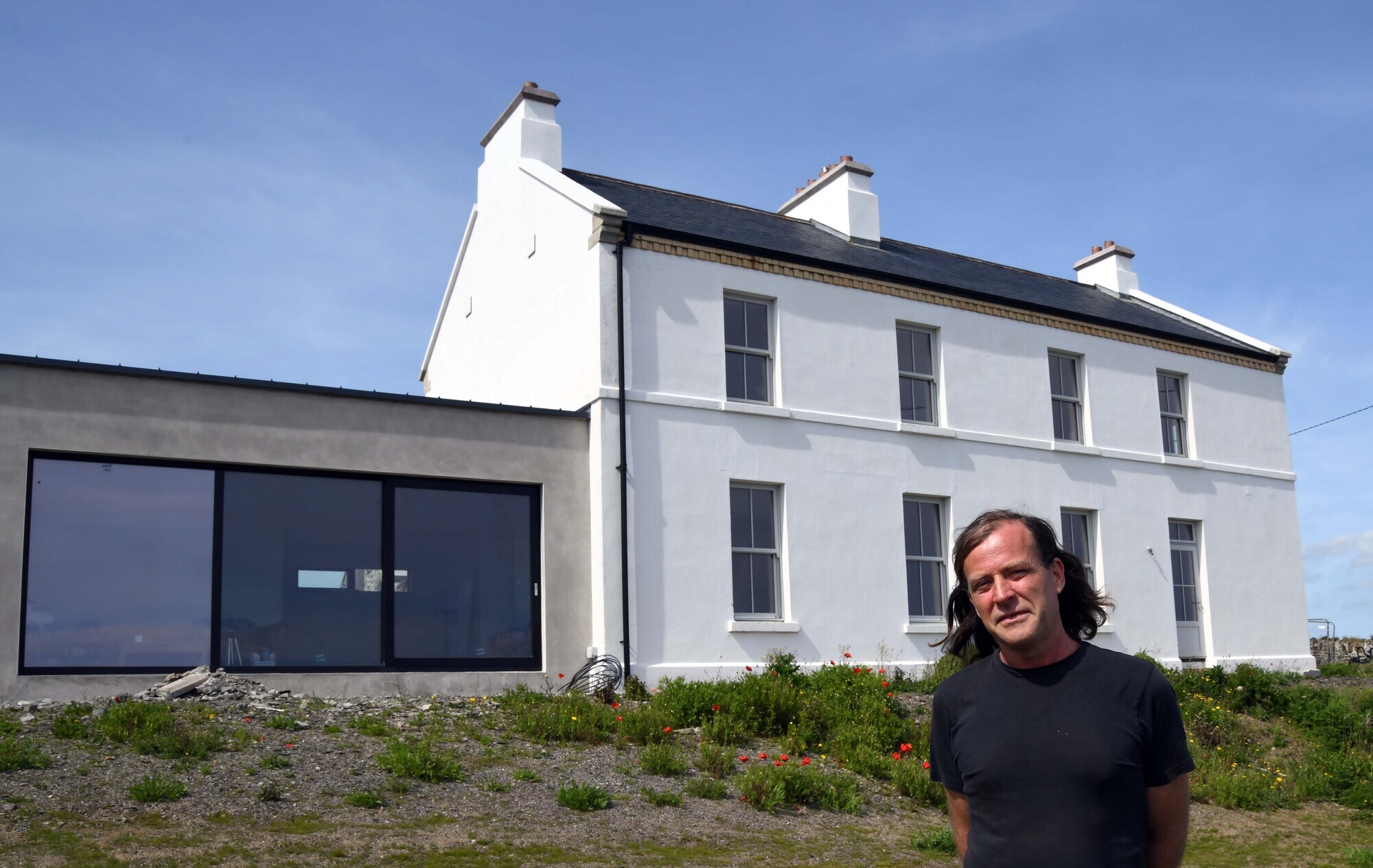
Herman Baily in front of Keeper's House, the former fog station in East Cork. Picture: Denis Minihane.
As he walked around the old fog station which rose from the cliffs above the beach he played on as a child, Herman Baily thought he had found his and his partner’s perfect home.
Once a paternal guard for sailors protecting them from shipwreck, Power Head fog and coastguard station near Inch beach in east Cork would be reimagined as a home for Mr Baily and his partner.
They bought the property and began to dream about their future there.
But a nightmare experience with architects and builders tore deep holes in their pockets and left their once-robust home a health hazard and structurally unsound.

Potentially dangerous, unfinished work was covered up and certified as ‘duly complete’.
But when Mr Baily pointed out these problems to the builder and the architect, he was dismissed.
Trapped in a contract with very few rights or avenues for redress, Mr Baily engaged in a protracted legal process that cost about €70,000 in legal and expert fees alone.
He believes many homeowners are being similarly abused by the building professionals they should be able to trust in Ireland.
He is now calling for an independent regulator for the building industry to better protect consumers from substandard and dangerous building practices “which are going on wholesale” in Ireland, often without the homeowner's knowledge.

He is also calling for an efficient, accessible redress scheme for consumers which can hold architects, builders and engineers to account for defective work.
“I would never build a house in Ireland again.
“There are good builders out there but for the most part, it’s such a risk.
“Engineers and architects are supposed to help – they are supposed to recognise problems and make sure that they’re fixed. But that did not happen in our case.
“The house was dangerous and structurally unsound, it could have fallen down.
“But they were defending the work.
“And many of the problems were covered up. If I wasn’t inspecting the house every day I would not have found them.
Structural failure, radon poisoning and mould growth were just some of the potential outcomes of the building defects identified in an independent architect’s report into the site.
The report also warned that “a future occupier of the premises would be put at serious risk of potential injury".
The original coastguard dwellings were expertly constructed and “extremely robust”, with “superior quality materials” used throughout, the independent architect’s report noted.
They were built at a time where “a passion for excellence” was seen as a “mark of personal honour” – an attitude that appeared wholly at odds with Mr Baily’s first experience of the building on the site.
“Infected timber” was left in walls which were then covered up, compromising the structural integrity of the external walls on an “extremely exposed” site, situated metres from a cliff edge east of Cork Harbour.

A radon barrier that was certified as installed was never installed in a high-risk area for radon.
In so doing, the report said builders had “not taken reasonable precautions to avoid danger to health and safety”.
“Significant concern” was expressed over the walls’ ability to bear weight due to incorrectly installed lintels.
Loose brickwork was “an active hazard".
From the moment Mr Baily engaged professionals, there were difficulties with the project.
When the architect put their plans out to tender, the project was effectively costing double the original budget of €400,000.
Adjustments to the plans were made and a contract with a builder was signed. The architects were then to certify the builders’ work.

Once that work was certified as being duly complete and in line with the contract’s specifications, Mr Baily and his partner would then be obliged to pay for the work.
“We started building in October and I spotted the beginnings of real trouble at the start of February,” Mr Baily said.
“That’s when everything fell apart.”
He questioned the builder and the architect on major problems he had noticed with the insulation but they dismissed him.
That evening, €30,000 worth of work was certified by the architects as duly complete.
“The bulk of that work had not been done at all. There was a 14m steel beam that had been certified as having been installed that didn’t even exist. It wasn’t on the site," he said.
“So we started investigating and that’s when we brought in the lawyers.

“They advised us to hire experts to do reports on works. We hired another architect, quantity surveyor and engineer to inspect all the works and they produced reports around June which backed up everything I was saying from the beginning and uncovered a whole load of other stuff.
“They were clear that if the project had not fallen apart at that point it would have fallen apart at a later point after we had spent a lot more money because there was no effective plan for the building at all really.
“But because we had signed this RIAI [Royal Institute of the Architects of Ireland] contract we were still under contract to the builder. We couldn’t even get rid of the builder who wasn’t doing any work.
"The National Standards Authority of Ireland told me things were wrong, another specialist told me things were wrong. But our architect just dismissed me.”
The site was essentially abandoned during the standoff, with “scant protection” for health and safety, the independent architect’s report noted, with a large hole the size of a swimming pool left there.
A report by an independent quantity surveyor found the couple had overpaid the contractor €26,766.55 at that early stage in the project.
The builders had abandoned the site and the architect then resigned, Mr Baily said.
“They said that I was interfering and they couldn’t do their work.
“But effectively it was just breach of contract. And they did it fearlessly. There were going to be no repercussions for them anyway.

“But there were major repercussions for us. As the homeowner, you’re caught into building contracts and you’re ultimately responsible for things like health and safety on the site.
“But if you’re involved with a contract like the RIAI one, you can’t go to court because you’re tied into arbitration and mediation through the contract instead. And that arbitration can be very expensive. Our solicitor told us it can cost the same as the High Court. So the arbitration is really of no benefit to the consumer.
“If we went to arbitration it would have cost another €50,000 and the builder wouldn’t have paid the award so we’d be left with the costs.
“Then the architects went into liquidation and their insurance company folded, so they had no insurance to cover us.
“We didn’t find out they had no effective insurance until December of 2014 after many months persistently requesting their insurance details.”
With no insurance to claim on, Mr Baily was left with no clear avenue for redress.
“Our solicitors told us that we’d be better off just licking our wounds, getting out of the RIAI contract and getting on with our lives.
“The builder was then sending us bills.
“So we engaged an expert mediator who also knows the RIAI contracts inside out and we appointed a new administrator for the contract.”
A new certificate for certified works was signed, citing €400 worth of completed work rather than €30,000. That bill was paid and the contract was terminated.
“That was June or July 2015. At that point, we were exhausted. We did nothing with our home for quite a while because we just didn’t have the heart.
“Eventually, in 2018, because the buildings were deteriorating we got in contact with a new engineer, who was great, and he took the reins on the house and got a good building crew in and we engaged those, without a contract, just on our word, and that’s where we are.
“The new builders did a really great job. I’m glad we got back in the saddle again but we’ve lost a fortune.
“The whole industry seems to operate around an attitude of ‘you get your house in the end, suck it up' ".
“What I spotted, most people would never have spotted that, it’s all work that would be covered up, so you might not have an issue for 20 years, and I’m sure that goes on wholesale, throughout the country.”
Problems with defective buildings are not new and Government is aware that more protections are desperately needed for homeowners and tenants.
In 2018, the Safe as Houses report was published by the Oireachtas which called for higher standards in new builds and increased protections for homeowners and tenants who experience defects in their homes.
An independent working group on defective housing was established in recent months, the only recommendation from the Safe as Houses report to have been acted on so far.
The report recommends:
- Creating a new Building Standards and Consumer Protection Agency similar to the Food Safety Authority and Environmental Protection Agency;
- The Government should establish a redress scheme to assist homeowners with latent defects;
- Local authorities should not be allowed to self-certify their own social housing developments. This would be contracted out via the Building Standards and Consumer Protection Agency;
- A bar on the awarding of publicly funded construction project tenders should be introduced to prevent such contracts from being awarded to developers/builders or associated construction professionals found to be in serious breach of building standards or fire safety regulations.
Concerns have also been expressed about self-regulation in the industry. The RIAI both represents and regulates the architecture profession in Ireland, something which some see as a clear conflict of interest.
As Fianna Fáil Senator Pat Casey said in a Dáil debate on the Safe as Houses Report in 2018, “Self-regulation on too many levels means no regulation".
Mr Baily added: “When the Building Control Act was going through its draft stages around 2006, the Consumer Protection Commission was saying that there’s a conflict of interest between representing a profession and also regulating that same profession and there should be an independent authority that has the reins over regulating professional bodies.
“But it wasn’t listened to by the government, they gave it to the RIAI in the end.
“That should be changed now."

CONNECT WITH US TODAY



Be the first to know the latest news and updates