'People are re-traumatised': Backlash from survivors of mother and baby homes
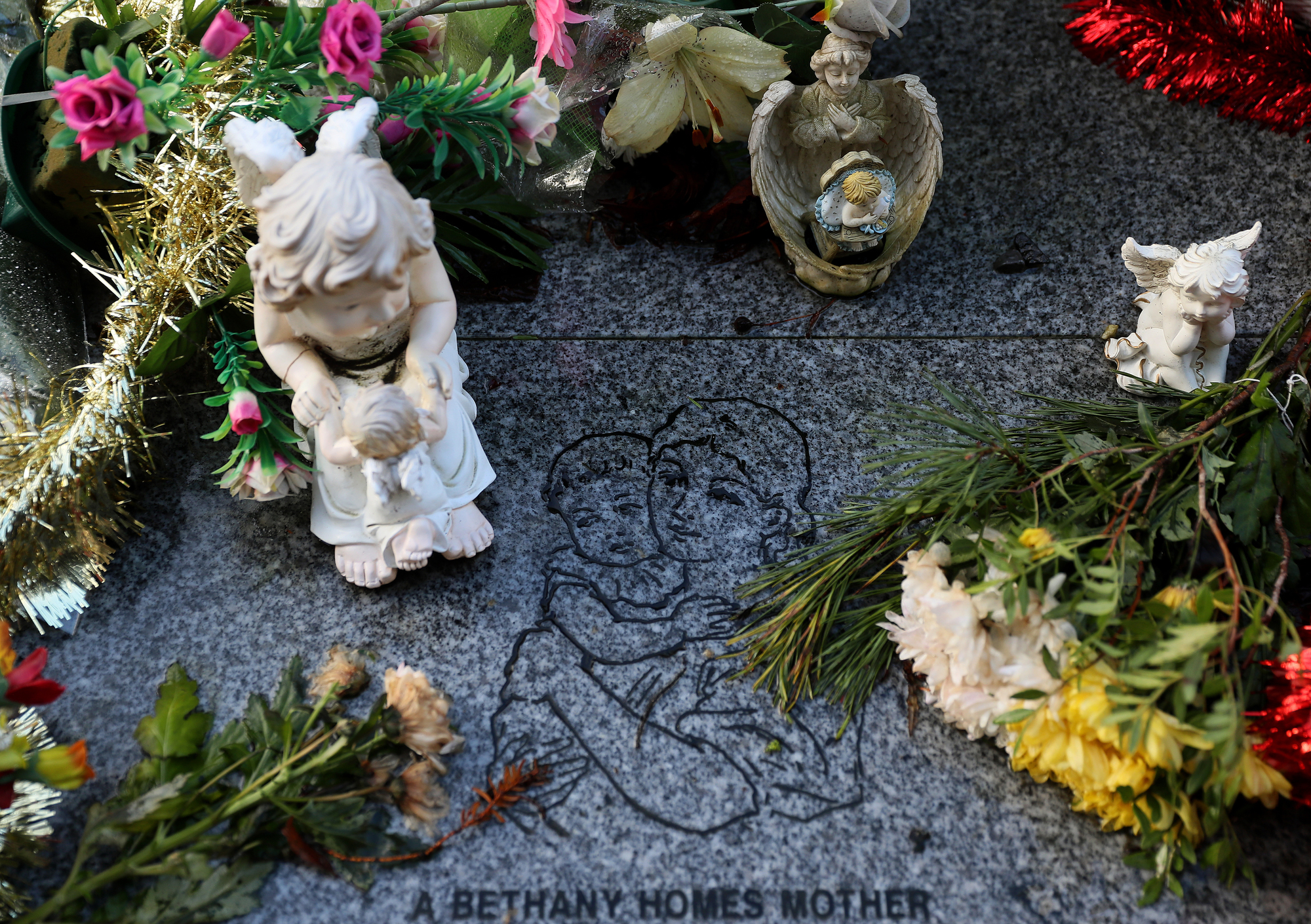
Flowers and figurines at the memorial to 222 children from the Bethany Mother and Child Home, at Mount Jerome Cemetery, Harold's Cross, Dublin. Picture: Brian Lawless
Survivors of mother and baby homes have hit out at "hurtful, insensitive and disrespectful" comments from a member of the Commission of Investigation which they say is further evidence that their voices were not heard.
Professor Mary Daly, one of three members of the Commission, sparked controversy when she spoke out about the Commission’s work for the first time at an online event organised by Oxford University.
The Commission’s final report, spanning 2,865 pages, detailed the experiences of women and children who lived in 14 mother and baby homes and four county homes between 1922 and 1998.
Prof Daly's contribution confirmed the evidence provided by 550 survivors to the confidential committee was discounted, adding the report "reads as realistic".
She said the main report, which was published in January, had to meet robust legal standards of evidence.
However, PJ Haverty, who was born in Tuam mother and baby home in 1951 and told his story to the Commission, said he is “sick to my teeth” of reliving his past but not being heard.
“I’ve a funny feeling they didn’t even listen to what I was saying to them. That’s the impression I got from them. Seven years this is going on and we still have nothing at the end of it. It's just the same thing going on and we seem to be getting nowhere," he said.
"A friend of mine died who was in the home with me in Tuam. She died three months ago now. She still had no answers."

In February, Commission chair, Justice Yvonne Murphy, declined an invitation from the Oireachtas Committee on Children to discuss the report, which has been subject to criticism from survivors and advocacy groups over its tone, content and some of the conclusions drawn.
Mr Haverty said if the commission has nothing to hide, then they should come before the Oireachtas.
“Why did this happen in Oxford? Why was it not open to survivors? It was a closed shop. Have they no respect at all for what we went through? For what the mothers went through? It’s just beyond me,” he added.
Maggie Lyng, who was born in a baby home in Temple Hill in Dublin, said survivors were re-traumatised when they gave evidence to the commission and this should have been handled more sensitively.
“This should have happened well before now, especially considering many survivors felt they hadn’t been represented well. It could have been handled a lot better than what has transpired. It’s been a farce from beginning to end,” she said.
“It seems to me that she prioritised herself as an academic, but didn’t have the manners or the bravery to come in front of the Oireachtas, never mind the survivors.”
She added: "Here we are in 2021 and people are re-traumatised, very upset, not represented and €11m has been spent on this, yet we're no better off."

Ms Lyng did not come under the terms of reference of the commission’s work, meaning she is still no closer to getting answers and does not know if she will be eligible for any redress scheme.
“None of it seemed to apply to me. In the specific apologies… it basically didn’t include anybody who’s not included [in the report]. It’s frustrating. As an adopted person, I’ve kind of always been excluded so it’s kind of par for the course at this stage,” she added.
She said Tusla and the Adoption Authority of Ireland (AAI) must now consult with adopted people as they continue to trace and offer support to affected individuals.
"Representation is key here. They have to consult adoptive people," she added.
Ann O'Gorman, whose baby girl died soon after birth in the Bessborough mother and baby home in Cork, in June 1972, and who still does not know where baby Evelyn is buried, said she has been very hurt by the latest revelations.
"I am disappointed and very hurt that some of our testimony, that our stories, were not acknowledged by the Commission, that they were disregarded. And the way we learned about it has just added to that hurt," she said.
Teresa O'Sullivan, who was born in a mother-and-baby home in 1957, said she was very disappointed about what had emerged following the Oxford talk.
She would have preferred if the Commission had spoken about the report before now.
“One of the biggest things about the Commission is transparency. It was about us, it was about families, it was about trauma, it was about memory loss and extreme neglect,” she told .
“There would be no Commission without survivors and that was very badly missed in this report," she said.
Another survivor, Anne Harris, who gave birth to her son at Bessborough mother-and-baby home, told the same radio programme it was “insensitive” that Prof Daly broke her silence in the UK and in an academic setting.
“It was degrading to hear this. With a thing that is so sensitive and associated with Ireland, Ireland is the place it should have been held.”
She said to do so “showed a lack of respect for the feelings” of those who gave evidence to the Commission of Investigation.
Ms Harris said she went on the record when she gave evidence to an investigative committee but said that despite being well received, there had been no follow up afterwards.
“I gave a statement, but never saw it again and only got the transcript after the report was published,” she added.