‘Help us understand the insanity that took the lives of our beloved children’
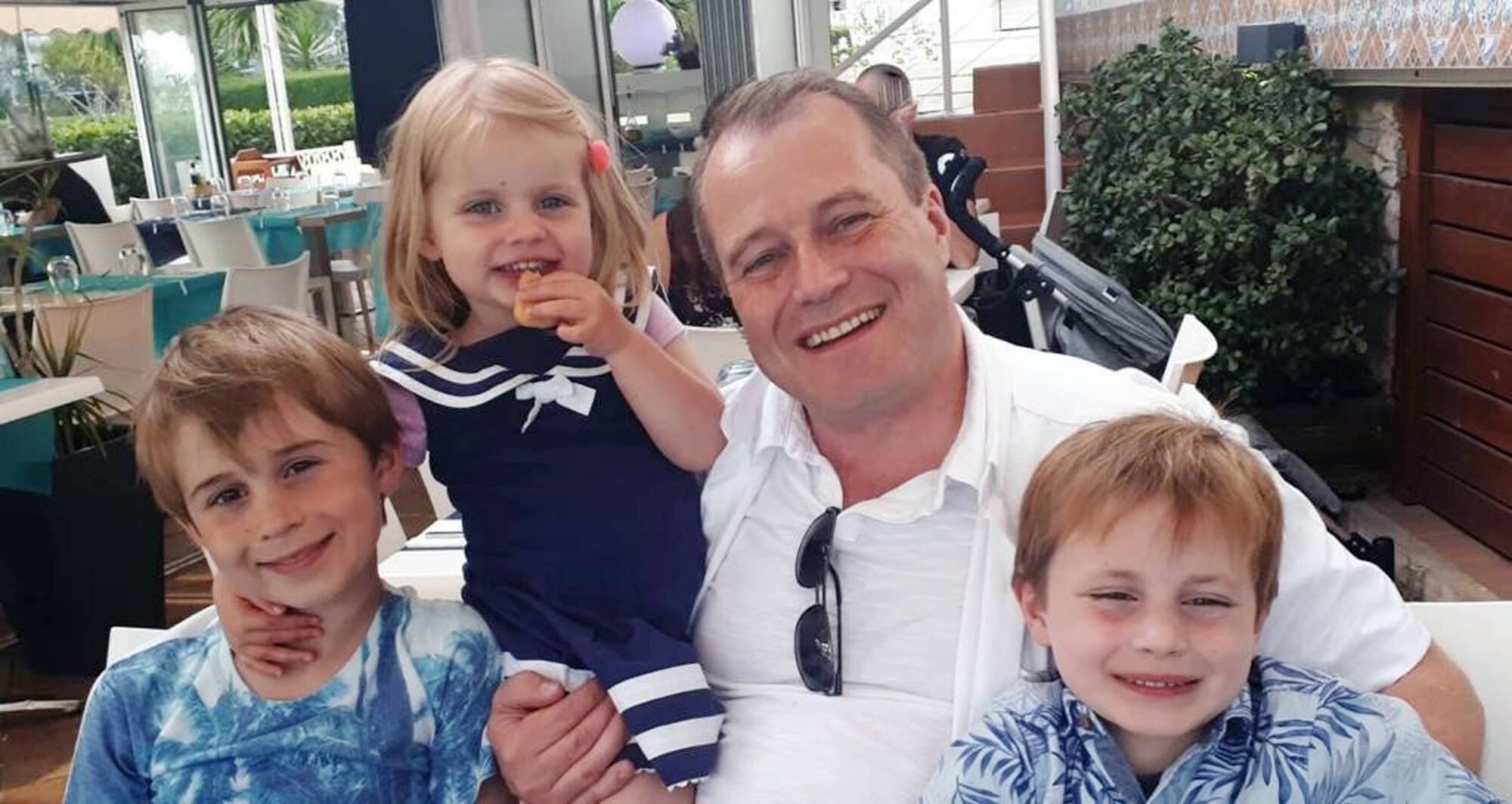
Conor, Darragh and Carla with their father Andrew McGinley. Their mother Deirdre Morley has been found not guilty by reason of insanity of their murders.
The husband of Deirdre Morley, who killed her three children, said the verdict of not guilty by reason of insanity was the right one but he is "still no closer to understanding" why his children died.
After four hours and 23 minutes of deliberation, the jury delivered its verdict, bringing to an end a trial that was described as a “tragedy of enormous proportions”.
Conor McGinley, nine, Darragh McGinley, seven, and Carla McGinley, three, were suffocated in their home by their mother, Deirdre Morley, on January 24, 2020.
The 44-year-old paediatric and renal nurse, who was off work due to mental illness at the time of the killings, had pleaded not guilty of their murders by reason of insanity.
The Central Criminal Court heard how Ms Morley believed in her psychotic state that killing her children was the “morally right” thing to do because it would save them from a life of pain.
She believed that she had irreparably damaged them due to her mental illness which she thought she had passed on to them.
Harrowing details about the children’s last minutes of life were read to the court.
Ms Morley had complied fully in garda interviews and said that she wanted to give as full and accurate an account of what happened as possible because other people who loved the children, particularly her husband, Andrew McGinley, deserved to know the truth.
Ms Morley has been committed to the Central Mental Hospital until July 31 when the matter goes back before the courts.
Her future care will be considered at that point in line with the provisions of the Criminal Law (Insanity) Act 2006.
Justice Paul Coffey, who presided over the case, thanked the jury on behalf of the people of Ireland for their work on this "short but very distressing case".
He exempted them from Jury service for the next 15 years as a sign of his gratitude.
Deirdre Morley's husband, Andrew McGinley, also thanked the jury after the trial.
“Today’s verdict is probably the right verdict,” Mr McGinley said in a statement.
“Everyone who knows Deirdre, knows how much she loved our children and how devoted she was to them.
“Whatever the outcome of this trial, it remains that our beloved children Conor, Darragh and Carla have died. As I write this, I’m no closer to understanding why.”
Mr McGinley has now asked for an urgent HSE investigation into her care before the killings. She was diagnosed with bipolar affective disorder type 2 since the children’s deaths — a new diagnosis from what she had before.
Treatment with the anti-psychotic drug Olanzapine since her children’s deaths has made her “herself again”, a caring, non-violent person, she said.
“If Deirdre’s diagnosis was questionable prior to January 24, 2020, then surely so too was her treatment and medication,” Mr McGinley said.
"We are now also aware of a number of occasions within Deirdre’s professional care when her initial diagnosis should have been queried but none of these seem to have been fully addressed.
“We ask the HSE Mental Health Services for an inclusive investigation into Deirdre’s diagnosis, treatment and medication prior to this tragedy. We ask for this to be conducted as a matter of urgency.
“This will help us understand the insanity that took the lives of our beloved Conor, Darragh and Carla.
"We as a family need to be included in any investigation as our exclusion during her treatment has left us with many unanswered questions."
He said that an inclusive investigation could help inform clinicians in their practice "and therefore avoid tragedies like ours happening again."
"We do not want any other family to suffer as we have," he said.
Mr McGinley referenced a tragic case in east Cork in which a man, John Butler, killed his two young daughters, Ella and Zoe, and then killed himself in November 2010.
His wife, the children's mother, Una Butler, has campaigned since their deaths for families to be involved and included in the psychiatric care of their loved ones.
"In the past 20 years over 50 children have died at the hands of one of their parents.
"Over 60% of those people were known to have had previous contact with psychiatric services. However, the Mental Health Act 2001 does not go far enough in ensuring that the family support structures for the patient are fully engaged and included by the mental health professionals treating our loved ones," he said.
"This was raised by Una Butler back in 2010 following the deaths of her beautiful daughters, Ella and Zoe.
"Alas, nothing much changed. The lessons which should have been learned from the sad loss of Ella and Zoe should have led to improvements in the Mental Health Act. This in turn would have prevented the deaths of Conor, Darragh and Carla in our opinion.
"It is too late for us but I do not want to see another grieving parent speaking in the future about the same exclusion after a similar catastrophic loss.
"My message here and now to anyone who has a loved one in psychiatric care is to get in there as soon as you can to be added as an advocate for their treatment plan."
Mr McGinley had returned home from a work trip to Cork on the evening of January 24, 2020, to find his wife unconscious.
At the time of her children's death, she had been on extended sick leave from her job as a nurse in Crumlin.
After killing the children, she had taken prescription drugs and brought half a bottle of wine to the N7 flyover, between Rathcoole and Newcastle, Co Dublin, where she had planned to end her life on the hard shoulder of the busy road below so that she didn’t hurt anyone who may be passing on the road beneath where traffic there was picking up after 4pm.
On entering his home, Mr McGinley found his deceased eldest son Conor’s feet poking out of the play tent in a downstairs room.
In the master bedroom at the top of the stairs, the bodies of Darragh and Carla were found laid out on the bed.
Medics at the scene said that the children’s bodies were already cooling when they were found and rigor mortis had started to set in. Saving them was impossible, the court heard.
“It's horrific, it’s horrific I know," Ms Morley is recorded as having said following their deaths.
“I just want them back. I just wish I could go back in time. I wish I had a time machine.”
The Central Criminal Court heard that Ms Morley had been treated in St Patrick's Psychiatric Hospital in July 2019. She had improved for some time afterwards, but following changes to her medication she was plagued by increasingly "dark" thoughts.
However, being a self-confessed "people pleaser", she hid her deteriorating mental health from her family.
Ms Morley, 44, sat quietly throughout the trial, wearing a surgical mask and dark clothing, as disturbing details about how she killed her three children were given to the court.
She planned to kill them on Thursday, January 23, lacing their food with prescription drugs (morphine and Tylex) to sedate them before she suffocated them.
However, when the boys immediately tasted something "disgusting" in their cereal (crushed morphine tablets) she aborted her plan.
She said she felt “relieved” going to bed that night that she had not killed them.
Her two sons, Conor and Darragh, slept in her bed that night “as a special treat” as their father, Andrew McGinley was in Cork for the night on a work trip.
However, the following morning was “difficult”, she said.
“Overwhelmed” after a disagreement with Darragh about screen time, she decided she “just had to end our suffering.”
She put thick brown tape over his mouth and a plastic bag over his head and suffocated him in the front room.
She said that she “had to kill Carla then.” She put a white bag over the little girl’s head and a cushion over her mouth as she watched in the dining room.
When she realised the child was still breathing, she put a pillow cover over her head and held her nose until she stopped.
She lay the two children's bodies together on her bed.
She then signed Conor out of school early, citing ‘family reasons.’ Other parents who saw her on that trip noticed nothing unusual about her.
She said that killing Conor was more difficult because he was "being really good."
She considered dropping him off to a friend's house instead of killing him but was "uncertain" if he would be okay, so she smothered him too.
In a garda interview on January 28, 2020, Ms Morley said: “I was thinking I wanted to stop, but I couldn’t. I didn’t want to do it, but I had to because I had started to do it.
"Something was telling me that I had to do it. But I didn’t want to. I thought I was sparing them from the pain of mental illness that I had and that I thought I had passed on to them.”
Expert medical opinion concluded that she was suffering bipolar affective disorder type 2 and a severe depressive episode at the time of the killings.
Mr Justice Paul Coffey said that in this "sad and tragic" case there was "no contest" about what the verdict should be.
Forensic psychiatrist Dr Mary Davoren said that Ms Morley was suffering a mental disorder at the time of the killings.
Although Ms Morley did appear to know that she was killing her children she "lacked the ability to appreciate the true nature of the situation" due to her mental illness, Dr Davoren said.
She believed that she was saving her children from a life of pain caused by her mental illness.
She did not know what she was doing was wrong and she had no capacity to stop herself from carrying out the killings, the court heard.
Justice Coffey said that “one of the truly tragic ironies of the case” was that Ms Morley, a paediatric nurse, had dedicated her entire professional life to the care of children.
Ms Morley first reported mental health difficulties after moving to Cork to study nursing in 1996. Her symptoms improved and then deteriorated again.
She was first prescribed anti-depressant medications in October 2018.
She was plagued with concerns about her children, that she wasn’t a good enough mother and that her imagined sub-standard parenting had irreparably damaged them.
On July 6, 2019, she was admitted to St Patrick’s psychiatric hospital with the symptoms of a depressive illness including low mood, excessive guilt, low self-worth, disturbed sleep and low appetite.
Although she appeared to improve for some time after discharge, by November, 2019, her sister contacted her GP to say that ‘Deirdre was very unwell, unable to get up or bring her children to school.’
She was again diagnosed with a ‘moderate depressive episode’.
On January 10, 2020, she visited her GP for a sick cert for work. She said that she felt somewhat over-sedated and denied suicidal ideation. She said that she planned to return to work.
Her anti-depressant medication was reduced.
Ms Morley said that she now wishes she had reached out to her husband and family for help sooner.
Since the killings, she said that she has written numerous letters to her husband "to try to make sense of things".
Samaritans Helpline on 116 123
Pieta House 24/7 Helpline on 1800 247 247


CONNECT WITH US TODAY



Be the first to know the latest news and updates